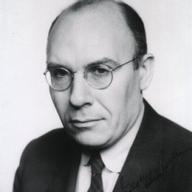
Dr. George Rosen - Public Health and the Future
Dr. George Rosen, Director of Health Education in the New York City Department of Health, lectures on the topic "Public Health and the Future." This 1949 Cooper Union Forum lecture is introduced by Dr. Johnson Fairchild.
In the Q and A portion of the program, Dr. Rosen responds to a question about why the AMA opposed national health insurance, saying that the organization is undemocratic.
Chairman Johnson E. Fairchild introduces the event. He talks about forthcoming Cooper Union talks and the history of the Cooper Union Forum. Many of the most famous discuss public health. He describes Dr. George Rosen as a champion of public health, and gave a speech at Cooper Union just last year. Rosen is Director of Health Education in the New York City Department of Health, and Editor of the Journal of the History of Medicine.
Rosen begins by stressing the difficulties inherent in predicting the future, and the necessities for doing so.
He stresses the links between the past, the present, and the future, quoting Leonardo Da Vinci.
Rosen defines "public health" as an area of human interest and activity which owes its existence to the basic social and biological nature of man." He links this definition to the need for cooperative living in early human history. He discusses the fundamental needs of humanity, including good health and prevention of disease.
Rosen mentions four major human needs as they relate to human health: The control of communicable disease; the improvement of the environment in a sanitary aspect; the relief of destitution; and the provision of medical care for larger or smaller groups of the population. He talks about the varied responses to these needs over time. He begins with the formation of urban populations in India. However, what we understand as 'public health' began in the mid19th century in the wake of the industrial revolution.
Rosen regards it to be "the fundamental truth of modern public health and social welfare [is] that the health of the individual is intimately and indivisibly tied up with the social and physical environment in which he lives."
He discusses the history of public health since the 1850s, linking it with the rise in urbanism and social reform in the United States and the United Kingdom. The most important historical document then was a report by the Citizen's Association of New York in 1865 (Peter Cooper was a founder.) The report stressed prevention.
The report was successful, though the bacterial nature of disease was not well understood.
[gap]
Rosen discusses the problem of tuberculosis.
Rosen tells us that public health depends on adequately staffed local health departments that provide preventive medical services. He discusses inadequacies of understaffed local health departments in the United States.
He talks about the decrease in maternal and infant mortality and deaths from communicable diseases. Chronic illness will rise because of this. Rosen talks about what this will mean.
He talks about reasons that people will not receive medical care, including rising costs, lack of facilities, and discrimination. He discusses current legislation and other solutions to the lack of health care and health insurance. This would constitute a huge improvement to public health.
He stresses the need for improved dental health. There are currently not enough dentists.
Dr. Rosen talks about the rise in understanding of nutrition in Great Britain. He talks about environmental impacts on public health and the development of bacteriology.
He talks about the changes of attitudes in social thought and policy over the last century. He feels we are forming a second phase in this, with increased awareness of environmental factors.
Efforts to improve health must incorporate adequate housing, safe working conditions, a living wage, and recreation.
He talks about the necessity for mental health. It is still a matter of conjecture as to what needs to be treated and how. This is still be be developed.
Health care must be considered as a whole. The realization that this is so is expressed in two ways: the control and regulation of environments through sanitation etc.; and the amelioration of the status of the lower social classes. These two expressions are coalescing.
Public health is at a turning point. No one can predict the next hundred years, but modern times lend a clue. The future will likely be about the promotion of health as well as the entrance of the government into the health field. He notes expenditures in research and social programs. Medical care programs will accentuate the development. The gap between social health and medicine will be bridged. The public health worker will utilize education.
He brings up the 1840 Utopian novel, 'voyage to Icaria, by Etienne Cabet. In that novel all citizens get free dental care and more. He thinks development of dental care will not be as strong, but will be preventative in a way that it currently is not.
He closes discussing his hope for the future, and what it will require: political leadership, realistic planning, adequate financial support and, most importantly the intelligent cooperation of the American citizens and the organizations through whom they make their will known.
Fairchild hosts a question and answer session:
Rosen is asked if only Jesus can cure. Rosen answers diplomatically, talking about the "healing power of nature" cited by Hippocrates. He notes that a theologian might provide a better answer.
Rosen is asked to describe the Blue Cross Plan. He explains the Blue Cross and Blue Shield plans and insurance based plans in depth.
Rosen is asked about Socialized medicine. Is it possible? He feels it is and cites several countries that have socialize medicine. He notes how carelessly the term is used. He clarifies that socialized medicine is basically what insurance is.
Rosen is asked about Britain's approach to socialized medicine. He does not think we will follow them, but we can learn from them. He points out that the Dean of the Columbia School of Medicine shares his opinion,
Rosen is asked what New York has for cancer detection. He answers that there is currently one, in Manhattan, with more to come. There are also places to receive full physicals (that might detect the possibility of cancer)
Rosen is asked the potential of fear is problematic. He answers he does not know, but expands about the good it can cause, as well as its dangers.
Rosen is asked about ventilation and heating, especially in public places and conveyances. He expounds upon the subject as it relates to government efforts. Housing has recently become a new subject again.
Rosen is asked about "planned parenthood" and its place in a public health program. He argues that it is worthwhile, likely best headed by volunteers.
Rosen is asked (facetiously) about equality and then weight, and the Bowery.
Rosen is asked about health care for migratory workers. These programs are being headed by state governments. In the past it had been tended to by the Department of Agriculture.
Rosen is asked about nutrition. He namechecks WNYC for their efforts spreading information about nutrition.
Rosen is asked about why the AMA opposes a national health insurance program. He answers that they oppose it because it represents change - some will lose income, some are old and dislike change. He also informs us that the AMA is not a democratic organization.
Rosen asks if the medical profession is approaching things from a public need or private need perspective. He answers that his response is similar to that of the previous question. He does admit that the AMA has much to said for it, particular in terms of training and determining standards.
Audio courtesy of the NYC Municipal Archives WNYC Collection
WNYC archives id: 150193
Municipal archives id: LT3781