Trump says Saudi Arabia's nuclear deal hinges on the kingdom normalizing Israel ties
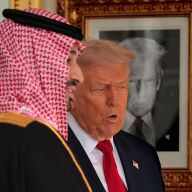
President Trump said on Thursday that a new nuclear energy deal with Saudi Arabia will require the Arab kingdom to normalize relations with Israel. That marked a turn, a day after the administration announced the signing of the agreement without mentioning that precondition.
Trump said in an online post that the deal "will be approved, but is totally subject to Saudi Arabia joining the very respected and successful Abraham Accords." The U.S.-brokered Abraham Accords, beginning in Trump's first term in 2020, normalized relations between Israel and a series of countries, including Bahrain and the United Arab Emirates.
The Saudi Embassy in Washington did not respond to NPR's request for comment. It is unclear how the new condition might affect the deal. The Saudi kingdom has long insisted it will not normalize relations with Israel until there is a clear pathway to establish a Palestinian state. The Israeli government strongly opposes Palestinian statehood.
"Does a social post supersede a signed diplomatic agreement? I think this is one of the frustrations that other countries have had with the United States," said Steven Cook, senior fellow for Middle Eastern studies at the Council on Foreign Relations. "No one in Washington really knows how it's going to work."
White House press secretary Karoline Leavitt told reporters that President Trump did not speak to Saudi leadership before posting the condition on social media, but said he has previously spoken about the importance of joining the Abraham Accords with Gulf and Arab allies.
"This deal with Saudi Arabia, the energy deal, is contingent on this condition, as far as the president is concerned, so, we'll continue to talk with our Saudi counterparts to get the deal finalized and hopefully see them join the Abraham Accords very soon," Leavitt said.
Israeli Prime Minister Benjamin Netanyahu welcomed Trump's condition that Saudi Arabia join the accords that would establish relations with Israel. "Saudi Arabia's joining of the Abraham Accords would be an historic leap forward for peace in the Middle East. Peace through Strength," the Israeli prime minister's office said in an online statement. It did not mention the nuclear energy deal.
The nuclear cooperation agreement, signed on Wednesday by U.S. Energy Secretary Chris Wright and Saudi Energy Minister Prince Abdulaziz bin Salman, would give U.S. companies priority access to supply nuclear reactors and fuel to develop a Saudi nuclear energy program, according to a Trump administration memo about the agreement seen by NPR.
The administration says it will submit the deal to Congress, which has 90 days to review it. Congress can object to the deal, but it would need a two-thirds majority to override a likely presidential veto.
Saudi Arabia wants to make an energy pivot
Saudi Arabia is one of the world's largest oil producers, but the Gulf state wants to pivot to other fuel sources.
"They want to build huge energy-intensive industries, data centers, desalination. And they're actually burning their own crude oil up to 1.4 million barrels a day at the height of the summer to do that," Daniel Benaim, a former State Department official who worked on Gulf issues, told NPR's Morning Edition. "They want to use their crude oil for exports to make revenue and then find other energy sources to fuel their own economic transformation domestically."
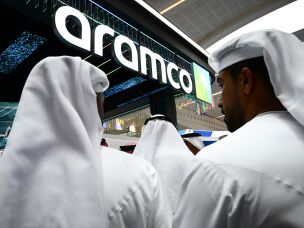
Guests stand at the booth of Saudi Arabia's Aramco oil company during the Abu Dhabi International Petroleum Exhibition & Conference, in Abu Dhabi, United Arab Emirates, on Nov. 3, 2025.
Giuseppe Cacace/AFP via Getty Images
Yet building a nuclear energy program also could raise the prospect of one day being able to create a nuclear bomb.
"They also want to provide the foundation, over time, for having more options to move toward nuclear weapons, should they feel the need," Matthew Bunn, a nuclear proliferation expert at Harvard University, told NPR's All Things Considered.
While Saudi Crown Prince Mohammed bin Salman has said the kingdom does not want a nuclear weapon, he also has said it will pursue one if Iran develops a nuclear weapon.
Concerns about the deal in Israel
Israeli political opposition leaders, former officials and analysts have expressed concerns about the Saudi nuclear energy deal.
Israel itself conducts nuclear research, and is widely believed to have nuclear weapons despite a policy of nondisclosure. But it fears other countries in the region developing nuclear programs of their own.
Yoel Guzansky, a senior researcher at the Institute for National Security Studies in Israel, said he was alarmed that the agreement appeared to let Saudi Arabia enrich its own nuclear fuel in-country.
"Saudi insistence on enrichment in Saudi Arabia ... was the thing that got [previous] negotiations stuck and U.S. administrations, one after another, did not permit enrichment," Guzansky said.
President Trump emphasized in his Truth Social post Thursday, "There will be no enrichment of material!" and added that "The United States is not opposed to Civil (Non-Enriched) Nuclear Facilities."
Under an earlier deal with a Gulf state, the Obama administration's nuclear energy agreement with the United Arab Emirates in 2009, the UAE gave up the ability to enrich nuclear material on Emirati soil.
Guzansky said the Saudi agreement may lead the UAE to reverse course on its own deal, which allows it to ask for better terms if another regional country — such as Saudi Arabia — signs a nuclear energy agreement with the U.S. with more favorable conditions.
"They'll say 'we want enrichment. OK, if not enrichment, give me the F-35'" fighter planes, Guzansky added.
Risks of an "arms race"
Israel's former defense minister and foreign minister, Avigdor Lieberman, criticized the agreement on Israel's public broadcaster on Wednesday, saying it risked pulling the entire Middle East into an escalating nuclear "arms race."
Ehud Barak, a former prime minister of Israel, told the country's army-run radio station the agreement was a sign of the "loss of trust between Israeli Prime Minister Benjamin Netanyahu and President Trump."
Opposition leader Yair Lapid told an Israeli podcast: "I can't explain just how much this is a total failure of Netanyahu's. That's his job. His job is to prevent a Saudi nuclear program."
Prime Minister Netanyahu, who faces elections in October, has not commented on the agreement.
But Israeli Economy Minister Nir Barkat seemed to downplay the risks. "If they want it for peaceful purposes, for energy needs, we can manage it, and we can also reach a peace agreement with them, God willing," Barkat said in a radio interview Wednesday. Speaking ahead of Trump's online announcement, Barkat was optimistic about "the condition that they [Saudi Arabia] join the Abraham Accords."
No "gold standard" anti-enrichment agreement
Under the agreement, Saudi Arabia is not permitted to reprocess U.S. nuclear material for weapons, but the deal and a bilateral security protocol with the U.S. does not forbid the kingdom from using American technology to enrich uranium or other nuclear fuel provided by third countries.
It also does not require Saudi Arabia to adopt terms that would lead to greater oversight from the International Atomic Energy Agency, according to the memo seen by NPR.
The U.S. required these provisions, known as a "gold standard," when it signed the UAE nuclear energy deal.
Saudi Arabia has been angling for nuclear cooperation with the U.S. for at least a decade, but concerns about the kingdom's human rights abuses and its possible aspirations to develop a nuclear weapon in the future stalled that cooperation.
Secretary of State Marco Rubio, when he was still a senator, co-sponsored a bipartisan bill in 2019 that would have banned nuclear energy cooperation between the U.S. and Saudi Arabia unless the Saudis were "truthful and transparent" about the killing of journalist Jamal Khashoggi in a Saudi consulate and committed to the "gold standard" provision, forgoing uranium enrichment.
"Trump's and Secretary Rubio's hypocrisy is matched only by their recklessness. They are allowing Saudi Arabia, a belligerent and authoritarian nation, to develop nuclear weapons technologies while starting a war with Iran under the guise of preventing an Iranian nuclear bomb," Sen. Ed Markey, D-Mass., who co-sponsored the 2019 bill with Rubio, wrote in a statement in response to the nuclear agreement.
Speaking to reporters in Manila on Thursday, Rubio said the Saudi deal has safeguards in place and that the U.S. wants to partner with countries looking to set up civil, peaceful nuclear energy.
The U.S. Energy Department argues that the deal expands U.S. technology exports.
NPR's Jane Arraf contributed reporting from Amman, Jordan; Sawsan Khalife contributed from Haifa, Israel; Alex Leff contributed from Washington.

WNYC is funded by sponsors and member donations