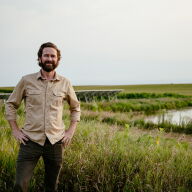
This farm raised thousands of pigs for slaughter. Now it's growing mushrooms instead
Inside a long, dimly lit building, Tyler Faaborg slipped into a "fruiting room" cordoned off by what looked like plastic curtains.
Fog rolled over shelves of sprouting mushrooms. A bulbous fungi called lion's mane still had another week before harvest, he explained.
"You can see they're sort of, a little bit pinkish," Faaborg said. "When they get mature, they're going to be almost all the way white."
Faaborg, along with his parents and brother, grows specialty mushrooms on their family farm in central Iowa and sells them as tinctures, coffee blends and flavored salt.
They call their operation 1100 Farm, which is a nod to the number of hogs this building and the one beside it each held for decades. The Faaborg family recently transitioned from pigs to mushrooms with technical and financial support from The Transfarmation Project, an initiative of the charitable organization, Mercy for Animals.
"We primarily work with industrial animal farmers to help them transition out of that way of farming and into sustainable practices, and that can be growing mushrooms, growing diversified vegetables, incorporating trees and agroecology," said Katherine Jernigan, who directs the project.
In addition to resources online and a network of experts to help farmers grow new crops and start small businesses, Transfarmation provides open-source blueprints for converting industrial pig, poultry and dairy barns.
"That's really what makes Transfarmation unique," Jernigan said. "We're finding ways to repurpose the infrastructure that the farmers already have."
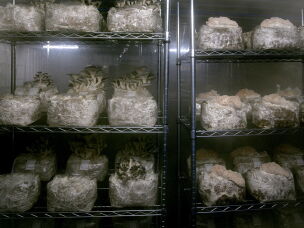
Mushrooms grow in a fruiting room inside a former hog barn retrofitted by the Faaborg family. The Faaborg family grows specialty mushrooms at 1100 Farm in central Iowa. Tyler Faaborg said the family makes their own mushroom blocks, which is cheaper than buying them.
Madeleine Charis King/Iowa Public Radio
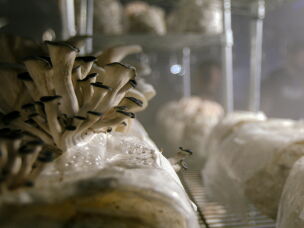
Mushrooms grow in a fruiting room inside a former hog barn retrofitted by the Faaborg family. The Faaborg family makes their own mushroom blocks. They are 50% soy hull, 50% hardwood pellets.
Madeleine Charis King/Iowa Public Radio
The Faaborgs just finished converting half of one 200-foot-long hog barn this summer. They say the retrofitted space will allow them to scale up their mushroom production after a successful pilot project.
The new mushroom operation is also designed to be a resource for other farmers as Transfarmation's second demonstration hub in the U.S. The first is a former chicken farm in North Carolina.
"The reason we established this as a demonstration hub is very much so the doors can be opened, so people can come and see firsthand," Jernigan said. "They can ask questions, and also, importantly, we're collecting data from this hub with the whole transition, as well as their production."
That data includes the Faaborgs' costs, hours of labor and product margins, along with lessons learned along the way. A Transfarmation spokesperson said the Faaborgs are being compensated $216,000 through a four-year contract for tracking and sharing their information with other farmers in the Transfarmation program.
Jernigan said other farms enrolled in the program have shown it's possible to be profitable switching from industrial-scale farms — known as concentrated animal feeding operations, or CAFOs — to specialty crops. Transfarmation's website includes estimated budgets for farms that grow strawberries, tomatoes and microgreens.
Having more test cases and being transparent about both the challenges and opportunities could help other farmers make the leap, she said.
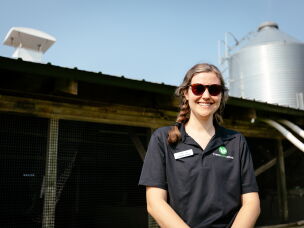
Katherine Jernigan of Transfarmation stands in front of an unused pig shed at 1100 Farm. Another shed nearby has been renovated and now houses the farm's mushroom-growing operation.
Madeleine Charis King/Iowa Public Radio
Tanner Faaborg, who brought the vision of 1100 Farm to the family several years ago, wants their mushroom operation to be another "proof of concept."
"It just takes someone doing something a little different to help folks realize that it is possible," he said.
His parents, Rand and Tammy, bought their 25-acre farm in the 1980s with the dream of a homesteading lifestyle, he said. The family of seven harvested and preserved produce from their garden and fruit trees. They had a wood-burning stove and raised chickens for eggs.
Rand Faaborg said they started out by raising a few market hogs for "pocket money" to supplement his income as a welder. But it didn't work out.
"I lost money," Faaborg said. "And then I saw in the paper this advertisement of contract feeding."
Becoming a CAFO
Under contract feeding, a company provides the animals and pays for the feed while the farmer contributes the labor and covers the costs of the infrastructure.
This legal arrangement is a key component of CAFOs, which the U.S. Environmental Protection Agency defines as operations that meet certain animal number thresholds and confine them in an area without vegetation for at least 45 days out of the year.
Large CAFOs in Iowa increased from 789 in 1990 to 4,444 in 2025, according to an analysis by the Environmental Working Group, an organization that advocates for greater regulation of CAFOs. Together with small- and medium-sized operations, EWG estimates 66% of all the CAFOs in the state housed a total of 33.4 million hogs.
Rand Faaborg said contract feeding seemed like a good opportunity at the time.
The family did not put up new buildings for the enterprise at first. They retrofitted existing buildings on the farm to raise 2,000 hogs at a time.
Faaborg said once the farm scaled up and became a CAFO, it was "very profitable" but required more work than he expected on top of his day job.
"I was working 16-hour days, sometimes 24-hour days, going to work without even sleeping," he said.
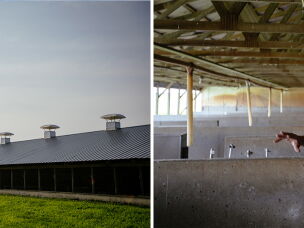
Rand Faaborg and his family converted stalls previously used for raising pigs.
Madeleine Charis King/Iowa Public Radio
After a few years, Faaborg said they borrowed $400,000 to build two new hog barns designed to improve efficiency. They had automatic feeder lines and systems to move the manure out to an open-air holding pit.
"Fortunately, we could make cash flow until we got the buildings paid off," Faaborg said, explaining it took 12 years to get out of debt.
But raising hogs was physically demanding work and became less profitable for the family over time, Faaborg said.
"In my day job, my pay over 35 years increased tenfold, and my pay raising hogs dropped by two-thirds," he said. He believes the decrease in profits was due to the proliferation of CAFOs across the state.
A new chapter for the Faaborgs
Rand and Tammy Faaborg decided several years ago they were ready to exit the hog business. Rand said they didn't have a deep love for raising pigs, but they'd poured so much money and time into the buildings that he didn't want to see them fall into disrepair or be bulldozed.
They asked their family if they had ideas to use the buildings for something else. That's when their son Tanner Faaborg began to lay out his vision.
"We have this infrastructure," he said. "We could retrofit it, change it, and do something that is a lot healthier on us, healthier for the planet, and actually is profitable, that'll be a job creator for the family, but for the community, as well."
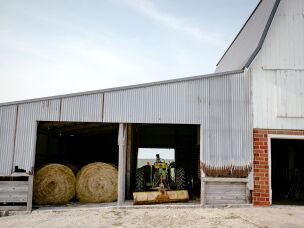
The Faaborg family used to raise pigs on their central Iowa farm. Now they are growing specialty mushrooms.
Madeleine Charis King/Iowa Public Radio
Tanner Faaborg said he developed a passion for sustainability and climate change mitigation in college. He joined Urban Ambassadors, a volunteer-driven nonprofit that promotes sustainability in the Des Moines area, and was part of the steering committee for the city's climate action and adaptation plan.
But his work in Iowa's capital felt out of line with other parts of his life.
"I would come back [to the farm] and help out with pig chores and kind of living a double life that I felt terrible about," Tanner Faaborg said.
The Faaborgs raised around 8,000 hogs each year, producing roughly a million gallons of liquid manure. They stored it in an open pit until Rand Faaborg could find row-crop farmers to haul it off to spread on their fields during tight windows in the spring and fall.
While manure can provide essential crop nutrients, it's a major contributor to climate change. Manure pits and lagoons release methane, which is "28 times as potent as carbon dioxide at trapping heat in the atmosphere," according to the EPA. Excess manure in fields can also increase nitrous oxide emissions and pollute nearby bodies of water when it rains.
Tanner Faaborg said he was also bothered by the reshaping of rural Iowa by industrial animal agriculture. Near his childhood home, he pointed to long buildings surrounded by cornfields down the road.
"There used to be a house over there. Now, instead, there's turkey barns," he said. "There used to be a house over there, and now it's hog barns."
These local changes have a ripple effect, he said. The small school he attended no longer exists.
"There's just not enough people," Faaborg said. "There are small towns and rural communities that are losing population every single year, and it's really devastating."
Where Tanner Faaborg saw an opportunity for change, his brother Tyler said he needed more convincing.
Tyler Faaborg said he raised and sold around 200,000 hogs a year across three counties. But when his parents announced to the family that they were done, he said it took about a week to decide he was ready to try something different.
"I had a good job. I got paid well," he said. "But I did it for 25 years. It's really hard on your body, and Tanner just kept talking to me about it."
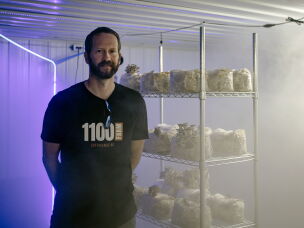
Tyler Faaborg stands in a fruiting room inside a former hog barn retrofitted to grow specialty mushrooms.
Madeleine Charis King/Iowa Public Radio
The Faaborgs began working with Transfarmation in 2021, sold the last herd of hogs a year later and received a $15,000 grant from the program in 2023 to start growing mushrooms and sell products as a yearlong pilot project. The Faaborgs reported that site preparations in one of their outbuildings, supplies, branding and website development cost roughly $35,000.
As the business grows and expands with the new demonstration hub, Tyler Faaborg said they'd like to sell fresh mushrooms to a few companies. Eventually, 1100 Farm could also convert the second hog barn. But Tanner Faaborg said it would be used for something else, possibly microgreens.
Rewilding the farm
The Faaborgs said the transition from CAFO to specialty mushrooms has not always been easy, and they have a long road ahead. But there have been rewards along the way, like the conversion of a manure pit into a freshwater pond.
A Natural Resources Conservation Service grant program, part of the U.S. Department of Agriculture, partially funded the remediation, Tanner Faaborg said. Instead of being an eyesore, he said it's become a haven for frogs, ducks and other wildlife.
"It just shows that if you create the right environment, that rewilding can happen faster than you think," Faaborg said.
Rand Faaborg said the manure pit was a significant source of anxiety when he raised hogs. Sometimes he'd make contact with people who said they would take the manure but not show up, he said.
"That part of my life is gone and in exchange is just this little pond. My grandkids catch frogs," he said. "That's probably been my favorite part of it all."
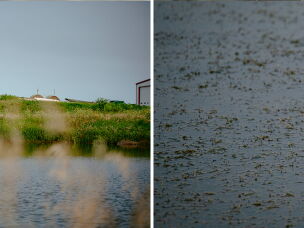
The Faaborg family has been working with The Transfarmation Project to convert what was a pig farm into one that grows specialty mushrooms.
Madeleine Charis King/Iowa Public Radio
The Faaborgs also have planted native grasses and flowers to support pollinators. They're expanding their orchard and adding hundreds of trees and shrubs next to the creek that cuts across the farm to support better water quality and wildlife habitat.
Standing next to an empty grain silo that once held pig feed, Tanner Faaborg said he'd like to turn it into a space for visitors to stay overnight and wake up the next morning to sip lion's mane coffee while looking out at the farm.
The list of projects is long enough that they could take the rest of his life to complete. But he hopes the impact of 1100 Farm extends well beyond that.

WNYC is funded by sponsors and member donations