Landmarks Commission to Hold Hearings on New West End Historic District
A new historic district proposed for Manhattan's Upper West Side is causing a rift between preservation advocates and the Real Estate Board of New York.
On Tuesday, the city’s Landmark Preservation Commission will hold public hearings on the creation of a massive West End Historic District. The proposed district would cover an area bound by 70th Street to the south, 109th Street to the north, Riverside Drive to the east and Broadway to the west. If approved, 800 buildings would be given landmark status on top of the 2,600 buildings that already have that status on the Upper West Side. The distinction could make the uptown enclave the neighborhood with the most landmark buildings in the city.
“We are very optimistic,” said Kate Wood, director of Landmark West!, an advocacy group founded in 1985 to organize community support for new landmarks on the Upper West Side.
Along with another organization, the West End Preservation Society, Wood's group has been working to build a consensus among property owners in the area in favor of the new district.
“There is a huge amount of public support, and there’s a lot of research that has been done to show that this area truly merits historic district protection—architecturally, socially, historically, and culturally,” she said.
The proposal does have opponents however—namely the Real Estate Board of New York, which argues that the historic district will limit the economic potential of the neighborhood.
“What it does do is add economic burdens to the property,” said Michael Slattery, a board vice president. “It's very hard for a retailer who wants to come in to sign a lease for space. They're not sure before then whether they can actually get the facade work done that they would prefer that makes their building profitable.”
While landmark opponents claim that these protections stifle development, Wood disagrees.
“Historic district protection manages that change so that when development does occur, it happens in a way that doesn’t undermine the character of the area,” she said.
When considering neighborhoods for historic district status, the Landmark Preservation Commission looks for three things: representation of at least one style of architecture, a “coherent streetscape,” and a “distinct sense of place.”
Michael Slattery, of the Real Estate Board, said he didn't believe the proposed West End Historic District meets those criteria.
“Including Broadway in that area seems inappropriate to me. It’s not the same character at all," he said. "It’s a commercial street not a residential street.”
At press time, Slattery said that the board had not yet seen any report showing how each building fits into the "distinct sense of place" required for landmark status.
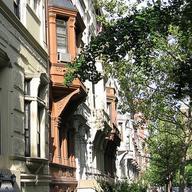
According to the Landmarks Preservation Commission, most of the buildings in the proposed district were constructed in the late 19th and early 20th centuries, and were built in Queen Anne, Romanesque, and Dutch Renaissance Revival styles, among others. The district would also include some of the taller residential buildings constructed after World War I that lack some of the detailed ornamentation seen elsewhere in the neighborhood.
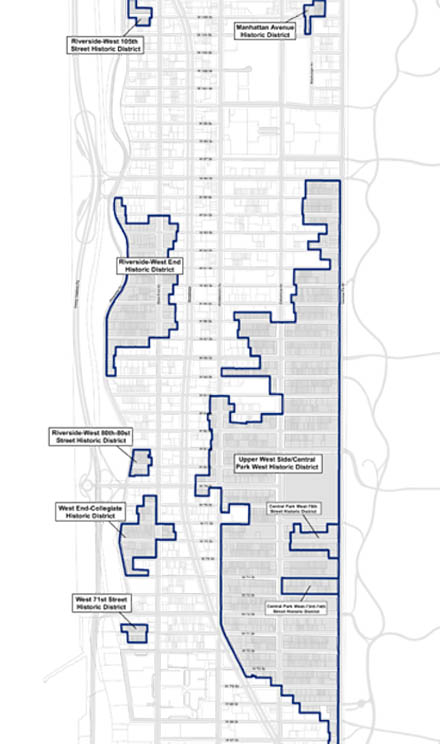
The Upper West Side is currently home to seven historic districts, five of which are in the area between West End Avenue and Riverside Drive (see map above-right). The proposed district would unite those five districts into a single, expanded district.
The current push to expand the district began in 2009, when two brownstones on West End Avenue were demolished by developers. The move angered some residents. A spokesperson for the Landmark Preservation Commission said that buildings within historic districts are rarely approved for demolition, except for rare cases when the building doesn’t match the character of the surrounding area.
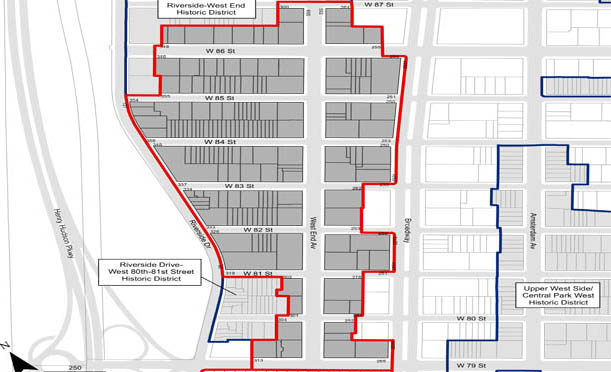
Tuesday’s meeting will only address the stretch of the proposed historic district that falls between 79th Street and 87th Street (see map below). Hearings for the other two sections are scheduled for June and October respectively.
After each hearing, the Landmarks Preservation Comission will research the proposal and create reports that will eventually go to the City Council for ratification. The proposal could take anywhere from a few months to years before a decision as to the historic district status is made.

WNYC is funded by sponsors and member donations