Protesters Call for Release of Detained Chinese Artist Ai Weiwei
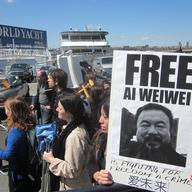
Hundreds of demonstrators gathered in front of the Chinese consulate in Manhattan to protest the detention of renowned artist Ai Weiwei by Chinese authorities, an event that was one of many held in dozens of cities Sunday throughout the world.
Ai gained prominence for his installations but is most widely known for designing the Beijing Olympic Stadium, also called The Bird's Nest, before labeling the 2008 Games "propaganda."
He has been held since April 3, when he was stopped by officials at Beijing airport. According to a one-sentence statement released by the consulate, the artist "is being investigated for economic crimes," but demonstrators rejected the accusation, saying he was being punished for his consistent criticism of the government.
"He's the conscience of the country," said artist Shirley Ayn Choi, who is originally from Korea. "When, after the earthquake (in China), thousands of children were buried without their names being known, he sought out to get every single one of the names listed."
Another artist, Gabriela Galarza-Block, traveled to the protest from Hartford, Connecticut, in part because she considers Ai an "amazing" artist, but also of what happened in her homeland of Argentina.
"I'm here because, coming from the country that I come from, we had a lot of people who disappeared in the 70s," she said, "and I think we need to support any person" taken against their will.
The event was organized by Anne Pasternak, who heads the group Creative Time.
"The whole project started when I posted a simple question on Facebook: what can we as an arts community, about the situation with Ai Weiwei?" Pasternak said.
One of the respondents to that question was curator Steven Holmes, also in attendance at the protest, who proposed "a series of actions" that would draw upon Ai's own work. Organizers zeroed in on Ai's "Fairytale: 1001 Qing Dynasty Wooden Chairs," which was presented in Germany in 2007.
"It seemed like everybody could bring a chair to a protest, no?" said Pasternak. "It's a pretty easy thing to do."
The momentum soon carried over into artistic communities across the world, prompting activists in at least 37 cities (according to this Facebook page) to schedule their events for 1 p.m. on Sunday. Meanwhile, the Guggenheim Museum started a petition, signed by the heads of leading arts organizations, calling for the release of Ai.
"We members of the international arts community express our concern for Ai’s freedom," reads the statement, "and disappointment in China’s reluctance to live up to its promise to nurture creativity and independent thought, the keys to 'soft power' and cultural influence."
While Ai's cause has generated international attention, demonstrators noted he was just one of many activists or intellectuals detained or imprisoned by the Chinese government in recent weeks; some pointed to rising dissent stemming from the unrest in the Middle East.
"I think most people are right to assume that it's part of a broad crackdown that we're seeing across China," said Holmes.
Demonstrators seemed divided as to whether the protests would help secure Ai's release or cause the Chinese government to further dig in its heels.
"I don't think that protesters are going to convince the Chinese government to release him," said Pasternak. "What we're really talking about here is honoring a life and keeping the story visible so that the Chinese government knows that we care and we're following the story."

WNYC is funded by sponsors and member donations