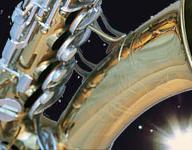
Saxophone à la Glass
Evening Music | May 6, 2010
When is a Concerto for Saxophone and Orchestra really a Saxophone Quartet? When Philip Glass writes a piece that can be played either way. Tonight it’s the Quartet version.
Rachmaninoff was only twenty when he composed his Suite No. 1 for Two Pianos, a work whose four movements were inspired by the words of four of his favorite poets. The aural poetry is rendered this evening by Martha Argerich and Alexander Rabinovitch. Gerard Finszi’s love for the deep-toned clarinet is evident in his Clarinet Concerto, given a radiant performance by Richard Stolzman, along with the Guildhall String Ensemble under Robert Salter.
The Rascher Saxophone Quartet commissioned the Concerto for Saxophone and Orchestra from Philip Glass back in 1995, but the group stipulated a piece that could be played with just the sax quartet if they wanted to do without the orchestra. Glass figured the quartet version would be the hardest to compose, so he wrote that version first, and that is what we hear the Raschers play tonight. We return to the Classical era with Ivo Pogorelich playing Mozart’s Piano Sonata No. 11, but then it’s back to the 20th century with Stravinsky’s “Symphony of Psalms,” Boulez leading the Berlin Philharmonic and Radio Chorus.
Rachmaninoff was only twenty when he composed his Suite No. 1 for Two Pianos, a work whose four movements were inspired by the words of four of his favorite poets. The aural poetry is rendered this evening by Martha Argerich and Alexander Rabinovitch. Gerard Finszi’s love for the deep-toned clarinet is evident in his Clarinet Concerto, given a radiant performance by Richard Stolzman, along with the Guildhall String Ensemble under Robert Salter.
The Rascher Saxophone Quartet commissioned the Concerto for Saxophone and Orchestra from Philip Glass back in 1995, but the group stipulated a piece that could be played with just the sax quartet if they wanted to do without the orchestra. Glass figured the quartet version would be the hardest to compose, so he wrote that version first, and that is what we hear the Raschers play tonight. We return to the Classical era with Ivo Pogorelich playing Mozart’s Piano Sonata No. 11, but then it’s back to the 20th century with Stravinsky’s “Symphony of Psalms,” Boulez leading the Berlin Philharmonic and Radio Chorus.