Celebrating Reynaldo Hahn
Evening Music | May 6, 2010
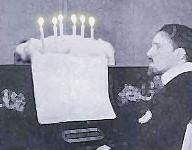
Tonight’s birthday celebrant is Reynaldo Hahn, born this day in Caracas, but bred in Paris, a friend of Marcel Proust and Sarah Bernhardt, and darling of the turn-of-the-century beau monde.
The evening begins with period-instrument performances of a Telemann Quartet, a medieval istampita, and Bach’s Cello Suite No. 2. British composer Geoffrey Burgon’s “The Calm” started life as a ballet score, but ended as an evocative reconciliation of activity and contemplation, achieved by combining the voices of harp, trumpet, and violin.
Sir Michael Tippett’s Concerto for Double String Orchestra emulates the Baroque model of pitting orchestral forces against each other in exuberant counterpoint. Another “Sir,” Andrew Davis, conducts the BBC Symphony. Schubert’s fishy melody for “Die Forelle” appears in triplicate this evening: first, in the song itself, sung by Barbara Bonney; then as the theme of the “Trout” Quintet, and finally re- or deconstructed as a song again by Hudson Shad, a group that is itself is pretty fishy.
Pianist Denver Oldham brings us William Grant Still’s “Africa,” a work the composer said celebrates the continent’s majesty, magic, and mystery. Winding down, we hear Reynaldo Hahn’s “Le bal de Beatrice d’Este,” a charming suite for winds, two harps, and piano designed to evoke an evening at a long-vanished Milanese court.