Next to Brahms
Evening Music | May 6, 2010
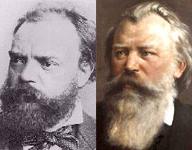
Hans von Bülow wrote to a contemporary that he considered him “[n]ext to Brahms, the most God-gifted composer of the present day”a sentiment that finds widespread agreement. Who was it? Read on.
After Respighi’s ever-popular “Ancient Airs and Dances” Suite No. 3, we hear music by the object of von Bülow’s enthusiasm, Antonin Dvorák. His opus 39, the “Czech Suite,” sometimes also known as the “Bohemian Suite,” was an “intoxicating success” when it premiered in 1879, and no wonder. It’s made up of four movements incorporating three Czech dance forms, and overflows with examples of the composer’s melodic genius and vivacious charm. Václav Neumann conducts the Czech Philharmonic.
From Czechoslovakia, we move to Finland, as we listen to Sibelius’s “Scènes historiques,” Op. 25. The world of the Kalevala is evoked in the first movement; the Finns in the Thirty Year War are memorialized in the second; the 17th-century residence of Duke Johan in Turku Castle inspired the third. Who better to conduct this work than Neeme Järvi, leading the Gothenburg Symphony Orchestra.
Beethoven’s “Pathétique” Sonata (No. 8 in C Minor) receives an exemplary performance by Emil Gilels. Then we hear from a 20th-century composer, Ernest Bloch, who was born in Geneva and died in Portland, Oregon. His intense Concerto grosso No. 2 has four movements and is set in the 18th-century form for which it is named, but it is clearly a more modern work, one that attests to his talent and sincerity as a universal musician, neither Swiss, Jewish, or American. Howard Hanson conducts the Eastman-Rochester Symphony.
After Respighi’s ever-popular “Ancient Airs and Dances” Suite No. 3, we hear music by the object of von Bülow’s enthusiasm, Antonin Dvorák. His opus 39, the “Czech Suite,” sometimes also known as the “Bohemian Suite,” was an “intoxicating success” when it premiered in 1879, and no wonder. It’s made up of four movements incorporating three Czech dance forms, and overflows with examples of the composer’s melodic genius and vivacious charm. Václav Neumann conducts the Czech Philharmonic.
From Czechoslovakia, we move to Finland, as we listen to Sibelius’s “Scènes historiques,” Op. 25. The world of the Kalevala is evoked in the first movement; the Finns in the Thirty Year War are memorialized in the second; the 17th-century residence of Duke Johan in Turku Castle inspired the third. Who better to conduct this work than Neeme Järvi, leading the Gothenburg Symphony Orchestra.
Beethoven’s “Pathétique” Sonata (No. 8 in C Minor) receives an exemplary performance by Emil Gilels. Then we hear from a 20th-century composer, Ernest Bloch, who was born in Geneva and died in Portland, Oregon. His intense Concerto grosso No. 2 has four movements and is set in the 18th-century form for which it is named, but it is clearly a more modern work, one that attests to his talent and sincerity as a universal musician, neither Swiss, Jewish, or American. Howard Hanson conducts the Eastman-Rochester Symphony.