Bernstein Conducts Copland
Evening Music | May 6, 2010
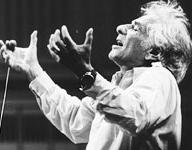
Aaron Copland said that Leonard Berstein’s “conducting of the Third Symphony is closest to what I had in mind when composing the piece.” We hear the New York Philharmonic under Lennie this evening.
Mozart was commissioned to write three concertos and a couple of quartets by an amateur flutist whom Mozart phonetically spelled De Jean, but who is thought to be a Dutchman named Dejong. We will hear the Flute Quartet No. 1 in D, K. 285, performed by Emmanuel Pahud on flute, joined by violinist Christoph Poppen, violist Hariolf Schlichtig, and cellist Jean-Guihen Queyras.
Because the Shanghai String Quartet will be performing at Carnegie Hall on November 19th, we thought we’d bring you a preview of their musical expertise. They play eight traditional Chinese folk songs, arranged for string quartet by Zhou Long, a modern composer who says he has been devoted to merging Eastern and Western cultures through his musical endeavors.
Because Copland composed his Symphony No. 3 (1944-46) as an end-of-war piece—intended to reflect the euphoric spirit of the country at the time—he quotes and expands his own “Fanfare for the Common Man” in the third movement to enhance the affirmative tone of the work. Enjoy it during our second hour.