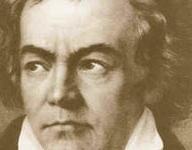
Beethoven's Shadow
Evening Music | May 6, 2010
After the appearance of Beethoven's monumental Ninth Symphony in 1824,
German symphonists struggled under Beethoven's shadow to create works
that would endure in comparison. One such composer was Johannes Brahms, who, some fifty-two years later, finally took up the gauntlet and threw his own formidable hat into the ring with his Symphony No. 1 in C Minor.
Johannes Brahms spent his early years playing the piano in restaurants, taverns and brothels to support himself and his family before deciding to dedicate himself entirely to composition. A turning point in Brahms' life and career was marked by his relationship with Robert and Clara Schumann (which, by the way, is an entirely different story altogether). Schumann regarded Brahms as "the long-awaited successor to Beethoven" and set the ball rolling by urging Brahms to write a symphony that would stand up to the "Beethoven's Ninth" test - something that few if any composers were willing to do (or even capable of doing).
Brahms himself was so wary of this responsibility that he spent some 15 years working on his First Symphony. In order to avoid critical comparison with Beethoven as much as possible, he even moved the premiere from Vienna (where he lived - and more importantly, where Beethoven had lived) to the smaller venue of Karlsruhe, where it was received with open arms in 1876. Although Brahms' first attempt couldn't completely escape the shadow of Beethoven (conductor Hans von Bulow called it "Beethoven's Tenth"), the Symphony No.1 in C Minor was regarded as an important turning point in the German symphonic pantheon (not to mention a turning point in Brahms' own career as a composer!).
Tonight, the Cleveland Orchestra takes up the Brahms gauntlet with a classic interpretation of the First Symphony, led by conductor Christoph Von Dohnanyi. Cleveland Orchestra fans can hear them live during the first week of February at Carnegie Hall, with conductor Franz Welser-Möst in four different programs (featuring the complete Piano Concertos of - you got it - Beethoven, with Rumanian pianist Radu Lupu).
» The Cleveland Orchestra at Carnegie Hall
Johannes Brahms spent his early years playing the piano in restaurants, taverns and brothels to support himself and his family before deciding to dedicate himself entirely to composition. A turning point in Brahms' life and career was marked by his relationship with Robert and Clara Schumann (which, by the way, is an entirely different story altogether). Schumann regarded Brahms as "the long-awaited successor to Beethoven" and set the ball rolling by urging Brahms to write a symphony that would stand up to the "Beethoven's Ninth" test - something that few if any composers were willing to do (or even capable of doing).
Brahms himself was so wary of this responsibility that he spent some 15 years working on his First Symphony. In order to avoid critical comparison with Beethoven as much as possible, he even moved the premiere from Vienna (where he lived - and more importantly, where Beethoven had lived) to the smaller venue of Karlsruhe, where it was received with open arms in 1876. Although Brahms' first attempt couldn't completely escape the shadow of Beethoven (conductor Hans von Bulow called it "Beethoven's Tenth"), the Symphony No.1 in C Minor was regarded as an important turning point in the German symphonic pantheon (not to mention a turning point in Brahms' own career as a composer!).
Tonight, the Cleveland Orchestra takes up the Brahms gauntlet with a classic interpretation of the First Symphony, led by conductor Christoph Von Dohnanyi. Cleveland Orchestra fans can hear them live during the first week of February at Carnegie Hall, with conductor Franz Welser-Möst in four different programs (featuring the complete Piano Concertos of - you got it - Beethoven, with Rumanian pianist Radu Lupu).
» The Cleveland Orchestra at Carnegie Hall