The Big Sax Theory
Evening Music | May 6, 2010
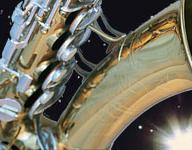
In Darius Milhaud’s “La création du monde,” written for a Blaise Cendars’ ballet whose scenario derives from African legends, the world begins, not with a bang, but a saxophone.
Stay tuned to hear the Sinfonia da Camera under Ian Hobson perform the jazz-inflected masterpiece by Milhaud, written soon after his return to France from his first visit to the U.S. in 1922, when he spent as much time listening to jazz in Harlem as he could manage. This experience paid off, as you will hear in the second half of Evening Music.
Meanwhile, enjoy Aaron Copland’s single-movement 1960 Nonet for Strings, which was originally composed for nine string parts, three each of violins, violas, and cellos. However, he authorized enlargement of the work to a “medium ensemble” of 24 strings, and it is that version we hear this evening, William Boughton conducting members of the English Symphony Orchestra.
Johannes Brahms first conceived what we now know as the Piano Quintet in F Minor, Op. 34, as a quintet for strings only, but abandoned that version for a two-piano setting, which is still around as Op. 34b. It looks like the conductor Hermann Levi, who had played the two-piano version with Clara Schumann, suggested the recasting as a piano quintet, thus stimulating what became Brahms’s first mature chamber work. Pianist Christoph Eschenbach joins the Amadeus Quintet in this wonderful work.