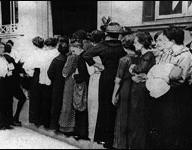
Hurry Up and Wait in NYC
New York, NY —
With the holidays approaching, New York heads into a season of ritualized waiting – waiting in store lines, waiting at the airport, waiting to see the Christmas show at Radio City Music Hall. WNYC’s Lisa Chow finds out how some places are working to cut down their lines.
REPORTER: In New York, even Buddhists can get impatient.
MONK CARMOE: M-O-N-K that’s my name. Monk. Like, I dread Duane Reade. Like when I go in and I just want to buy some tooth picks. And it is like, I’m there until I get arthritis.
REPORTER: Monk Carmoe is 30 and he lives in Brooklyn.
CARMOE: There’s always something inevitably happening wrong with the register, or they have to call the manager, and it’s like, one girl there and it’s rush hour and you’re just buying a bottle of water why do you have to pay by credit card-- Things like that just drive me crazy.
REPORTER: Waiting is inevitable in a city of 8 million.
It causes particular pain when … employees decide to take their breaks right in front of you.
Or the receptionist takes a call from a faraway customer … and you’re standing there, waiting. Does it have to be so aggravating? Some researchers at Columbia University don’t think so.
Awi Federgruen is chairman of the Decision, Risk and Operations Division at the business school.
He and his colleagues study complex mathematical models with the hope of reducing the amount of time we spend waiting … in traffic, hospital emergency rooms, and on the phone with customer service.
VOICE: Welcome to the MTA New York City transit travel information line.
If you thought you were waiting too long for the MTA’s subways … trying calling them.
VOICE: Passengers are advised that effective July 22, 2005, backpacks and other large containers are subject to random search.
So in this case they are forcing you to listen to this message.
And you can immediately see what might be wrong about the design of this. I might want to find out how to get from point A to point B. But I will only find out about it after going through a long path of choices that I need to make, only to find out that really my question is not going to be answered.
Some call centers try to make you feel better … by telling you how long you’ll have to wait. Federgruen says a “smart” call center would give you regular updates on your progress in line. And since everyone has a different tolerance for waiting … a really smart center would know your breaking point … by studying your previous calls … and catch you, right before you hang up.
So now at this point we’ve been waiting 3 minutes, almost 4 minutes. Yeah, yeah, and that could be very annoying …
But what about waiting 20 hours … in physical pain?
Linda Green is another professor at Columbia Business School. She studies hospitals in New York, where emergency room waits can last that long, even longer. She’s experienced it personally.
GREEN: Even if you’re a connected person, and I know people who work there, I’ve spent many many hours waiting for things to happen. My father was ill and we didn’t know what was going on with him. And he needed to be hospitalized and you just wait and wait and of course this is the worst kind of situation in which to wait because people are extremely nervous.
REPORTER: Many hospitals have been cutting the number of beds they staff … to stay alive financially. And, Green says, fewer beds mean longer waits. Still, she believes hospitals could do a better job.
In one case, a hospital didn’t have a staff member around to move someone from a bay in the emergency room to a bed elsewhere in hospital. This created a backed-up ER... and longer waits.
Simply doing a better job scheduling the so-called transport staff, or hiring more of them, could have helped.
Green points out one place that’s gotten waiting right.
Whole Foods has one line feeding into all their cashiers. They’ve got electric signs on top and there’s somebody managing the queues, saying you go to register 32 and you go to register 38. You see these long lines but they move so fast.
You may not shop at high-end grocery stores … but we all have to wait for elevators. Across this city, elevators make 30 million trips a day. That’s nearly 4 trips per New Yorker. That means … if each trip lasts a minute … you may spend a full day, 24 hours, each year in an elevator.
Maybe double that time waiting for one.
The wait in the Marriott Marquis was so bad … people were missing the first act of their Broadway show … by not taking into account “elevator wait time.”
Ed Pietzak is director of engineering at the Times Square hotel.
PIETZAK: We tried to speed up our door closings, putting load weighing devices on to try to limit the amount of people on the elevators. We even looked at some odd ball ideas like double decking the cars.
REPORTER: Nothing really worked. There were just too many people using too few elevators.
Or so the hotel managers thought … until they invested 11 million dollars in a “smarter” system … developed by a Swiss company called Schindler.
Let’s punch in 45. We’ve been assigned to elevator C.
Instead of punching in your floor number inside the elevator … you do it in the lobby. The benefit is a computer can clump together guests traveling to the same floor. The elevator arrives in 15 seconds.
But strangely enough, some businesses enjoy making people wait. That’s because they understand consumer psychology.
People want to be in the know. You see a line – and you think, what am I missing? Maybe it’s for a table at a restaurant, a movie, or a video game console.
VOICE: Look at all these people. They don’t belong here. What are you doing? Who are these people?
POLICE OFFICER: Relax. Let me take care of it. Keep going. Keep walking.
A couple of weeks ago, the police tried calming down crowds in front of Circuit City in Union Square. Play Station was going on sale at midnight. Twenty year old Stefani Castillo lost her job in a beauty salon to wait in line.
CASTILLO: I passed almost a week here without sleeping at all. My back is killing me. My legs hurting. But at least, it’s good because it’s an item that’s very advanced, technological.
REPORTER: At least for her, it was worth the wait. Her story, and our telling of it, creates buzz. And buzz helps sell. For WNYC, I’m Lisa Chow.
Thanks for waiting.

WNYC is funded by sponsors and member donations