Addressing Student Behavior with a 'Restorative Justice' Circle
At the Expeditionary Learning School for Community Leaders in Coney Island, "restorative justice" is used mainly in two ways. Students who get into disputes are sent to mediation so they can work out their problems. And those who break the rules, or who have been suspended, often also attend what's known as a "harm circle."
"An essential part of the circle is the student has to take responsibility," said Alexandra Edwards, the school's special education coordinator and teacher. They do that by facing other members of the community who have been affected.
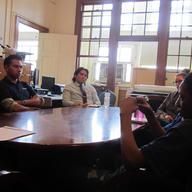
In March, freshman Michael Johnson attended a harm circle because he had been cutting classes. Another school might have sent him to detention. But Michael sat at a long table in the principal's office with four teachers and another student.
Edwards led the session, stating it was not about punishment but about "determining how to repair the harm" so that Michael "can make better choices in the future." Michael freely acknowledged he had been cutting a lot and was "not really focused in class."
His peer mentor, Jharol Aguirre, chimed in (all freshmen at the school get older mentors) with encouragement.
"It's not like you can't reach that potential," he said. "Right now it feels more like you're choosing not to do it."
Edwards asked Michael why he thinks he's been leaving class and wandering halls. At first, the teen said, "I think it's just how I'm feeling at the moment." But after she pressed him for more information, he acknowledged, "Most likely it was something I didn't like, so I got angry and left."
As the session continued, Edwards had the other teachers tell Michael how his behavior frustrated them and rubbed other ninth graders the wrong way. Jason Feldman, the dean of character and culture, suggested that Michael attend a weekly lunch session for students to discuss anger management techniques with a counselor.
The session went on for an hour, following protocols the teachers had learned during training in restorative justice. By the end, Michael agreed to visit an anger management session and to keep a journal of his feelings when he gets frustrated in class. The teachers also arranged for him to make up classwork he'd missed after school. Jharol offered to check in with Michael more regularly, as his mentor.
"I think I'll change, probably," Michael said. "I see how people feel about what I'm doing."

About a month later, Michael said he had walked out of only one class since the circle - and just for a few minutes. It was during a math lesson and he said he was starting to have trouble focusing because he began to feel angry about something. "I raised my hand to go get water," he recalled. He said he went to the water fountain, took a walk through the hall, and came back to class within five minutes. "I didn’t miss much of the lesson."
But Michael had yet to attend an anger management session and he'd been late for school a few times. Feldman did get Michael to fill out a checklist to rate his behavior on a scale of 1 to 4 in various categories. He also designed a simple one-page sheet to prompt him to write down his feelings whenever he was angry or frustrated.
Feldman acknowledged the teen might need to go to another harm circle, and that there would be regular check ins. "In no way does restorative justice, or any process, make someone better tomorrow," he said, conceding he sometimes feels like he's "pulling a large boulder up the hill."
If things didn't improve, he said the school would call Michael's family and still had the option of suspending him. But the dean said he still believed in this alternative to detention or suspensions because it forces students to confront their problems instead of simply accepting a punishment.
"He's aware of it," he said, of Michael's difficulty staying in class. "He is taking ownership of it."

WNYC is funded by sponsors and member donations