Astronomers Tackle 'Political' Science
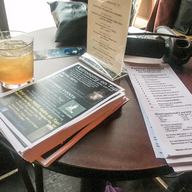
Every month, a group of scientists hold court at a bar in Brooklyn, taking on topics like the moon, orbits, and whether life exists elsewhere in the universe. It's called for Astronomy on Tap, and in March, dozens gathered at the Way Station in Prospect Heights for the program's latest topic: Political Science.
The astrophysicists who lecture leave behind their day jobs — and their formal titles — and go by names like Tycho Brewhaha, DJ Carly Sagan, and MC Stardust. And they really get into character: Carly Sagan, also known as astronomer Emily Rice, was wearing a neon orange wig, big horn-rimmed glasses, leggings with planets all over them, and a string around her neck holding a telescope pendant printed in a 3-D printer.
“Scientists are sometimes thought of as, like, smart people…maybe even uptight, you know, very polished, very practiced,” Rice said. “But, like, we’re not! We’re real people, we can be fun!”
Part of Astronomy on Tap’s mission is to bring people face-to-face with scientists like Rice. It’s also about making science accessible — and free and fun — for the general public. Organizers said that in this program, they wanted to address political policies that could affect scientists and their work.
The result is a wide-ranging line-up, from a discussion of refugee scientists like Maria Goeppert Mayer, the second woman to win the Nobel Prize in Physics, to a tongue-in-cheek talk on what quantum physics and U.S. visas have in common.
Astrophysicist Summer Ash drove home the point that immigration policies impact science, too.
“Scientists need to roam through the world and scientists do take care of each other,” she said. “I hope that this helps you see and think about the whole Muslim ban and these travel restrictions that affect scientists — they affect science.”
Astronomy on Tap's next event, on April 27. They'll be talking about dinosaurs.
Correction: This story has been corrected. Maria Goeppert Mayer was the second woman to win the Nobel Prize in Physics. Marie Curie was the first.

WNYC is funded by sponsors and member donations