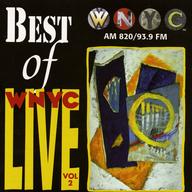
The Best of WNYC Live - Volume Two
Originally published in 1999.
WNYC has, since its inception in 1924, viewed live music as an important part of our programming. But no one could have foreseen the dramatic and unexpected renaissance of live performances on WNYC in the 1990s – especially after decades of dwindling opportunities to hear live music on the radio. A series of cutbacks by the New York City administration (which still owned and contributed somewhat to the operation of the station) in 1991 resulted in the loss of the few remaining City employees at WNYC, including longtime midday host Andre Bernard. We suddenly found ourselves with a gaping hole in the afternoon. It was a problem, but also an opportunity.
A couple of phone calls and some very tentative questions soon revealed that the city was not just teeming with musicians, but that it was full of musicians who loved the idea of playing live on the radio, for an audience the size of WNYC’s. And we loved the idea of bringing the musical community and the larger community of WNYC listeners together, showing that the formidable world of Classical Music was actually made up of real people – people who told us about their kids, who told bad jokes, who broke strings in mi-performance. So on John Cage’s birthday, September 5, 1991, we invited Margaret Leng Tan to play some of Cage’s works on our piano (which, having been neglected for many years, was perilously close to the sound of Cage’s “prepared piano” anyway). And we haven’t stopped since. What you have here are just a few recent examples of the diversity and the talent WNYC has presented vin our live music programs. From world-famous stars like Richard Stolzman to the young but gifted singers in the American Boychoir, from the legendary Beethoven to up-and-coming Raimundo Penaforte, WNYC takes advantage of being in New York – a city that contains a whole world of music.
Richard Stoltzman
Gershwin/arr. J. Gach: Prelude #2
One of the world’s greatest clarinetists, Richard Stolzman has been a regular guest in the WNYC studios. Here he performs a terrific arrangement of the second Gershwin Piano Prelude, which plays on the bluesy quality of the original. Recorded: August 19, 1999. Engineer: George Wellington.
The Eroica Trio
Raimundo Penaforte: An Eroica Trio, II
Penaforte is a New York-based composer who did, coincidentally, his own arrangements of the 3 Gershwin Preludes. His colorful and effective arrangements for the Eroica Trio convinced them to ask him for a piece of his own. An Eroica Trio was the result. Like the Gershwin, it is an unabashedly American work, played with great energy by one of America’s leading chamber ensembles, and WNYC’s unofficial house band, the Eroica Trio. Recorded: July 22, 1999. Engineer: Wayne Shulmister,
Robert McDuffie
Poldini/Kreisler: Poupee Valsante
McDuffie can play virtually anything on the violin, from Baroque sonatas to a Jimi Hendrix-inspired arrangement of The Star-Spangled Banner, which he has played before New York Jets football games on several occasions. Here he plays one of Fritz Kreisler’s classic salon pieces, where the charming surface masks a piece of often fiendish difficulty. Recorded: May 11, 1999. Engineer: George Wellington.
Alexander String Quartet
Beethoven: String Quartet #9, Op. 59 #3, 2nd movement
The Alexanders came into our studio with an unusual concept: they’d take requests for any movement from any Beethoven string quartet and would play the most requested movements. Votes were cast via email in the days before their appearance, and this movement came out on top. Small wonder: it stands on its own quite well, and divorced from the rest of the 9th quartet, creates a surprisingly exotic mood through some unusual twists in the melody.
Sydney Symphony Orchestra
Edo de Waart, conductor. Beethoven: Symphony #5, finale
Since we can’t fit an orchestra into our studio, we have to go to them. This performance was part of the Sydney Symphony Orchestra’s 1998 U.S. tour, and came to us from the Tilles Centre, where the orchestra and Edo de Waart put on a memorable series of Beethoven Symphonies and Concertos – all of which were broadcast live back to our Manhattan studio, and then heard across Australia via the Australia Broadcasting Corporation. Recorded at the Tilles Center, C.W. Post Campus, Long Island University on November 15, 1998; director: Eileen Delahunty; technical director: Edward Haber; engineers: George Wellington (music mix) and Irene Trudel. Thanks to the Sydney Symphony Orchestra, Sydney, Australia.
Valery Kuleshov
Bizet/Horowitz: Carmen Variations
An extraordinary young talent, Valery Kuleshov has spent an increasing amount of time in the United States in recent years. He has become fond of American composers, especially the late Morton Gould, and when last seen here was in the process of adding Gould’s 1994 Anniversary Rag for WNYC to his repertoire. Here he tackles Horowitz’s virtuoso showpiece based on Bizet’s famed opera with typical elan. Recorded: June 4, 1998. Engineer: Edward Haber.
Vox Vocal Ensemble
George Steel, director. Robert Parsons: Nunc Dimittis
Vox is a relative newcomer on New York’s early music scene but has quickly established a niche for itself – a result of director George Steel’s innovative programming (and his position as director of Columbia’s Miller Theater). In Robert Parsons, they’ve discovered a largely neglected composer whose work is full of harmonic surprises; parts of the Nunc Dimittis (sung in English despite the Latin title) sounded like they could’ve been written 4 years ago instead of 400. Recorded: April 29, 1999. Engineer: Wayne Shulmister.
Eliot Fisk
Trad/arr. Segovia: Canciones Populares
Carrying on the legacy of the great Andres Segovia, Eliot Fisk has been omnivorous in his choices of repertoire. As with Segovia, he plays the classic works of Spanish composers like Tarrega and Torriba at the same time that he premieres new works written for him. Here, he plays the master’s own arrangements of a pair of popular songs, the second familiar to many listeners as “Loch Lomond.” Recorded: December 11, 1996. Engineer: Michael DeMark.
Dubrovka Tomsic
Bach/Siloti: Prelude in B Minor
Dubrovka Tomsic is a first-rate Slovenian pianist who simply doesn’t appear enough in these parts, and whose reputation therefore doesn’t match her prodigious talent. As if to prove the point, she performed for us this deceptively challenging arrangement of Bach’s Prelude in B Minor, after only mild urging from our resident piano maven, Sara Fishko. Recorded: April 15, 1999. Engineer: George Wellington.
Modern Mandolin Quartet
Piazzolla: Melodie in A Minor
Born in Argentina, Piazzolla was raised in New York. And though he died in Argentina in 1992, he was a frequent and welcome visitor to WNYC. Best known for his nuevo tango style, he also had a strong lyrical bent, which he indulged to great effect in this lovely melody. The arrangement is by the Modern Mandolin Quartet, a San Francisco-based ensemble that has made many live appearances and has premiered several commissioned works on WNYC. Recorded: October 26, 1995. Engineer: Michael DeMark.
Shanghai String Quartet
Griffes: Two Sketches Based on Indian Themes
Based for many years now in the United States, the Shanghai Quartet has a wide-ranging repertoire that includes the so-called “standard rep” as well as new works by contemporary composers like Zhou Long. Here, they play an overlooked gem from the early 20th-century American composer Charles Tomlinson Griffes. Recorded: June 17, 1999. Engineer: George Wellington.
Christopher O’Riley
Scriabin/arr. O’Riley: Sequence from “The Lady With the Lapdog”
An unusual project brought frequent visitor Chris O’Riley back to our studios in fall of 1999. “Vers La Flamme” was a narrative but wordless dance by Martha Graham, set to piano works by Scriabin. It was O’Riley’s job to not only play the music, but to help create the sequences of pieces that would accompany each part of the event. For this tableaux, O’Riley plays excerpts from the Sonata #4, as well as the Album Leaf (Op 58 #1), Poeme (Op. 59 #1), and the Prelude in G#m (Op. 11 #10). Recorded: September 21, 1999. Engineer: Edward Haber.
The American Boychoir
James Litton, conductor. Libby Larson: Reasons for Loving the Harmonica
Kurt Masur’s first call when he needs a boy’s choir (which happens more frequently than you might think), this Princeton-based group had a great time performing Libby Larsen’s musical meditation on the humble harmonica. And why not- how often do kids get a chance to sing words like “spit”? (A little spit on the instrument means the music is fervent, we’re told.) My favorite reason for loving the harmonic: “because it gleams like the chrome on a ’57 Chevy.” The American Boychoir’s new CD on Virgin Classics is called Fast Cats and Mysterious Cows – a title they came up with while soundchecking before this performance. Recorded: June 3, 1999. Engineer: George Wellington.
Producer: John Schaefer
Master at WNYC Studios by: Edward Haber
Thanks to: Eileen Delahunty, Fred Child, Sara Fishko, Ralph Graves at Digital Chips, Inc., and YOU, for supporting WNYC Radio.

WNYC is funded by sponsors and member donations