Celebrating the Life and Music of Zakir Hussain
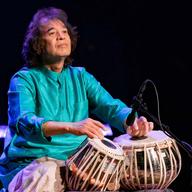
Zakir Hussain, who died yesterday at the age of 73, would be the first to tell you that he stood on the shoulders of giants. Well, one giant, at least. Zakir was the oldest son of the legendary tabla player Alla Rakha, who toured the world with Ravi Shankar. By the time he was a young adult, Zakir was a master tabla player himself, and, taking advantage of his father’s work introducing this tuned pair of hand drums around the globe, he proceeded to move the instrument beyond South Asian music, and in the process became one of the architects of what would come to be known as “world music.”
Zakir made early recordings with George Harrison and Mickey Hart of the Grateful Dead. But it was his groundbreaking work with guitarist John McLaughlin in the mid-70s band Shakti that catapulted him to international fame. He went to work with jazz artists, rock musicians, and classical ensembles from both India and the West. Like many great Indian musicians, he scored films in the subcontinent’s enormous movie industry, commonly referred to as Bollywood. Unusually, though, he occasionally appeared in front of the cameras too, with featured roles in the Merchant-Ivory film Heat And Dust and several Bollywood films.
Zakir understood that percussion, and rhythm, were universal musical elements, in ways that melody and harmony are not. And so he could often be found playing with percussionists from all over the world – Mickey Hart, Brazil’s Airto Moreira, Balinese gamelan musicians – and touring with them under the name Zakir Hussain’s Masters of Percussion. But he never left his roots behind. His last several appearances in our studio were opportunities for him to use his own position, as the world’s most famous tabla player, to introduce a younger generation of Indian classical musicians.
This was a serious business. But Zakir was always a genial, even jovial speaker – he was happy to demonstrate the distinctive melodic aspects of the tabla, and to admit when he was doing something that his eminent father might’ve raised an eyebrow at. His best stories were never about instruments or concerts, but about the people who made or played them. He leaves behind an astonishing discography, and an impressive list of awards, but it was that personal connection, the one that made him so indispensable in so many different musical contexts, that made him so effective at conveying his unshakeable belief in the power of rhythm to bring people together. - John Schaefer