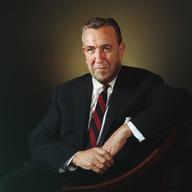
Chester Bowles
The Douglas P. Cooper Distinguished Contemporaries Collection | Dec 31, 2015
Douglas Cooper traveled to the home of the Ambassador and Mrs. Chester Bowles in Essex, Connecticut. A mile-long road through evergreen woods led to their sprawling Colonial-style home on the Connecticut River.
The Interview
Cooper touched briefly on Bowles co-founding of one of the 1970's top-ten advertising agencies, Benton and Bowles, in the 1920's. They had latched onto some of the country's leading consumer brands at Proctor and Gamble, such as Ivory Snow and Crest. Bowles attributed his writing skills to that entrepreneurship.
The focus of the conversation was Bowles' just-published memoir, Promises to Keep: My Years in Public Life 1941-1969. Cooper asked about Bowles appointment, by Roosevelt, as Director of the Office of Price Administration. The main objective, Bowles explained, was to control prices and wages, a role he expanded after the war as head of the postwar Office of Economic Stability.
Bowles was then elected Governor of his home state, at which time he espoused strong convictions on improved transportation and slum clearance. He tells Cooper that he did not fulfill his longstanding ambition to be a diplomat until he was tapped by Truman to become Ambassador to India in 1951.
Cooper asked about Bowles' roles as Representative from Conn. and Under Secretary of State in the Kennedy Administration, with an emphasis on his opposition to policy in SE Asia. He was also critical of Kennedy and Johnson's emphasis on re-election and was a critic of seniority vs. merit in these national roles.
Returning for a second assignment in India, Bowles tells Cooper he sees population growth coming under control in twenty years, surfaces his views on India's dangerous relations with Pakistan, and tells of his clandestine efforts in Svetlana Stalin's emigration from the Soviet Union.
He tells Cooper that while he endorses environmental clean-up, the successes of Nader, the advances in civil rights, he decries the current generation's lack of interest in history which, he believes, may be their undoing.
Behind the Scenes
Only at the conclusion of the interview does Cooper reveal that it was his father who performed neurosurgery on Bowles to relieve the tremors of Parkinson's Disease. Bowles shouts to his wife to come downstairs and meet me.
Two years later when, upon leaving radio, I sought a job in advertising, I was having no success. I telephoned Bowles, who wrote a letter to the then-President of Benton and Bowles (where I'd already interviewed), and a position "opened up."
Still later, when the Company was to hold a fiftieth anniversary party, the President summoned me to his office; he asked if I could supply him with Bowles' telephone number. It happened that I knew the alias under which the Ambassador had come to Dad's hospital (to stave off the press); I called in, asked for, and obtained, "John Chester's" unlisted number.
Cooper touched briefly on Bowles co-founding of one of the 1970's top-ten advertising agencies, Benton and Bowles, in the 1920's. They had latched onto some of the country's leading consumer brands at Proctor and Gamble, such as Ivory Snow and Crest. Bowles attributed his writing skills to that entrepreneurship.
The focus of the conversation was Bowles' just-published memoir, Promises to Keep: My Years in Public Life 1941-1969. Cooper asked about Bowles appointment, by Roosevelt, as Director of the Office of Price Administration. The main objective, Bowles explained, was to control prices and wages, a role he expanded after the war as head of the postwar Office of Economic Stability.
Bowles was then elected Governor of his home state, at which time he espoused strong convictions on improved transportation and slum clearance. He tells Cooper that he did not fulfill his longstanding ambition to be a diplomat until he was tapped by Truman to become Ambassador to India in 1951.
Cooper asked about Bowles' roles as Representative from Conn. and Under Secretary of State in the Kennedy Administration, with an emphasis on his opposition to policy in SE Asia. He was also critical of Kennedy and Johnson's emphasis on re-election and was a critic of seniority vs. merit in these national roles.
Returning for a second assignment in India, Bowles tells Cooper he sees population growth coming under control in twenty years, surfaces his views on India's dangerous relations with Pakistan, and tells of his clandestine efforts in Svetlana Stalin's emigration from the Soviet Union.
He tells Cooper that while he endorses environmental clean-up, the successes of Nader, the advances in civil rights, he decries the current generation's lack of interest in history which, he believes, may be their undoing.
Behind the Scenes
Only at the conclusion of the interview does Cooper reveal that it was his father who performed neurosurgery on Bowles to relieve the tremors of Parkinson's Disease. Bowles shouts to his wife to come downstairs and meet me.
Two years later when, upon leaving radio, I sought a job in advertising, I was having no success. I telephoned Bowles, who wrote a letter to the then-President of Benton and Bowles (where I'd already interviewed), and a position "opened up."
Still later, when the Company was to hold a fiftieth anniversary party, the President summoned me to his office; he asked if I could supply him with Bowles' telephone number. It happened that I knew the alias under which the Ambassador had come to Dad's hospital (to stave off the press); I called in, asked for, and obtained, "John Chester's" unlisted number.
__________________________________________________________________________
The Douglas P. Cooper Distinguished Contemporaries Collection (1967-1974) contains rare interviews with influential writers, statesmen, artists, songwriters, journalists and others who have left their mark on our culture.
The Origins of The Cooper Collection
Douglas P. Cooper
WNYC is funded by sponsors and member donations