Richard Goldstein & New Music Criticism
"As an impressionist in an age of impressions, we strive to know what we feel. The critic has become a farmer of his own perceptions, yielding a crop of emotions which, when harvested between margins, becomes an opinion." — Richard Goldstein
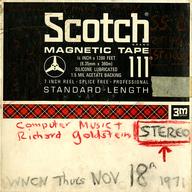
In this episode of Recordings, E.T.C., Ed Canby discusses the writings of Richard Goldstein, one of the first popular music critics who wrote a regular column on the subject in The Village Voice from 1966 to the late 1970s. Goldstein was a staunch advocate for electronic and popular music and explored the role of the critic and their impact on how new forms of music-making are perceived.
Canby plays three pieces of computer-generated electronic music to illustrate the "shock of the new" found in contemporary, experimental music. For many, this seemingly chaotic music defies any kind of known genre and oftentimes has the affect of "short-circuiting the senses". Yet this "critical and sensory unmooring" is necessary for any art-form that wishes to escape the confines of genre or creative stagnation. Canby notes that Beethoven's audiences were similarly disoriented when they first heard his music that, at the time, was perceived as strange and dissonant. "It was only bad," says Canby, "because it did not do what it was supposed to do — It was only ugly because it did not conform to people's sense of what was beautiful, which tends to be rather fixed."
According to Goldstein's writings, the role of the critic, especially in dealing with new music, should be defining the contextual space around a piece and relaying the intent of the musician to the listener. He writes, "I suspect that my writing elicits a more sympathetic response when it deals more with approach than when it attempts to define standards." Context, in his opinion, should be elevated to the level of criteria in music criticism.
Music Played
Charles Dodge - Changes (1970)
J.K. Randall - Quartersines (1967)
Barry Vercoe - Synthetism (1970)
All three pieces were assembled and realized at the Columbia-Princeton Electronic Music Center
WNYC archives id: 58693

WNYC is funded by sponsors and member donations