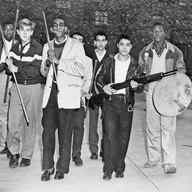
Curfews, Nightsticks and Juvenile Delinquency
In this 1959 edition of Public Press Conference, New York City Mayor Robert Wagner is joined by Youth Board President Ralph Whalen and Police Commissioner Stephen P. Kennedy in answering questions sent in from listeners. The moderator is Gabe Pressman. A proposed curfew and the police use of nightsticks are hot issues of the day. Mayor Wagner reports most city officials are opposed to a curfew for young people, pointing out that the small percentage of troublemakers such a restriction would affect are the very types who have bad home lives and would instead congregate in "cellars and backyards," still causing trouble. Kennedy, the police commissioner, is in favor of retaining nightsticks. He warns that the police department "is not a punitive agency, not a social service agency, but a law enforcement agency." A listener accuses the Youth Board of "giving gang lords a special glory." Whalen defends the organization, insisting that if it sees any evidence of illegal activity, it contacts the police immediately. But "gangs exist," he points out. His job is to "bring them around." Another listener blames "coddlers, lenient justices, professional do-gooders, and sob sisters" for the recent upswing in gang violence. Whalen argues for more parental authority to be exercised.
There is a surprising question for Wagner submitted by none other than former President Herbert Hoover! He advocates increased funding for Boys Clubs (with which he had a long affiliation) and other organizations. The problem, Wagner points out, is that the hardcore delinquents can't be tempted to join such groups. A more eerily topical note is sounded when a listener asks "Why are people allowed to buy guns so freely?" Wagner's and the Police Commissioner's answers could be ripped from today's headlines. Tighter legislation needs to be enacted, on the federal level. Otherwise, guns simply come in from states with loose or nonexistent regulation.
While the problem, even the term itself, "juvenile delinquency" (and its proposed solutions) may seem quaint, one can discern from this uneasy discussion the seeds of New York City's eventual descent into the maelstrom of crime, "white flight," and fiscal insolvency that characterized the next decade. The municipal government, however well-intentioned, seems ill-equipped to respond to changes brought on demographic and cultural shifts in the population.
Robert Wagner (1910-1991) was a popular, three-term mayor. His father had been a powerful New York senator. Wagner himself, though a product of the Tammany Hall, turned on the machine in his final campaign. In its obituary, the New York Times summarized Wagner's tenure, noting:
By the time that young Robert became Mayor, at the age of 43, the city was undergoing profound change as post-World-War-II prosperity enabled middle-class whites to start moving to the suburbs in waves. They were replaced largely by blacks from the South and Puerto Ricans lured here by the hope of better jobs and less racial discrimination than they had found in other parts of the country, as well as relatively generous welfare benefits. Mr. Wagner, even his critics acknowledged, grasped the enormity of the social problems that were accelerating and sought in a deliberate, methodical way to solve them…Flexing his political muscle, Mr. Wagner won infusions of state and Federal funds to clear slums in urban-renewal areas, build public housing and to help maintain the 15-cent subway fare. He granted collective-bargaining rights to municipal labor unions. He integrated government with more black and Hispanic appointees who began to reflect the city's rapidly changing population. And his third-term campaign against his estranged political mentors dealt the Democratic machine a defeat from which it has never recovered.
Gabe Pressman (1924-2017) was one of the first television reporters to cover City Hall and started his electronic media career as the host of WNYC's Campus Press Conference. The Wall Street Journal noted, when
…he arose to address his fellow New York Press Club members at their annual awards ceremony in June, his admonition to jealously guard the freedom of the press was as full-throated as ever. “I think I’m sort of a nut job on the First Amendment,” he admitted. …Mr. Pressman’s message to his colleagues was never to fear speaking truth to power. “If the press doesn’t stand up for that, no one else will,” he said. “It’s unusual for anyone in authority to stick up for the press. We have to do it for ourselves….Part of my effort is to brainwash my fellow journalists into doing more human-interest stories about the people we serve.”
Audio courtesy of the NYC Municipal Archives WNYC Collection.
WNYC archives id: 5713
Municipal archives id: LT8817

WNYC is funded by sponsors and member donations