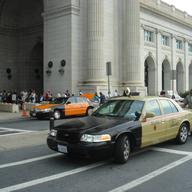
Discrimination Complaints Trickle In About D.C. Cabs
Five weeks after creating an easier process for residents to complain about racial discrimination by D.C. taxi drivers, human rights officials are seeing a small increase in allegations, saying further public outreach will be necessary to make the riding public aware where to file a claim.
Since Aug. 5, when the initiative was announced by the D.C. Taxicab Commission and D.C. Office of Human Rights, three complaints have been filed alleging racial bias against cab drivers. The previous two years saw only five complaints.
“We haven’t quite begun to do extensive outreach in the community so we think that people don't know," said Monica Palacio, the director of the Office of Human Rights. "They don’t know how easy it is to file a complaint, or what the outcomes might be.”
Palacio’s administration moved to establish the new system after its investigation determined the low number of complaints did not match the apparent number incidents on the streets of Washington, based on anecdotal evidence and news media reports. She said it's common for cab drivers to either deny service to African-American passengers or refuse to drive to predominantly African-American neighborhoods.
“If you file a complaint it will be investigated, and it is not that hard to prove,” she said.
A common rationale
In interviews with WAMU 88.5, cab drivers said decisions about whom to pick up are often misunderstood. In their minds, they are not racially discriminating against black people by denying them a ride. They are making a business or safety decision, they said.
“I pick up anybody. I don't have a problem with their race or anything,” said one cab driver, who asked not to be identified. “The issue is when you pick up someone you don't know what kind of person you are picking up and where they are going is not clear.”
When asked which areas of the District he tries to avoid, he responded, “Certain areas of Northeast, even Northwest and Southeast. Daytime, I don't have a problem. Nighttime, nobody is going to protect me.”
When pressed to explain, the driver said: “There are robberies. Somebody might kill you.”
The cabbie said driving at night to any neighborhood could be dangerous, but “most of the time black people are living in the area,” referring to neighborhoods where he believes there is the most crime.
“If I see a police officer, I feel safe. If I don't see the police, I don't have any protection. Somebody is sitting behind me in my cab and I don't know what he is doing.”
To Palacio, such decisions are based on unacceptable stereotypes about appearance and neighborhood.
“They are supposedly making a business decision in that moment,” she said. “They are making that decision based on someone’s appearance, based on their skin color, the clothes they are wearing, the neighborhood they are standing in, and that is not a business choice at that moment, because you do not really know if this person can pay or not pay. You are making a decision based on how they look.”
A touchy subject
The aforementioned cab driver said he no longer drives at night out of fear he could be robbed.
“I don't want to pick up a customer and have to ask where they are going. For that reason, I stopped working after midnight,” he said. He was among a group of cabbies, all immigrants from Africa, conversing on the sidewalk near Freedom Plaza in downtown D.C. during the middle of the day. Some angrily refused to speak to a reporter about the subject of racial discrimination.
One Ethiopian-born driver, who refused to be interviewed with a microphone, suggested the reason black residents struggle to hail cabs is because they have been forced to live in neighborhoods east of the river, comparing it to a “reservation.”
Others who were willing to be interviewed said cab drivers don't appreciate being labeled as racists. A decision to refuse to take a passenger from busy downtown D.C. to a neighborhood in Southeast or Northeast could be based on business, said another driver who asked to remain anonymous.
“Some cab drivers feel like gas is very expensive, and they have to pay insurance and maintenance, so he feels like if he won't get a [return fare] it has nothing to do with discrimination or human rights,” he said.
By law, D.C. cab drivers are required to serve all parts of the District, and may not ask a passenger about their destination before accepting the ride. Likewise, assuming a passenger may ask to be taken to a certain neighborhood based on their skin color or dress and then denying a ride is also illegal.
“You have only two defenses for denying someone a ride. They are inebriated beyond control, or they are menacing and threatening you physically. There are no other reasons,” said taxicab commission chairman Ron Linton in an earlier interview.

WNYC is funded by sponsors and member donations