Dispatches From the Bang on a Can Summer Festival 2022: Part 2
A Lunchtime Sampler, Bang on a Can Style
By Emma Bauchner
It’s a Bang on a Can Summer Festival tradition that just after lunchtime, a handful of Fellows fill the galleries of MASS MoCA with sounds as striking as the art on display. For a few minutes, the young musicians are able to take their impromptu audience of festival attendees and museum-goers on a one-of-a-kind journey.
For oboist David Munro, that journey began in the Sol LeWitt galleries, where large, colorful geometric drawings grace the walls. In particular, Munro selected Wall Drawing 880, subtitled Loopy Doopy, as his backdrop. A cacophonous tangle of green and orange, it’s a work that at once dazzles and shocks the system—much like the music Munro shared. Prefacing the performance with a warning that audience members might need to cover their ears, Munro dove headfirst into Heinz Holliger’s diabolical Studie II. Under Munro’s careful control, his instrument sputtered, squawked, scurried and scooped, tracing a highly dissonant melody through a stream of articulations. Holliger was one of the great oboe virtuosos of the 20th century, and in his own compositions pushed the oboe to unlikely feats of timbre and volume that few dare to replicate. For both Munro and his audience alike, Studie II was a musical challenge that yielded fine rewards.
The next destination was Spencer Finch’s Cosmic Latte, a room in which a constellation of warmly-tinted light bulbs dangle from the ceiling. The work’s title is a reference to the name astronomers have given to the average color of the universe, and the installation indeed evokes the aura of the cosmos. Violinist-composer Yaz Lancaster knelt in one of the room’s corners as they performed their chosen work: Anne Leilehua Lanzilotti’s ko’u inoa. Rapidly rotating their bow back and forth across the strings, Lancaster created a delicate texture, breathy and fluttering, beginning at a whisper and growing gradually stronger. They played with the kind of hushed conviction that instantly quiets a crowd, eager to listen. It felt perfectly natural when Lancaster opened their mouth and began to sing toward the end of the piece, the audience hanging on to the resonance of each note.
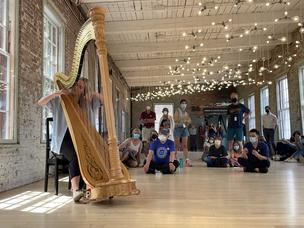
The focus shifted to the middle of the room for a performance by harpist Melissa Achten. Cradling her instrument and closing her eyes in a brief moment of stillness, she then wordlessly launched into the opening movement of Caroline Lizotte’s Suite Galactique, “Exosphere.” The piece began in the depths of the instrument, filling the space with dark, clouded sonorities a typical concert-goer might not associate with the harp. Achten played hauntingly and hypnotically; expanding across the instrument’s full register, she took her time unfurling the work’s mysterious harmonies, allowing the ends of phrases to linger in the air. The movement’s delicate final notes, played on the instrument’s highest, shortest strings, completed the gesture of mystical ascendance.
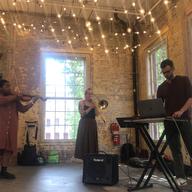
Closing the recital was a trio: Sarah Manley (trombone), Kennedy Taylor Dixon (viola), and Dan Langa (electronics), who assembled on the other end of Cosmic Latte. Bathed in the starry, yellow light, they began an improvisation exploring ambient soundscapes. The trio had determined the work would be centered in the key of E, but knew little else about what they were creating together. Playing with the sensitivity of seasoned collaborators, they responded as much to each other as to the environment around them, tapping into Cosmic Latte’s easy tranquility. Their meditative performance enveloped the room in warmth, allowing the audience to share in a collective exhalation.
Emma Bauchner is a New York-based writer, radio enthusiast, and music lover. She studied music at Vassar College and currently works as a programming coordinator at WQXR.
A Spooky Gallery Fills with Screaming: Bang On Can Composers Premiere Their Short Works
By Alice Koeninger
The Bang On A Can Summer Festival ramped up for LOUD Weekend yesterday with a taste of what the composers and instrumentalists have to offer. Each composer wrote a short work while at the festival, and these works premiered in the very galleries in which they were conceived.
Composers Dan Langa and Yaz Lancaster chose the Marc Swanson gallery installation entitled “A Memorial to Ice at the Dead Deer Disco” as the setting for their premieres. The musicians were seated in front of an illuminated staircase that led to a platform hung underneath with ghostly drapery. The atmosphere was that of a haunted ballroom.
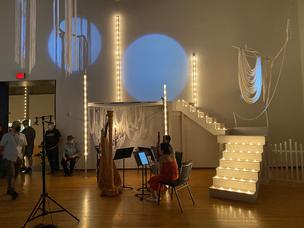
This suited Langa’s piece, called “Ebb,” which the composer described as “intertwined decay” in his introductory speech. He described how he wrote the piece originally on his computer using a synthesizer and a delay effect, before transcribing the parts for each instrument. Harpist Melissa Achten, violist Amy Huimei Tan, and bassoonist Maya Stone began in unison with a bright, loud note. The piece seemed to have several beginnings, with the instruments dashing out a few notes before pausing and repeating the gesture until the wave of music gathered momentum.
Achten’s harp playing was eye-wateringly beautiful, her melodies supported by the bassoon and viola. There was an underlying consistency of melody throughout the piece by both bassoon and viola. The musical phrases pushed forward and then immediately pulled back, like a wave crashing to shore and sliding back leaving a line of foam in its wake.
The bassoon, then the harp each reached out, grasping for land, before the trio faded away, getting quieter and quieter until stillness signaled the end of the piece.
Lancaster’s work, though written for the same instruments, along with the composer on violin, had a very different feel and impact. Their piece, entitled “Prime,” was inspired by the Jenny Holzer text-based installation on exhibit and borrowed from a poem written by the composer themself, which ends with the question “why [do] we pay so much/just to live?”
The piece started with a rumbling bassoon, then the viola and violin came in together, mirroring each other. The quartet’s gathered, galloping melody soon turned dissonant and ominous. Harp and bassoon worked together to create an underlying woven texture that the viola and violin slashed into with violent bowing. The texture was reminiscent of a song by the screamo group Vein.fm that Lancaster drew inspiration from while writing their piece. The harp climbed higher and Achten suddenly began screaming, “We! Pay! So! Much!”, each word punctuated by plucked notes.
The screaming, so unexpected in classical music, was made even more surprising by the juxtaposition of the harp, normally a source of elegant and soothing sounds. The outburst was biting and pointed. Lancaster and Tan soon joined in with a responding chorus, “To live!” Their yells were throatier than Achten’s, influenced by the screamo genre. This call-and-response was transformed into a protest chant that demanded to be heard.
The musicians stopped yelling and the melody once again became idyllic. Though there was no audible sinister undertone, the effect of going from screaming back to innocent prettiness was quite eerie. It was as if the musicians were responding to the news of the federal interest hike in real time, lashing out at the concept of paying even more while Americans stand in food lines.
The short works recital also featured pieces by Kyle Brenn, Udi Perlman, Samantha Wolf, and Erika Dohi. All of the composer Fellows will be premiering their longer works during the LOUD Weekend festival on Friday at noon.