Dispatches From the Bang on a Can Summer Festival 2022: Part 5
Finding the You in You at the Bang on a Can Summer Festival
By Lara Mitofsky Neuss
Whether you’re a Fellow, a faculty member, or a concert-goer, you have a place in July at the Bang on a Can Festival, and you only have one job: to be you.
Each year about thirty Fellows (performers, composers, and now writers) gather at MASS MoCA for three weeks in July to collaborate with each other, with art, and with the Bang on a Can Festival Artist Faculty. I attended in 2015 as a Clarinet Fellow, fresh out of my undergraduate studies and still trying to find who I was. I came back this summer as a Media Fellow, emotions pouring over me as I arrived — I was reminded of the glorious utopia I had just stepped back into; the place where I felt comfortable and accepted when expressing myself through conversations and performance; where the me inside of myself was let free. The Fellows show up, and we leave even more ourselves than we came. Faculty member and bassist Gregg August couldn’t have articulated it better – he pointed out “the vulnerability” in the participants that starts to show as they become increasingly comfortable in their own skin.
Each performance I saw here was connected to the person performing it. Yaz Lancaster’s Prime was performed by themself alongside other fellows in the Marc Swanson installation, A Memorial to Ice at the Dead Deer Disco, and it brought screams of chaos, a real depiction of raw, human emotions. Yaz had many works performed during the festival, and they spoke openly about their identity and creativity to the audience: “As a Transgender and Non-Binary person I was thinking about the joy and freedom I get to experience by creating myself through little things/changes everyday.” Throughout the festival, Yaz had a similar experience to me, a feeling of inspiration and collaboration: “I found myself being constantly inspired and (re)interested in creating and making music, and left with a lot of new ideas and collaborators.”
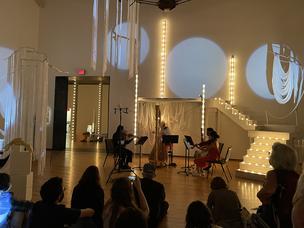
Caroline Jesalva both sang and simultaneously played her violin in the James Turrell Skyspace, in her own arrangement of Softly, As in a Morning Sunrise by Romberg and Hammerstein. It’s commonly performed in an upbeat jazz tempo, but as Jesalva explained: “I wanted my arrangement to be more reflective of the original — bring out more of the melancholy, nostalgic sound world.….and that was easily achieved through the amazing acoustics of the Turrell Skyspace.”
It’s almost like the art here at MASS MoCA turns the light bulb on in our brains — bringing to life these ideas inside us that help us express who we are.
The feeling continued into the LOUD Weekend; the culmination of the festival. It began on Thursday with Julia Wolfe’s Steel Hammer. The piece was performed by the Bang on a Can All-Stars, the resident ensemble of the festival, joined by 3 vocalists, Rebecca L. Hargrove, Sonya Headlam, and Molly Netter. The vocal trio, even in behind-the-scenes rehearsals, sang together flawlessly as one unit, honing in on each other's individual voices to create an original, beautiful timbre together. Each All-Star’s personality came through, from Mark Stewart’s vibrant guitar licks, to Dave Cossin’s smooth, relaxed, and steady percussion lines, to Ken Thompson’s confident, excited cues. They all embodied that unspoken environment I feel here of being yourself, and every time Thompson smiled because of how much fun he was having, the audience was reminded of that.
The day continued with a George Crumb mini-fest — Festival performers, including faculty member and cellist Nick Photinos, wore eye masks in the darkness as they calmly performed Crumb’s Vox Balaenae in a quiet, creepy, pristine way. The night-time performance of Crumb’s Black Angels in the gallery had bug-like string sounds and eerie wine glasses. Crumb passed away very recently in February, and so the Crumb mini-fest was a heartfelt touch to the festival. Both Nick Photinos (cellist) and some of the other faculty knew him and had mentioned his quiet yet genuine nature, and were delighted that a younger generation was discovering his music. It’s these small touches that help the Fellows grow, as we get the opportunity to experience new people and sounds that we may have not encountered before.
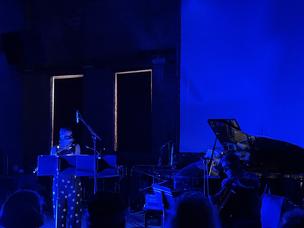
The varied musical adventures continued on Saturday — Phil Kline’s Zippo Songs was performed by Kline himself on guitar, David Cossin (percussion), Todd Reynolds (violin). And Theo Bleckmann (vocals). They took us through a multi-genre ethereal, yet upbeat adventure through time. The piece is based on poetry that American soldiers wrote on their lighters while in Vietnam. I once again saw that sense of community while I watched the performers interact with one another. Reynolds looked back at Cossin as he laid down the beat in that chill Cossin-way, letting Reynolds sing freely on his electronic-infused-violin. You could tell they were one another’s biggest fans.
In the outdoor Chalet, Saturday presented an interdisciplinary multi-genre showing of artists. Phong Tran, who was a Bang on a Can Fellow in 2017, sat at his computer creating an electronic, groovy environment. He had also turned a corner when at the festival: “I experimented with a lot of things I hadn’t done before and that spawned into new things.” I had never seen anything like it but at the same time the music gave me a comfortable, familiar feel. He was friendly and inviting and I almost felt like I already knew him when we spoke.
Ganavya Doraiswamy, who combines South Indian vocals with jazz and contemporary styles, performed music inspired by poetry and urged the audience to send her their favorite poems for her to perform in the future. She sang the poems with warm vocals while playing resonant bass chords under them. She claims to not know how to play bass, but I beg to differ. When she felt like her tuning wasn’t on par she just kept playing, looking for the pitch and talking to the audience about it. It was human and real, and it took that wall down that sometimes lives between performer and audience. She later mentioned a feeling she had about coming to the festival: “I felt this pull, like I had to come here.”
One of my favorite parts of the festival, aside from the incredible performances, were my conversations with the people. Seeing faculty member and violinist Todd Reynolds again was a true joy; he’s invested in the Fellows succeeding, and his favorite part of the festival is when he sees the Fellows start to have what he calls a “lightness to their being” as the weeks go on. They realize that they can be comfortable in rehearsals, in performances, and that they can have fun no matter what comes out of their instrument.
Mark Stewart and Todd Reynolds performed in the Hunter Center alongside festival Fellows in a Steve Reich extravaganza. In addition to their sublime performances, Stewart and Reynolds both bring the Fellows through new learning experiences each summer. Stewart creates an Orchestra of Original Instruments every year, first taking Fellows through Gunnar Schonbeck’s gallery of homemade instruments, and then culminating in a performance with self-made PVC pipes and vacuum hoses. Reynolds teaches the participants “soundpainting”, which is a series of gestures used to create live improvisations. Reynolds honed in on how there are no mistakes, and urged everyone to lean into the sounds they make and let loose. I started to tear up during their performances during the Reich concert that night. They both embody a sense of self that I rarely see.
To this day I still say that attending this festival in 2015 was the best three weeks of my life. I am so honored to have gotten to attend again this year as a Media Fellow; to witness, to connect, and to write about all of these amazingly human artists. As Philippa Thompson, our rockstar Summer Festival Manager says: “It’s the People, it’s the People, it’s the People.”
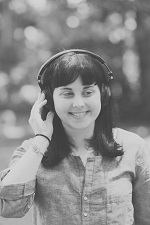
Lara Mitofsky Neuss’ goal as an artist is to foster a community of acceptance through creativity and innovation. She is a member of the Audio Reviews writing team at the International Clarinet Association, is a recording engineer and the Digital Marketing Coordinator at Arts Laureate, and she is the Clarinet Program Manager of the New Works Project.
Bang on a… Gong?: Michael Gordon’s thundering Fields of Vision
By Paige Gullifer
36 percussionists. The expanse of MASS MoCA’s courtyard. One Michael Gordon extravaganza.
LOUD Weekend found its loud.
The culmination of Bang on a Can’s Summer Festival, LOUD Weekend’s kaleidoscope of musical experiences promised noise. But not even offerings of earplugs seemed to quell the sheer force of sound Gordon’s Field of Vision brought to the occasion.
Combining the University of Michigan Percussion Ensemble, and the So Percussion Summer Institute, under the direction of Doug Perkins, Field of Vision began imperceptibly.
The audience, busy wandering between rings of percussion constructed around the courtyard, were slowly surrounded by a growing wash of ambient sound, as the percussionists, waiting among the crowd, strode to their instruments one by one.
While Field of Vision began with floating ambience, it quickly rose to a clamour. The open air did little to dispel the cloud of sound, which bordered on deafening. Sound waves rattled the neighbouring windows, and water stirred in people’s drink bottles. The asphalt, warm underfoot, trembled.
The inescapability of Field of Vision was almost overwhelming. The audience couldn’t just step outside for a moment. They were outside, and this outside’s very foundations were quivering. And when the first bass drum strike rang like a gunshot, the audience’s reaction was visceral: a collective flinch.
While the sheer volume of sound was unnerving, so too was its transience of location – volume fluctuations flowed like waves through the courtyard. Gordon has long been fascinated with the idea of constructing stereo effects from acoustic instruments: ‘The basic idea of this piece is that no two instruments are at peak volume at the same time, instead volume is traded across the ensemble.’ The resulting swells of sound resemble the panning effect of a set of headphones: sound that is three-dimensional.
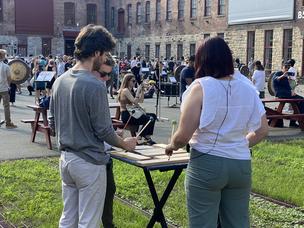
Earlier this week, the work debuted at Caramoor’s Sunken Gardens in Katonah, New York. The garden was a far cry from the post-industrialism of MASS MoCA’s brick enclave. Although the two locations differ massively, Gordon and Perkins eagerly anticipated the change of location: ‘We were talking about when it gets here (to MASS MoCA) it’s going to be absolutely amazing. It sounded the same, it’s still the same piece, but it’s really not the same, the sound was just so incredible,’ said Gordon.
MASS MoCA, a converted factory space, complemented the percussion instruments. Among the more standard bass drums and gongs, recycled junkyard materials formed the basis for more unconventional instruments. Aluminium sheets, cut from the discarded waste of automobile production, and car brake drums found renewed life as instruments. The brake drum has been used repeatedly in other works, often struck by a hard mallet to produce an intense ringing. In Fields of Vision, softer mallets were rolled against them to produce a long-lasting resonance. This gradually exposed the brighter tones of the instrument, and as the work progressed the range of metallic overtones increased beyond the opening low rumble.
As a stark contrast to the metal, the midpoint of the piece included flimsy sticks, held aloft and shaken in a bundle. ‘At that point we needed something organic, something you could find,’ Gordon said. The performers, who walked through the audience from one station to another, looked skyward, absorbed in ritual. After a soundscape of sustained ringing, the brittle chatter of sticks was refreshing. It was only a brief departure, as ultimately the everlasting quality of metal prevailed.
Gordon noted the powerful quality of these metal instruments: ‘To me, aurally, there’s something cleansing about this sound; it’s not a highly refined sound, like you might get with someone playing a violin who has really worked to purify their sound, and it’s not an artificial sound… it’s very natural.’
But this eclectic instrument palette provided some compositional challenges. ‘If a composer is writing a piece for orchestra, they know what strings sound like,’ he continued. ‘They know what winds sound like, they know what everything sounds like – with this, I really didn’t know.’
To find out, Gordon spent some time with the University of Michigan percussion ensemble. Invited by Perkins, the Director of Percussion, Gordon was able to experiment with a surplus of students and instruments, ‘We put people here, we put people there, we just started experimenting. It was a very organic development. I never quite had 36 percussionists to play with, usually 18 or 20, so the final work was really something.’
While the scale of the work, both in terms of instrumentation and geography cannot be understated, Fields of Vision’s conclusion was unexpectedly poignant. Melody had scarcely been glimpsed among a powerful array of textural layering, until the final cloud of sound began to dissipate. As quiet settled, a simple melodic line was spelled out in gong tones. After sixty minutes of unrelenting pandemonium, the effect was immediate: some audience members, who had spent the large part of the hour with their fingers in their ears, slowly withdrew them, opening up their senses to the world again.
Paige Gullifer is a writer and saxophonist based in Sydney, Australia. Paige is currently completing her Bachelor of Music Performance at the Sydney Conservatorium of Music, and is an active writer around Sydney, having been published by organisations such as Limelight and the Adelaide Symphony Orchestra.
The Versatile Bang on a Can All-Stars
By David Ainsworth
Mark Stewart recalled the music he has played with the Bang on a Can All-Stars as he sat down for an interview Saturday night at MASS MoCA.
Bang on a Can “has probably commissioned about 250 pieces for the group,” Stewart, a co-founder of the band, explained. “It’s a huge variety.” He added that the compositions consist of almost all kinds of music in the world today.
One of the missions of the New York-based contemporary music organization Bang on a Can is to go beyond specific genres. It’s about exploring and experimenting, and the willingness to be open to new ideas. The All-Stars are a crucial embodiment of this philosophy. Since their founding in 1992, the Bang on a Can All-Stars have been performing music with several influences, including classical, jazz, avant-garde, and rock.
“The repertoire is all over the place,” said Robert Black, another co-founder of the All-Stars. “It’s everything.” The band has played repertoire from a variety of artists, including Tyondai Braxton, Ornette Coleman, Brian Eno, Philip Glass, Michael Gordon, David Lang, Steve Reich, and Julia Wolfe. Black added that the All-Stars have also branched out into the rock world, working with the band Sonic Youth.
The mixing and melding of genres were prominent during their performances Thursday and Friday.
On Thursday, the All-Stars performed Steel Hammer, a piece composed by Wolfe. It kicked off LOUD Weekend, a music festival in North Adams, Massachusetts, that showcases music of multiple genres, including classical, jazz, rock, avant-garde, and everything in between. In addition to the main band, the All-Stars were joined by vocalists Rebecca L. Hargrove, Sonya Headlam, and Molly Netter. The song “is a meditation on over 200 versions of the John Henry ballad,” according to Julia Wolfe’s explanation on the Bang on a Can website.
Perhaps the biggest stars were the vocalists. With their striking voices, they were able to give a rousing interpretation of Wolfe’s work. Starting the piece a cappella, they featured beautiful and powerful harmonies.
The piece would not have been possible without the rest of the band, though. Guitarist and multi-instrumentalist Stewart’s banjo played a crucial role. Ken Thomson’s powerful clarinet was backed up by his harmonica. Cellist Arlen Hlusko carried several tones across the spectrum, ranging from very quiet to loud. Vicky Chow played the piano in unique ways, both traditional and experimental. Percussionist David Cossin handled multiple instruments, ranging from xylophone to a powerful rock- and jazz-influenced drum set. All the while, Black held down the fort with his bass.
Like many other pieces at LOUD Weekend, Steel Hammer showcased other instruments that were not just the ones the band primarily played. For instance, foot stomping was featured, and Stewart’s mountain dulcimer brought sonic variety to the show.
The All-Stars were the brainchild of Michael Gordon, David Lang, and Julia Wolfe, all of whom co-founded Bang on a Can in 1987. They were looking for musicians to play some compositions they programmed.
“The reason they formed the band, they had this idea of a repertoire ensemble and they picked the six players they thought would best represent the aesthetic,” explained Stewart. Another goal, he added, was to spread the word about contemporary music.
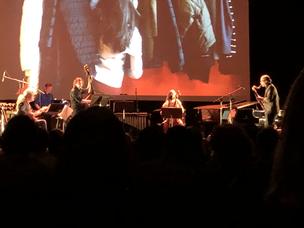
On Friday, the All-Stars returned to the stage with Can Dance, a concert where works from various composers partnered with films. The concert highlighted many styles and themes. Turistas by Angélica Negrón, for instance, drew on numerous Latin rhythms. It was featured with the film Kookik, which celebrated an immigrant family. With or Without Card by Henry Threadgill, meanwhile, had more of a jazzy sound. It accompanied the film Split Womb, with figures moving to the swinging and sometimes chaotic music throughout. The film The Burglar, which followed a happy man dancing, complimented Trevor Weston’s jaunty and jubilant composition Dig It. The piece featured lots of variety, ranging from joy and excitement to slow and soothing passages as the man begins to calm down, if only for a brief moment.
Julia Wolfe’s intense composition, Into the Clouds, matched the mood of Andrea Miller’s film. The song’s hard rock beat, powerful drums, and a quivering bass made it one of the highlights of the show.
After these pieces and more, the set concluded with David Lang’s Interstate, featuring a film by Annie-B Parson. It embodied people’s desire to enjoy life and have fun. With an upbeat mood expressed by dancers in colorful clothing, this was a satisfying ending to a great show. Can Dance, along with Steel Hammer, both showed the All-Stars’ knack for performing music of multiple genres with ease.
With these shows complete, Black was excited about how the next generation of composers will influence subsequent aspects of the band’s music. In addition, the band’s lineup has changed over the years, bringing in a new generation of All-Stars.
“The repertoire is going to keep evolving as you see new composers come along,” said Black. “There’s always a new group.”
David Ainsworth is a musician and journalist based in Oregon. He has a Bachelor of Music in Jazz Studies from Portland State University and a Master of Science in Journalism from the University of Oregon.