Dispatches From the Bang on a Can Summer Festival 2022: Part 6
Art and Atmosphere Inspire Petite Premieres by Bang on a Can’s Composer Fellows
By Emma Bauchner
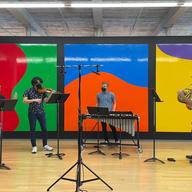
“Your presence fills the room,” Pulitzer Prize-winning composer David Lang proclaimed to a small audience that had gathered in the MASS MoCA’s Sol LeWitt galleries. The line was delivered theatrically—complete with emphatic hand gestures—and with a sincerity that felt ever-so-slightly feigned; it was subtle, but there was a hint of irony lurking behind it. Just as the words left his lips, the violinist, vibraphonist, and french horn player who stood beside him catapulted into a dissonant, syncopated phrase, almost like a dance gone wrong. In other settings, the bizarre melody might have felt cold and uninviting, but in front of LeWitt’s brightly-colored wall drawings, it was humorous and playfully off-kilter. Suddenly, the players came to a stop. There was a brief second of silence before Lang delivered another line: “my dog loves you!” The audience erupted with laughter.
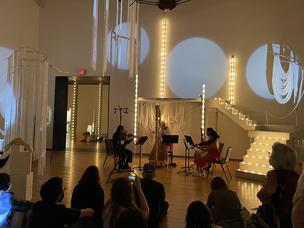
Udi Perlman’s “Compliments” was one of six pieces that premiered last Wednesday during week three of the Bang on a Can Summer Festival, in an afternoon recital simply titled “New Short Works.” The six composer Fellows, who were also set to premiere longer works at LOUD Weekend, had been given just two weeks to put these pieces together.
Some parameters were provided: the pieces were to be 3-5 minutes in length, and would be scored for trio. The composers got to rank their choices from three unique combinations of instruments: violin/vibraphone/horn, voice/violin/cello, and viola/bassoon/harp. Not everyone got their first choice, but each composer was able to find inspiration in these unusual groupings. “They all have different ways of blending and juxtaposing,” explained composer Samantha Wolf. “A trio is really interesting because it's exposed, but also an ensemble context. So it's fun to think about how to play with that. Like how much you want it to sound like an ensemble versus a collection of soloists.“
The project became further focused when one of the composers had a suggestion: “I sort of prompted the idea that we should write it in a specific gallery and have it played in that gallery,” said Yaz Lancaster. That idea immediately appealed to their peers, many of whom were already feeling invigorated by the museum’s formidable collection of contemporary art. “Coming in on the first day, we were taken on a tour through MASS MoCA,” recalled Wolf. “The level of stimulation was incredible. Just seeing everything and getting a sense of the grandness and scale of the place really fired up some synapses.”
Lancaster was interested in one artist in particular: “I've always liked Jenny Holzer,” they explained. “A lot of my work too deals with the politics of everyday life, and how everyday interactions have political undertones.” Several of the neo-conceptual artist’s works had been on view when the fellows arrived at MASS MoCA; Lancaster was particularly struck by Holzer’s use of text, which planted a seed for them to incorporate “singing…or screaming.”
But when it turned out the Holzer exhibition was set to close before the works would premiere, Lancaster had to adapt. Their piece continued to evolve as they opted to respond to space on a more macro level. “I'm almost always thinking about the space that my work is going to be shown in, but not in an acoustic sort of way,” Lancaster explained. “For this project it was like, we're in an institution. I'm not sure how much a ticket costs to get in here, but I'm aware that only certain people can come see the work. So having something that was very blatantly anti-capitalist and anti-institution just felt right to me.” Sticking with their impulse to work with text, they turned to one of their own poems, “Prime.” Its closing lines—“i don’t understand / why we all pay so much / just to live”—packed just the punch they were looking for.
Lancaster was also inspired by their assigned instrumentation, but not in the way one might expect. “One thing I was thinking about was that people associate the harp with really pretty, delicate music,” Lancaster recalled with a grin. “And I just thought, I need [harpist Melissa Achten] to scream. I think she has to.” The harrowing, repeated cry of “WE PAY SO MUCH,” screamed by Achten directly into the strings of the regal instrument, was one of the recital’s most memorable and strikingly topical moments.
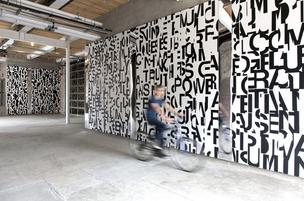
Lancaster wasn’t the only composer who was drawn to text-based art. “We had our first week of composition seminars in the back of MASS MoCA, where a text-based mural covers the walls,” recalled Wolf, referring to Mary Lum’s Assembly (Lorem Ipsum). “I remember being in that space for a few hours every day and slowly contemplating the mural around me, realizing I could make specific words and letters out of it. And then through a lot of talk about text in seminars and in the pieces, I realized that actually this could be text, this could be musical. This could be sonified in really interesting ways.”
Feeling inspired, Wolf recorded herself trying to read the mural’s hodgepodge of spliced letters; to create her work “lorem ipsum (a very structured chaos),” she attempted to transcribe that recording for her assigned instrumentation of voice, violin, and cello. In Wednesday’s premiere, the strange collection of syllables flitted between all three performers—some whispered, some sung, and some articulated by jagged motifs from the strings. The resulting popcorn texture aptly echoed the mural on which it was based.
In addition to visual art, the composers found themselves surrounded by another source of inspiration: the musicians they were working with. This was particularly true for Erika Dohi, who found a muse of sorts in the voice of Icelandic singer Þórgunnur Örnólfsdóttir: “When I met Þór and heard her speak, I just thought she had the coolest accent,” she recalled. Dohi had already been toying with the idea of generating text from a striking dream she had of a friend tracing a spider web; taking a chance, she asked Örnólfsdóttir to translate the dream into Icelandic.
The language was brand new to Dohi, but she found its natural rhythms and inflections sang a melody to her that jumped off the page. “It kind of rhymes–-it was really inspiring, actually,” said Dohi. “We had a very short time to write these pieces…I was in the hotel room, listening to the accent and coming up with this melody. It was fun.” The melody, sinuous and hypnotic, was woven like a spider web around eerie harmonies from the cello and violin, drawing listeners into the mysterious world of Dohi’s dream.
Perlman’s “Compliments,” too, was inspired by the mix of art and individuals he encountered at the festival—but he didn’t realize that until after the fact. “Sometimes when you write a piece, you have a very clear idea of what it's gonna be—it almost writes itself,” he explained. “This was not the case for this piece. I kind of just tried out things and wrote a bunch of music and was like, what is this? What does it do?”
Perlman had been spending time in MASS MoCA’s sprawling Sol LeWitt galleries, which cover three floors of one of the museum’s central buildings with the artist’s unmistakable wall drawings. Perlman immediately sensed the parallels between LeWitt’s multifaceted take on minimalism and the musical language of Bang on a Can’s three founders—Michael Gordon, David Lang, and Julia Wolfe—who are often associated with the post-minimalist movement in contemporary classical music. “The first weekend, I went with a few friends to walk through [the galleries]. And we were saying, it's kind of like the history of minimalism in music, in three stories,” he recalled. “Seeing it here while being at Bang on a Can with the clear minimalist influence, there was lots of resonance.”
Perlman found himself particularly drawn to LeWitt’s “complementary colors,” the informal name given to two wall drawings: 852 and 853, displayed side-by-side in the galleries. Taken together, the drawings consist of three pairs of complementary colors—red and green, blue and orange, and yellow and purple—each filling a square outlined in black, meeting on a wavy axis. Choosing this wall as the location for the performance, a humorous play-on-words occurred to him. “I was considering the complementary colors thing and then thought, wait, compliment? What if they just say compliments?” he recalled. “I didn't really think too hard about what it might mean…I literally Googled ‘compliments’ and started experimenting.” As he rearranged phrases and inserted pauses in the music to incorporate the compliments he had found, the terrain of his piece continued to take shape. “It had been a musical idea, a harmonic idea, basically,” he said. “But then once the compliment idea was in place, it kind of just locked everything in.”
There was just one question left: who would deliver these compliments? Perlman initially experimented with the three musicians saying them to each other, but eventually thought of his teacher, David Lang. “David has some speaking parts in his own pieces,” said Perlman. “So I asked him if he would be willing, and he said, ‘Oh my God, yeah,’” recalled Perlman with a chuckle. “He said, ‘I love performing, but I never have a reason to do it.’”
“I never would have emailed him about it, though,” Perlman admitted. “It was the kind of thing that only happens here.”
Emma Bauchner is a New York-based writer, radio enthusiast, and music lover. She studied music at Vassar College and currently works as a programming coordinator at WQXR.