Dispatches From the Bang on a Can Summer Festival 2023: Part 1
Shiri Riseman’s “Oho Ayayay” grapples to find the right words
By Brooke Knoll
How do you communicate when you don’t have the words to express yourself?
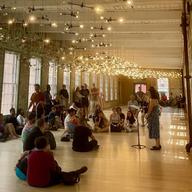
That’s the question that Shiri Riseman asked herself when writing her work “Oho Ayayay” for solo voice. The composer and Bang on a Can Fellow performed it under the twinkling lights of the Finch Gallery at MASS MoCA with an audience seated on the floor around her.
What came out of her mouth, however, were not words.
She started with low, almost guttural noises: an “oh” sound, much like seals barking. When reaching the upper register of her voice she switched to an “ay” sound. At times she sounded like a flock of seagulls, and in other moments like the strained voice of a toddler. Her voice soon reached a fever pitch, bouncing around frantically, anxiously, before turning into a low growl.
Even though there weren’t any distinguishable words during her performance, it was clear she was trying to tell a story. Through her articulation, Riseman expressed moments of frustration, joy, and even fear. She was desperate to communicate with the audience how she was feeling even though they could not speak her “language.”
One of Riseman’s earliest memories inspired this piece. “It’s actually the first song I ever sang,” she admitted in a later interview.
As a young child growing up in Israel, she remembers seeing a political ad on TV during election season. While her family didn’t agree with the views of the ultra-Orthodox party that ran the ad, the melody of its anthem stuck with her.
She can still chant the “ohs” and “ays” of the original tune, which she used as the basis for “Oho Ayayay.”
Riseman often finds herself drawn to more primal forms of expression in her composing: gibberish, babbling, and made up words. Her 2019 piece “Shliglugim” for four voices uses nasally, swooping sounds that sound like a conversation between bickering family members. Even when she composes for other instruments, she tends to “vocalize” them.
Being at a loss for words can happen when we feel heightened emotions, are put in an uncomfortable situation, or are presented with unexpected information. As children, we have no choice — we are not equipped with speech to help us connect with our world. Riseman doesn’t want us to forget about that period of our lives.
“I make music that says ‘I wanna say something but I don’t have the words’,” she said.
“I just want to say something.”
Brooke Knoll is a contemporary harpist, radio professional and digital marketer based in Kansas City, Missouri. She is an active improviser with the Extemporaneous Music and Arts Society and is an on-air host for Classical KC.
I Accidentally Joined an Orchestra
By Gray Harrison
I stood uncertainly in front of a man named Jacob as he held between his fingers a reed I had just been told to “wet.” He was attaching my saliva-soaked reed to a mouthpiece with tape, while I, confused and embarrassed, held a human-length strip of PVC piping in my other hand.
As a media Fellow at Bang on a Can at MASS MoCA, I was aware that I would be reporting on the festival, but not that I would be part of an orchestra, or that I would be performing an original piece with this orchestra in four days.
It was a little after 10 a.m., and the blue sky warmed our backs. I had followed a swarm of musicians and composers whose names I didn’t know out to a brick building called “The Chalet,” where we seated ourselves in a wide circle facing each other. Then our conductor, Mark Stewart, led us outside. Founding guitarist of the Bang on a Can All-Stars and longtime director of Paul Simon’s band, Mark leads the Orchestra of Original Instruments (affectionately known as O of OI) every summer with the Fellows. He instructed us to pick out a mouthpiece, a reed, and an instrument of choice, which was either a PVC pipe or a black bendy coiled pipe.
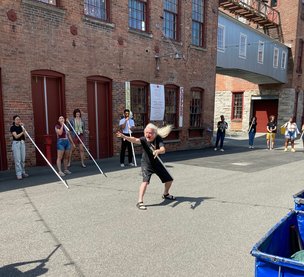
My instrument now fully constructed (thanks Jacob), I blew into it. The elephant bellow that erupted out of the other end made me jump. I’m a writer who identifies with the cats that sneak into my backyard, preferring to observe from behind trees and make as little sound as possible. Here I was making a gargantuan noise, joining the riotous symphony happening around me.
I discovered through trial and error that if I compressed my mouth tighter around the reed, it would make the sound of a fog horn, and if I let in more air, a higher-pitched squeal. But within these basic rules there was much deviation. The sounds that came out were unexpected, unplanned, and thrilling.
We broke into quintets and sextets and were given five minutes to write a thirty second piece. Our group began in a circle, making a succession of slow whole notes, and with each rotation of the circle, we doubled the speed. When it got too fast to make sense of, we let loose into a whirling mess of sound.
Five minutes had passed. It was time to perform our piece in front of the others. I watched carefully for my turn. Already a beat behind, I blew with all the air in my lungs, but it was silent, except for a sputtering of spit. I laughed for a millisecond, and I don’t know how it happened, but a sound came out. It was a trumpet sound, a flourish of squealing notes. And people cheered.
Mark said to me later that sometimes the sounds that catch people’s attention are made by accident, when you aren’t trying, or sometimes when you’re trying too hard. Despite his professional background collaborating with major figures in popular and contemporary music, his true passion lies in what he describes as a “sledgehammer approach to sound-making,” where anyone, at any age, can learn to make music. It starts with playing around with the simplest of materials. Banging on a can, if you will. As he said that morning, “embrace the skronk.”
On the second day, we added choreography, balloons, and percussion into the mix. As the chaos intensified, so did my childlike joy. “It feels like summer camp,” fellow orchestra member Luciano Medina remarked at dinner. “Mark brings that out in you.”
Mark’s philosophy is that everyone has the right and the ability to make music. Even writers who like to hide.
Gray Harrison is a nonfiction writer pursuing her masters in Cultural Reporting and Criticism at New York University. Her writing usually blends memoir and deeply researched arts criticism.