Dispatches From the Bang on a Can Summer Festival 2023: Part 4
Marc Swanson’s Glistening Elegy
By Gray Harrison
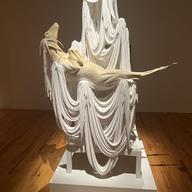
This past week, two figures have haunted me. They are angels made of white drapes, bearing shrouds in their invisible hands. Between them is a Pietà. A faceless Madonna holds a deer, whose head is cradled by a single antler.
These statues are part of Marc Swanson’s multimedia installation, “A Memorial to Ice at the Dead Deer Disco.” The exhibit has been at MASS MoCA since July 2022 and will stay through August this year. Swanson was influenced by Hudson River School painter Thomas Cole’s works that drew attention to the dangers of industrial development to the land. He also draws upon the colossal mourning period among the gay community during and after the AIDS epidemic, as well as nineteenth century depictions of glamour and death.
Upon entrance to the exhibit, a signpost points four ways, hooded in white fabric like a medieval Reaper. Above hang branches dressed in ice-white tassels. A flickering candle lights a mirror on the wall. Inside the mirror is a photograph of a spider clinging to delicate threads.
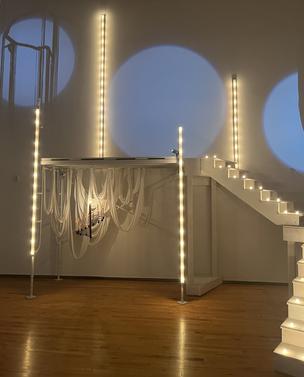
Dance floor lights bejewel an ascending staircase. At the top of the staircase, a spotlight beams on an empty wall. Around the corner, a glittering silver chandelier of rhinestone antlers slowly turns, casting Gothic shadows against blue and yellow disco lights.
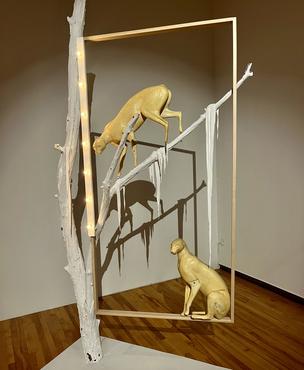
Life-sized animal figurines adorn the exhibit. All of them are eyeless, colorless, and very thin. Two cats on a diagonal branch, lit by a frame of dressing room show lights. A snake with no fangs. An egret hunched wrong. A deer veiled in a white sheet has perked ears– even weighed down by the heavy fabric, it looks alive. On the ground below a wreath of brown roses lie shards of animal bodies and a human hand.
Swanson’s elegy to Earth’s great tragedy has impacted my experience at Bang on a Can. In the warbling notes and playful mimicry in Celka Ojakangas’ piece “dry chuckles,” I heard a celebration of birdcall, and my mind also jumped to future days without it. In Daijana Wallace’s piece “FGBG,” my perception of the giddy scampering and creeping steps of cats was colored by the cold, blank eyes of Swanson’s figurines.
I grew up in the forests of New Hampshire, where I’ve witnessed dwindling populations of monarch butterflies, honey bees, and moose in my lifetime. The New Hampshire Department of Fish and Game keeps a running list of endangered and threatened species in the state. Among them are the common loon, New England cottontail rabbit, Eastern wolf, Eastern box turtle, and shortnose sturgeon.
In early June, I watched, along with millions of other New Yorkers, as the skies turned an ominous orange. People once again donned N-95s and walked uncharacteristically slow between the cement canyons, a tight, heavy pressure on our lungs.
Swanson has remarked that “the two spaces I have felt the most comfortable and spiritually connected are the nightclubs of my youth and in the woods today.” Yet these same spaces are also burdened with the monstrous tragedies of AIDS and climate change. While at MASS MoCA, I have felt both the communal jubilance of music-making, and have grappled with challenging feelings about endangered communities, human and nonhuman.
I went on a hike with my siblings the day I arrived in the Berkshires. My brother and I agreed that sometimes the only way to handle climate dread is to make an ironic joke about it and move on with the day. It’s too troubling to speak about. But Marc Swanson makes you linger, and every once in a while, lingering is essential.
Gray Harrison is a nonfiction writer pursuing her masters in Cultural Reporting and Criticism at New York University. Her writing usually blends memoir and deeply researched arts criticism.
Nolan Hildebrand Makes “Noise” at MASS MoCA
By Isabela Gamez
Nolan Hildebrand’s connection with music started with the loud clash of a drum kit.
Growing up in Manitoba Canada, the weather was very cold and he needed an indoor activity to pass the time. The drum kit kept him occupied and gave him a way to express himself. “Coming from a drum kit perspective has given me my affinity for noise music,” said Hildebrand. “It shapes the way I think about music: rhythm and noise as opposed to being pitch centric.”
Metal as a genre was his “first love” and eventually led him into the style known as harsh noise. He was inspired by Merzbow, an influential music project started in Tokyo, Japan in 1979 by Masami Akita who Hildebrand called, “the granddaddy of Harsh Noise music”.
His passion for noise eventually led Hildebrand all the way to the Bang on a Can summer music Festival. He previously found his way to New York to present his music and research at the National Student Electronic Music Event and the CUNY music conference for graduate students. He is attending as a BoaC composer fellow where his piece “knurl cracked green” was performed on Wednesday in the MASS MoCA galleries.
The instruments in the ensemble were the big inspiration for the piece. Nolan Hildebrand explained that he desperately wanted a piano to be used in this piece, because he really wanted to use the scraping of the piano sound and the electric guitar. He wasn’t sure if there would be one available for the performance. He said he was, “waiting in limbo.” Once he got confirmation he knew exactly what he wanted to do. Madeline Hildebrand (no relation) took her hotel keycard to scrape strings in the piano, it felt harsh and scratchy. Mark Stewart screeched frantically on the guitar while Carina Yee grated the bow across her violin strings.
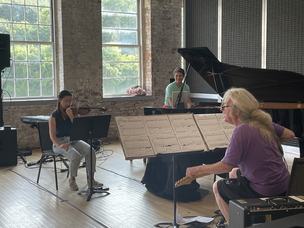
The word “Knurl” was inspired by the name of a noise project of a Canadian experimental composer by the name of Alan Bloor. The green part of the song refers back to another of Hildebrand’s pieces called “Cracked Green.” The imagery of the color was to represent something disintegrated and moldy.
Once the piece started, Hildebrand never sat down. He stood in front of the audience conducting the entire time in order to make sure everyone was where they needed to be in the piece. He said, “I kind of have a hard time focusing on listening, because I’m trying to make sure that I feel like I’m more of a part of the performance.” The performers created an intensity that kept the audience engaged during the entire performance. They played with gritty passion and each was in tune with each other. They signaled each other's entrances and exits with their instruments.
“I thought of these instruments as sound objects and wanted to create interesting noise, because yeah, I really like noise.”
Isabela Gamez currently studies at the University of Arizona majoring in journalism and minoring in Spanish and Mexican American Studies. She previously interned at the Digital Futures Bilingual Broadcast Studio and Arizona Public Media. She is active in the reporting of
social justice issues.
How do you compose a song? Bang on a Can’s Composer Fellows reveal their approaches
By Brooke Knoll
When you set out to bake a cake or build a piece of new furniture you’re given a roadmap in the form of a recipe or instructions. When you set out to compose a new piece of music, however, there isn’t anything to help you build a song from scratch besides the knowledge within you.
I sat down with a few of Bang on a Can’s Composer Fellows at dinner on Wednesday night to pick their brains on their own composing processes. Earlier in the day, I heard short works for trios that each of them had composed during their time at the Summer Festival.
“Three days before the Festival started we were told ‘okay, here’s your ensemble,’” Fellow Nolan Hildebrand explained to me. Earlier in the summer, they were presented with a few different options for instrumentation. While they were able to indicate their preferences, the ensemble they were ultimately assigned was a complete surprise.
For Celka Ojakangas, that was the fun part. “I knew there was going to be one ensemble that someone didn't want to write for, as much.” When looking at the list of options, she immediately gravitated to the trio for bass, saxophone and accordion. “I was like, ‘I'm gonna do that one.’”
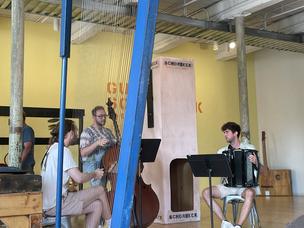
She laughed as she told me how freaked out she was by the daunting task of composing for accordion. “I was like, oh, man, I need to know everything about accordion. But we only had so much time.” The lack of time and preparation had her choose a direction, quickly — and she leaned into it.
“It became so dorky. Like, you know — I definitely got some strong dinosaur vibes at the beginning. It just felt like a giant walking in the distance or something.”
The inspiration for Shiri Riseman’s piece came before even getting the instrumentation. After taking a break from composing for a while, she knew she wanted to write something inspired by ragas, a family of scales used for improvising in Indian classical music.
“It was a good opportunity to experiment with it, you know, bring back something that I had put down,” she noted. Her piece “Sing II” was written for piano, guitar, and voice, and I could hear the lilting, wavering motifs that inspired it throughout.
Once receiving the ensemble configuration and knowing how much time he had to compose, Fellow Jacob Ridderberg felt comforted by the time constraint. He told me how that limitation helped his composing: “Sometimes, when you have, like, an infinite amount of time, you spend a lot of time trying different stuff out, and then potentially that also results in a piece that's more fragmented, or there's a lot of different moving parts.”
Although each Fellow faced different challenges and outlooks when composing throughout their time at Bang on a Can’s Summer Festival, they all told me how much they loved working with the musicians.
“I think that's really what inspires me to write a lot of music,” Ojakangas admitted. Her piece “dry chuckles” was a result of getting to know the Musician Fellows over the course of three weeks. “Often the people that ask me to write for them also like funny, fun things. We're trading humor.”
“It's always nice to get a feel for what people are interested in when you're working with them,” Ridderberg added. “That often results in a better piece overall and a better performance
Brooke Knoll is a contemporary harpist, radio professional and digital marketer based in Kansas City, Missouri. She is an active improviser with the Extemporaneous Music and Arts Society and is an on-air host for Classical KC.