Dispatches From the Bang on a Can Summer Festival 2024: Part 3
The Bang On A Can collective, which has championed new music since 1987, decamps every summer to MASS MoCA, the vast complex of former industrial buildings in North Adams, Massachusetts that now houses one of the country's largest contemporary art museums. Since 2002, Bang On A Can has hosted Fellowship programs for emerging composers and musicians - a way of allowing a younger generation of creators and performers to essentially grow up together. This year, they have once again included a Fellowship program for aspiring music writers, and invited me and the radio host/music scholar/pianist Terrance McKnight to serve as the faculty.
This week, we are reporting back from the Berkshires with a new batch of writing fellows. You’ll get their impressions of the concerts, rehearsals, and unusual concert settings they're experiencing. It all leads up to the big event this weekend - Bang On A Can Summer Festival's LOUD Weekend at Mass MoCA -a "fully loaded eclectic super-mix of minimal, experimental and electronic music," (massmoca.org). Follow our writers, Elizabeth Derner, Jurgis Kubilius, Leona Oliveros, Maddy Briggs, and Stephanie Manning as they follow the musicians and composers who may be the next generation to change the sound of contemporary music. -John Schaefer
Performing with the Sky
By Maddy Briggs
The air was thick with heat and music when Montreal saxophonist Thomas Gauthier-Lang burst into his set at MASS MoCA’s Skyspace with a furious flurry of notes. The room was flooded with muted red light and a storm of sound.
“Every time I improvise, it feels like I’m becoming more and more myself,” he said. “It feels like I meet myself again. I have physical reactions before I play, but there was something more visceral there before I performed in the Skyspace. When I started, it just stopped. It felt like home. I was very happy.”
Gauthier–Lang’s performance was part of a lunchtime recital for Bang on a Can’s Summer Festival, as one of this year’s young Fellows. It was hosted within James Turrell’s Skyspace; a large, circular building with a cut-out in the centre of its roof through which to view the sky as part of a visual art installation. As the colours cast on the walls begin to change, so does, seemingly, the colour of the sky. Within its walls, sound behaves in unusual striking ways as it bounces off every surface.
Performers and composers have been at the museum for the better part of three weeks, preparing for the Festival’s annual LOUD Weekend over 1–3 August. “If I could summarise my experience at the Bang on a Can Summer Festival, in one sentence, it would be: if you think you’re giving yourself permission, give yourself even more. My improv was the result of that mantra,” said Gauthier-Lang.
The saxophonist had never performed in the space yet; the venue and its unique voice was something he had to investigate live, in front of his audience.
“I saw the circular pattern in the room, and I just wanted to walk around it, and that absolutely changed the sonic experience for me,” Gauthier-Lang explained.
“And I like the idea of obsession. This walking was reflecting this obsessive thought; and the way I’m playing – there’s parts that reoccur, but never in the same way. I felt like the Skyspace could serve as a vector of this intention. It amplified every intention I had.”
This spiralling obsession raised its head in Gauthier-Lang’s improvisation in a multitude of ways. Circular breathing, a technique which allows a wind player to play continuously without stopping to breathe, means that he doesn’t need to break away from the performance to come up for air. He clogged the room up with repetitive, rapid trills, and began to sing; eerie and gravelly when filtered through the instrument, the sound cut over the top of the tangle of notes.
Halfway through Gauthier–Lang’s performance, the roof of the Skyspace opened up, almost as if he’d summoned it. Accompanied by a rush of cool air and natural light, the mechanical drone of the movement was a surprisingly musical pairing with the improvisation.
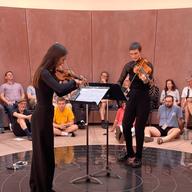
The change in the Skyspace also set a radically different stage for the performance of three movements from composer Justin Wright’s If Two Could Travel as a Particle of Light, performed by violinist Lora Kmieliauskaitė and violist Ella Beard as the recital’s gentle closer.
“Justin’s piece wasn’t going to work in a different space,” said Beard. “It had to be there. We weren’t looking for any other place. That was the question: just, ‘When?’”
Originally written to be performed at Wisconsin’s “awe-inspiring” Yerkes Observatory, the second-ever performance of Wright's work found a natural home in the Skyspace. Under a bed of whispery harmonics, plucks of the string get an immediate reaction from the space; long notes are softened and drawn out.
Wright’s piece was a heavy contrast with the dazzling fury of Gauthier-Lang’s improvisation. Beginning with scratchy, airy strings that evolve into a delicate, rapid-fire flow of notes, the music traces the intertwined journey of two particles of light across the universe. Before particles leave a star, Wright noted, they spend time bouncing around inside it, “kind of like a machine”.
If Two Could Travel as a Particle of Light invites both performers into a setting in which they can develop a beautifully tight rapport with one another; that connection is embedded into the fabric of the piece.
“There’s three ways of listening in that performance,” said Kmieliauskaitė. “There’s listening to your own sound, listening to your colleague, and then listening to the room.”
One of the techniques Wright had written, Beard calls ‘chaos fingers’; it’s hard to perform, but produces a non-uniform, fluttering effect that adds a randomness and texture to the music that feels like it supersedes the capabilities of just one instrument.
“It sounds like a chamber orchestra, to be honest,” said Kmieliauskaitė. “One instrument plays harmonics, the other plays normal notes, and everything comes together in a very nice chaos.”
Like Gauthier-Lang, Kmieliauskaitė and Beard found an unintentional performance partner in the environment around them – a passing plane, the soft twitter of birds and the rhythmic hammering of nearby construction; several audience members had remarked that the latter had actually worked with the performance.
Gauthier-Lang described the sound of the Skyspace as ‘otherworldly’. The room barked back quickly at any percussive sound he would throw into it – sharp clicks of his keys, any smacks of his reed, were all met with tight slapback. The inclusion of voice into his performance, at the same time as playing, was a very personal element for the performer.
“I’ve been trying to incorporate my voice into my music in a way that pleases me. As a queer person, my voice has often been the butt of the joke or the reason people would bully me, because they hear it as something feminine,” he explained.
“I wanted to use it in a space like this. I gave myself permission to use my real voice in that space, and it felt very empowering because of the way I could hear myself there; I could hear how beautiful it was.”
Gauthier-Lang, Beard, Wright and Kmieliauskaitė all come away from the Skyspace performance with aspirations to record within it; the experience of creating music under the domed sky, for all, was something transformative.
Maddy Briggs is an electroacoustic composer and writer. She joined Limelight as Staff Writer in 2022. Her work has been featured in VIVID Sydney, the International Electroacoustic Music Festival and on BBC Music 6.