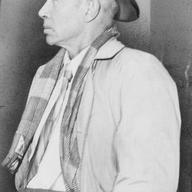
e. e. cummings
Synesthesia, the automatic, involuntary experience of one of the five senses overlapping with another, is one of the more curious quirks of the mind - for Vladimir Nabokov, the french letter “a” drew the color of “polished ebony"; for others, the word “moonlight” might dissolve on the tongue with a felt tinge of sweetness; or the number 9 may strike one’s field of vision on the arching march of a number line. It’s unclear whether e. e. cummings, featured here in a broadcast that aired shortly after his passing in 1962, was among the .25 to 4% of the population who experience synesthesia, but people have not unreasonably read into his work a link between the visual and the verbal. If this is a tangent you’d like to pursue, here, let us get you started. Regardless, synesthesia is an alluring phenomenon, the kind of thing that can elicit envy in some, fascination in others, and inspire the purchase of hallucinogens in both. But it bears considering that you’re experiencing something very close to it right now, just by reading this sentence.
In reading, as with synesthesia, one sense, sight, calls forth another, hearing, instantly and effortlessly - direct and unbidden. It’s something we learned, yes, but is now so deeply ingrained that it feels close to instinctual. Much has been written about the implications of reading and writing on the mind, most of it covering its two most dramatic historical events - the evolution of the alphabet in ancient Greece, and the invention of the movable type printing press as Europe awoke into the renaissance. The orality and literacy dichotomy coincidentally hit the public consciousness most deeply in the year of this recording, 1962, sounding out from the Toronto School with the publications of Eric Havelock’s Preface to Plato, a book length study of the rise of literacy in Athens and Plato’s puzzling banishment of the poets, and Marshall McLuhan’s Gutenberg Galaxy, which made an excited case for the great change begat by the print revolution.
Following this tradition, the more recent (and more-levelheaded) literacy theorist David Olson has remarked that “the history of reading is largely the history of attempting to cope with what writing does not represent.” From this single simple invention, the written word, and this single attendant struggle to cope with its failures, he argues, are born two often antagonistic cultures - with a drive towards single definitive readings of the written word, science; and in the search for a richer reading of inward states, literature. And from this, I’d add, we have an interesting place to consider cummings’ work.
In a sense, writing not only led to science, writing is a science - a quixotic quest for an ever more exact approximation of the act of speech. It is, however, a social science (of a sort) and always has been, defined by high and low use from willing and unwilling practitioners - nothing less than the whole of humanity over the rush of millenia. Somewhere along the line, spaceswereintroducedbetweenwords, then commas, :colons; periods. question marks? Capitalization (parentheses) “quotation marks” ampersands & ellipses… the very marks of cummings’ art. But also tools to describe tone, emotion, and the ever-deepening introspection missing from the written word - the study of the human mind. As Olson notes, these became models for speech and thought as much as or more than the representations of the spoken word they were perceived to be.
We now have ever more refined means of capturing language, not the least of which is recorded sound. The audio file at the top of the page came to us as a 12” “acetate” disc, itself partially borrowed from a 1953 Caedmon Records LP, which we transferred via the digital recording software Pro Tools. Below is a graphic representation of the waveform of e. e. cummings reading his poem “dying is fine)but Death.” Nice, but useless without a means of decoding it.
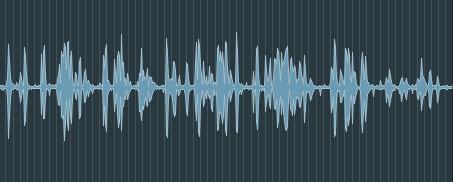
What is left out of this bit of “writing” is not merely a means of decoding it however, but a means abstracting it - a way to let other people read the poem their own way, without exhaustively matching e. e. cummings tone for tone, tempo for timbre, something that is still probably best accomplished by reading the poem as written.
?o
baby
i
wouldn't like
Death if Death
were
good:for
when(instead of stopping to think)you
begin to feel it,dying
's miraculous
why?be
cause dying is
perfectly natural;perfectly
putting
it mildly lively(but
Death
is strictly
scientific
& artificial &
evil & legal)
we thank thee
god
almighty for dying
(forgive us,o life!the sin of Death
If, as Olson claims, the history of reading is a coming to terms with what scripts can’t capture, as scripts evolve, so will reading. In our age, where all scripts have been pared down to 0 and 1, new ways of reading have evolved, and new ways coping. For instance, at my alma mater, The University of Texas at Austin School of Information, there is the wonderful project HiPSTAS, which would use cummings’ and others’ archival digital audio to scan, catalog, and tag every poetic lift, lilt, iamb, and caesura, developing a new grammar of the digital word. On the darker side, consider also the copybots that trawl (and troll) YouTube for copyright infringing materials - a different sort of machine reading, enlisting powerful new technologies.
But writing is an art too - one that e. e. cummings exploited to near its fullest, and, if we may read into his recitation of “dying is fine)but Death” pictured above, one that he felt superior to science. As the host of the 1962 WNYC Memorial program for e. e. cummings tells us, “he made a poetic art of commas and parentheses, and the typographic oddities of his poetry were an expression of his fierce individuality.” True, but his idiosyncratic approach to typography enlists a more standardized typography’s powers and would mean far less without it; he uses them to reconsider not only the symbols themselves, but the very act of writing, and whether its tether to oral expression had become an all-too-exacting mutual leash. cummings’ experiments in typography have been called emblematic verse, figured verse, concrete poetry, shape poetry, figured verse, and versive. He was not alone in using them. American pragmatist philosopher C. S. Peirce called similar works “Art Chirography.” Chirography, as you may know, is the art of handwriting. cummings’ work would be more properly considered “art typography” if it didn’t sound a bit tedious. But then, I suspect he might have found the whole idea of categorizing his art a bit tedious.
At this point one would be tempted to say we should return to the source, let it “speak for itself.” It’s hard to escape the feeling there are two sources though, with whatever the core “poem” might be being bandied about an uncomfortable volley between paper and sounded word. So on the one hand we have cummings’ written legacy, and it’s hard not to grant primacy to it given the “fierce individuality” it represents, flying in the face of standardized typography. But we also have this 1962 recording, which includes no less a figure than e e cummings himself reciting some of his finest work, along with the capable Dave Allen. Some of us will end up envying the rare person who is both illiterate and synesthetic, but for a far different reason than simple fascination over an odd mental quirk - we envy them first for their lack of choice - their experience is inborn and cannot be changed, and is probably often quite beautiful. And we envy them for not having erected written scaffolding that builds the looming Babel of our tottering literate world. So for the rest of us, better both, really - better that we should learn to rest in Keats’ negative capability, toggled between the written and the aural, better that we should find succor in the strengths of what each has to offer, and better that we have the likes of cummings to teach us how.
Track List - Poem (reader):
- dying is fine)but Death (cummings)
- anyone lived in a pretty how town (Allen)
- pity this busy monster, manunkind (Allen)
- all in green went my love riding (Allen)
- *Santa Claus: A Morality (cummings)
- Spring is like a perhaps hand (Allen)
- my father moved through dooms of love (Allen)
- what if a much of a which of a wind (Allen)
- life is more true than reason will deceive (cummings)
- no man,if men are gods;but if gods must (Allen)
Reprinted from E. E. Cummings: Complete Poems 1904-1962, edited by George James Firmage. Copyright © 1956, 1984, 1991 by the Trustees for the E. E. Cummings Trust. With permission of the publisher, Liveright Publishing Corporation. All rights reserved.
Caedmon Recordings of e. e. cummings are used with permission of Harper Audio.
Audio courtesy of the NYC Municipal Archives WNYC Collection.
WNYC archives id: 150265
Municipal archives id: LT9390
*temporarily used by kind permission of Harper Audio. Now removed.

WNYC is funded by sponsors and member donations