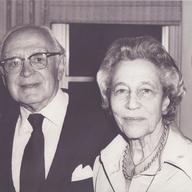
Elliott and Eleanor Sanger
Douglas Cooper and George O’Brien talk with the co-founder and program director of WQXR radio, New York, about Elliott's book, Rebel in Radio.
George, who for twenty years had been night manager at "QXR," noted that it was the fortieth anniversary of the purchase of the station by The New York Times. The couple recalls that the takeover was leaked by Leonard Lyons at the Post, and Eleanor was surfeited with station personnel and phone calls to validate the well-kept secret.
Cooper asked about the first days of the FCC (1934), two years before Sanger co-founded the station with John V.L. Hogan. The author reports that early regulation began under Hoover in the late 1920's, when a high-powered station in Ohio would inadvertently block the signal of a New York broadcast.
Elliott likened the early years to a club or a family affair. He noted that it was a major challenge to get an audience to tune "off-band" to 1560 on the AM dial, so when they later added FM, he made sure to get on mid-dial. We held an exchange about the emphasis on classical music, later adding Gershwin, contemporary (i.e., Rodgers) and jazz.
Elliott stressed the poor technical quality of early AM when the transmitter was on a garage roof in Long Island City and Depression-era receivers were not refined. In league with FCC doctrine, the station's number one rule was that programs be educational or cultural.
An early emphasis of the FCC was to avoid monopoly in smaller towns. Sanger never had that conflict, since New York City had thirty stations and multiple daily papers to avoid concentrated political positions.
It was too costly to derive the station's news from The Times. Only when there was a rare strike did all The Times departments provide news, theater, book reviews. It was a foreshadowing of later years that they utilized the AP and other wire services: the $350,000 to buy The Times' package equaled the cost of running the entire station. Eleanor noted that among her programming responsibilities was to report minority opinion.
Elliott mused over using each personality in many capacities, and getting national news free from the Christian Science Monitor. He was a Columbia University School of Journalism graduate (1917), and was always on call, such as when his phone rang at 4 AM to apprise him of the sinking of the Andréa Doria. He served in the War and worked in advertising prior to his radio career.
Sanger wrapped up by interjecting that he believed the chief value of his book would be in schools of communication, as a means of learning the history of this (then) "new" medium.
_______________________________________________________________________________________________________________
The Douglas P. Cooper Distinguished Contemporaries Collection (1967-1974) contains rare interviews with influential writers, statesmen, artists, songwriters, journalists and others who have left their mark on our culture.

WNYC is funded by sponsors and member donations