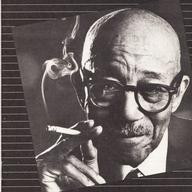
Eubie Blake and the Keys to the Kingdom of Ragtime
This show is part of a three-hour marathon interview of the legendary rag-timer. Eubie was not only a brilliant talker but easily the oldest guest ever on this show. He was born in the 1870s.
Eubie was sprightly, agile, very healthy, and able to climb four flights of stairs with some ease. He was a spellbinding talker in the 19th-century style when speech was the primary entertainment in America. Eubie could initiate the way other people talked too. That was part of his range of virtuoso conversation. He could recreate whole dialogues between people with his uncanny mimicry.
Eubie lived in Bed-Sty in a large house typical of the architecture of 19th century residential Brooklyn. He came from a mixed working-class neighborhood in Baltimore. As a child, he often played with white kids. As part of the demi-monde world of show business even when he was a teenager, he worked everywhere. He was a very worldly man who would have felt insulted if somebody thought him to be of a bottom class or a provincial. He thought little of what he called “slumming.”
Eubie attended many classical concerts with Lucky Roberts, another great pianist, who also wasn't from a bottom class and while playing the piano made a fortune in real estate. Eubie was also a friend of Willie the Lion Smith. It's hardly a surprise that he and Noble Sissle, wrote the songs for Shuffling Along, the first Black musical that presented rounded characters of color who had mature emotions, we're not one step from the cotton fields.
When an adult Eubie went through the arduous Schillinger Musical Method and studied at NYU.
My feeling was the Eubie came from that first generation of Black people who were out to prove from Reconstruction Days they were as good as anybody. It's a ruling premise one can find in many African-Americans of his time including Jack Johnson, Scott Joplin. James Reese Europe and so on. Since he was from Baltimore and moved to New York, he never experienced Jim Crow head-on in all directions all that much. Of course, once is enough. It made him different from younger people of color, many of whom were familiar with subtle ways they could be disdained or dismissed.
Besides that, Eubie was a genius, one of a group with an ad hoc license to make their own rules.
One is going to get a very different sense of Eubie from these tapes than they might have had they seen him publicly. Eubie, like Louis Armstrong, was a performer who often gave the audience what they wanted. That's why both of them were at the top of their profession. If one listens to Louis Armstrong tape made in his Queens home, one is going to see a different Louis Armstrong than the one who was in front of an audience. That was true with Eubie.
Beneath his accommodating exterior, Eubie was a fiercely proud man who knew who he was and wanted to be honored for it. That didn't stop him from being an excellent listener. One time he asked me to play the piano for him. I refused. I didn't want to be embarrassed by my lack of craft compared to him. He was sincerely nonplussed by my refusal.
Somebody ought to revive his complex rags. They are ambitious, in strange keys and reach into classical music for a style that aims to be an American music using folk forms for extended excursions, a direction taken up later more famously by Duke Ellington.
WNYC archives id: 85307

WNYC is funded by sponsors and member donations