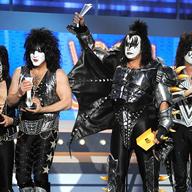
Kiss' Paul Stanley On Being Starchild, Discovering Beethoven And Entering The Hall Of Fame
Last week at the Rock and Roll Hall of Fame induction ceremony, Tom Morello of Rage Against The Machine took the stage at the Barclays Center in Brooklyn to introduce a band being inducted that evening.
"Kiss was never a critic’s band," said Morello. "Kiss was a people’s band!"
In the four decades since the band released its first two albums, Kiss has sold more than 40 million records in the U.S. alone. Twenty-eight of those albums have achieved Gold status, more than any other American band. And their over-the-top on stage performances -- both with and without the makeup -- have made them a touring juggernaut. And in case you were wondering: Kiss is still very much alive and on tour today. This summer, the band will crisscross the country, performing at more than 40 venues along the way. However, only two of Kiss's original four members are still in the band's current lineup.
In an interview with Soundcheck host John Schaefer, Paul Stanley, known to the Kiss Army as "Starchild," talks about his new memoir, Face The Music: A Life Exposed, his first encounter with Gene Simmons, accidentally writing a famous mondegreen, how he stays in shape, and why the band decided to enter the Rock and Roll Hall of Fame.
Interview Highlights
Paul Stanley, on creating "Starchild" and how much that character represents him on- and off-stage:
The two are very integrated at this point, but initially without even being conscious of it I was creating a character to live behind. To this day, that character exists, but perhaps much more comfortably with the me that's off stage. I was born deaf in one ear -- I have what was called a microtia, which is a condition where you virtually don't have an ear. You have a piece of misshapen cartilage. And not being able to hear on one side makes for a lot of vulnerability and a sense of unease.
On connecting with music and discovering Beethoven at a young age:
As a very young boy, music connected with me on a level that I didn't even understand. The emotional connection of any of the arts can be so thrilling and enthralling and inspiring. Hearing [Beethoven's] Emperor Concerto as a kid was monumental to me. It was so majestic and so powerful.... I was very fortunate to be around a lot of music in my house, and what my parents didn't give me, they blessed me with an appreciation of all the arts.
On how Kiss went from being a band to being "more than a band":
The idea was to be the band we never saw. We were living in a time where many bands thought they were doing the audience a favor by showing up. And that's so peculiar because I paid for a ticket! So I'm owed your respect, and the best that you can possibly give me. I expect you to look good, to sound good, and to show appreciation for me. And then I'll show appreciation for you. So in essence, we came out of the audience, grabbed the instruments, and said 'let's show you how it's done.' The look was an outgrowth of that.
On being inducted into the Rock and Roll Hall of Fame:
There's no vindication in it for me. All it is is a certain closure for fans, and I'm pleased for that because it means something to the fans. To people who've championed us against odds, it's a sense of validation. If they understood... what the Rock and Roll Hall of Fame actually is, it doesn't hold quite as much weight. It's a small boys club. It's not the Hall of Fame of the People. That's why when you hear about who's getting inducted, half the time you don't know who they are. Because it's not based on popularity or how much you may have influenced your field -- it's purely based on favoritism and personal interest.