NJ Transit Rail Commuters Face Challenges Above and Below Ground
At its first board meeting since Amtrak released a grim report detailing the post-Sandy conditions of its tunnels, New Jersey Transit officials tried to manage agita about how future tunnel closures might affect commutes.
"We just got the report also," said Ronnie Hakim, NJ Transit's executive director. "We will obviously be having discussions with Amtrak about any scheduled work."
The engineering report calls for closing the damaged tunnels, one at a time, for extensive repairs. Amtrak says it's preparing to close one of the East River tunnels as early as 2016, but won't close the Hudson River tunnels until a new tunnel is built.
(That new tunnel is known as the Gateway Project, and Amtrak hopes to build it in the next decade.)
"I think we'll have some further time to coordinate with Amtrak," said Hakim. "Obviously we have to do whatever we can to maintain an adequate level of service for our customers — notwithstanding the construction work that's going to go on."
NJ Transit uses both the Hudson and the East River tunnels, as it stores some trains in a rail yard in Sunnyside, Queens.
When asked about what she was doing to push for Gateway, Hakim said: "We currently have what I'll loosely refer to as a principals' meeting with Amtrak, the MTA's Long Island Rail Road, and ourselves. I think that will probably be the right forum to have those discussions, in terms of how to prepare and how to plan."
But with no financing in place to build Gateway, and what some are describing as a regional transportation leadership vacuum, commuters are worried. Joseph Clift, the technical director of rider advocacy group the Lackawanna Coalition, has been advocating for a new Hudson River tunnel since Gov. Chris Christie axed an earlier precursor, known as ARC. "And I'm now reduced to begging for a third single-track tunnel as a first step in a much bigger plan," he told NJ Transit's board.
Even without formal tunnel closures, NJ Transit trains often struggle to get in and out of New York. Last month, only 85 percent of trains at Penn Station were on time.
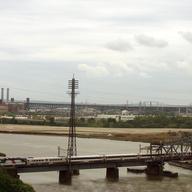
Meanwhile, NJ Transit is facing other pressing issues — like the rapidly deteriorating Portal Bridge, a 104-year-old swing bridge that carries Amtrak and NJ Transit trains over the Hackensack River in Kearny, NJ. "It's the elephant in the room," said Albert Papp, the director of the New Jersey Association of Railroad Passengers. "It is the Achilles heel, the weakest element in the Northeast Corridor." (Other words that are often used when talking about the Portal Bridge include "chokepoint" and "bottleneck.") The bridge, which carries tens of thousands of rail commuters each day, often gets stuck open, or its tracks get misaligned. Due to its age and condition, it's saddled with speed restrictions. There have been fires. But even though design work began in 2011 on a replacement, that project is also dogged by a lack of funding.

WNYC is funded by sponsors and member donations