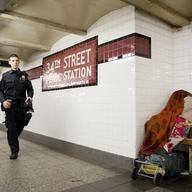
For Police, a New Alternative to Arrests or Emergency Rooms
Police often interact with people who are mentally ill or in the throes of addiction. And their choices for how to respond are limited. Often-times, they make an arrest or transport someone to a hospital emergency room. But soon there will be a third choice — dropping them off at a so-called diversion center where they can get proper help.
For advocates of criminal justice reform, the centers represent a long-awaited merging of public health and policing.
“This is really a paradigm shift of public safety,” said John Volpe, special adviser on criminal justice for the city’s health department. “The health department and police partner in a way to really meet need with the right response, rather than the typical response of putting people through the criminal justice system, which often does little good to anybody and costs a lot of money.”
A mayoral task force first announced the centers in 2014 as a way to reduce the population of mentally ill people in jails. The first center was supposed to open the following year but there were major delays. First, finding a non-profit to run the centers proved difficult because not enough funding was allocated to them. The contracts were then increased. Volpe said finding a place to locate centers was also a major hurdle.
“Finding real estate in New York, you know it’s very difficult,” he said. “It definitely was a factor.”
Last Friday — three years late — the city announced that they signed 10-year leases for centers in East Harlem and the North Bronx. One major hurdle was cleared. But there are more to come, such as deciding whether police should use handcuffs when they transport people, and deciding what sort of behavior falls within that grey area where an officer can choose a center instead of an arrest.
“It’s not felony level. It’s not violence. It’s not identifiable victims,” Volpe said.
He imagined the behavior being more along the lines of a shirtless man running through traffic or someone being verbally aggressive outside a bodega, and the police get called. Instead of a disorderly conduct charge, a person might wind up at a center where medical staff would evaluate them and where a social worker would try to figure out who their last psychiatrist or therapist was, so they can reconnect them to treatment.
The health department says the centers will feel like a hybrid between a “welcoming lounge and a health clinic”. There will be food, a place to shower and wash clothes and offices for medical exams and assessments. The total cost of the program is $9.5 million. Each center is expected to serve up to 25 people at a time, and as many as 2400 per year. Five days is the longest anyone would be allowed to stay. It’s all voluntary, and people can walk out at any time. Staff at the centers are supposed to ensure people get connected to services before they leave. Only police in the two precincts that surround the centers will be allowed to drop people off.
“The plan is to have it a whole lot easier than arresting someone or summonsing them as well as going to the hospital,” said NYPD Deputy Chief Terri Tobin. “We’re going to be very proactive in terms of making sure that all the officers get a walk-through so that they’re very educated about what will happen when they bring someone to the diversion center.”
Tobin said police officers have a front row seat to the dysfunction of the mental health system because they often bring people to emergency rooms, only to see them get released back onto the street without treatment. She believes police will embrace the centers.
Arizona has had these types of centers for 20 years. Tobin and Volpe visited Phoenix to see how they work.
“Someone actually flagged us down,” Tobin said. “I happened to be on a ride-a-long with one of the officers out on patrol and the individual said, 'Listen, can you bring me to the diversion center? I don’t want to be out here.' ”
Nick Margiotta, a retired Phoenix Police Officer, worked on the diversion center program for several years. He said the centers were always full but slightly different from what New York City plans to open.
“They’re open to anyone, not just law enforcement," Margiotta said. "But law enforcement is their primary customer.”
The key to making the centers attractive is to make the hand-off between police and health-care providers simple, Margiotta said.
“If it’s seamless, if it’s easy, if the answer is usually yes, if there’s not a lot of barriers and triage to get them in, then police will use these facilities a lot,” he said.
The first thing the centers do is stabilize the people who enter.
“For some folks it will be medicine. For some folks it will be eating. And for some folks it will just be letting the effects of the substance they’re on wear-off,” Margiotta said.
In New York, advocates say the centers are a crucial reform for a city where police respond to more than 160,000 mental-health calls a year. But it’s a tougher sell in communities where the centers will actually be placed.
George Torres is the District Manager for Community Board 12 in the northern Bronx. He questioned why the center was going up there instead of the south Bronx, where a serious opioid crisis exists. He read from a press release the city recently released as proof of the need for intervention.
“Yeah right here, ‘Mayor de Blasio and First Lady McCray announce plan to fight opioid epidemic in the south Bronx, November 28, 2018’,” Torres said. “It’s not the north Bronx. The precincts that have this problem are in the south Bronx.”
Volpe, from the health department, acknowledged the north Bronx doesn’t have the highest need. But he said it’s still at a level that makes it a viable location. Bronx Councilman Ritchie Torres agreed. He represents the north Bronx.
“Look, I expect NIMBYism and a knee-jerk reaction, but I cannot claim to be an advocate for criminal justice reform and then oppose a center that would divert the chemically addicted and mentally ill from the criminal justice system,” he said. “Those positions are incompatible in my mind.”
Torres has a year to convince his constituents that the centers are worthwhile. They aren’t scheduled to open until next fall.

WNYC is funded by sponsors and member donations