Review: The Inside Skinny on Giacometti
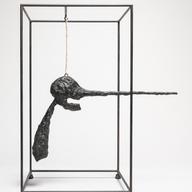
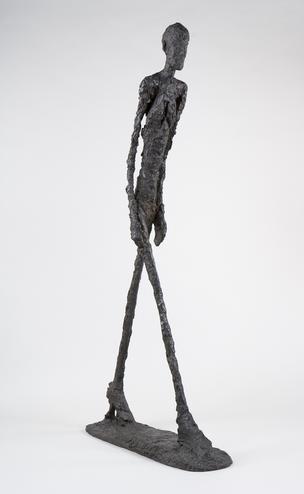
Giacometti is one of the deities of 20th century sculpture, and the retrospective of his work currently at the Solomon R. Guggenheim Museum is a marvelously intimate affair. He remains best known, of course, for his towering sculptures of bone-thin men and women, gaunt, ghostly beings stripped of everything except for poetic resonance. The women tend to stand in place, straight as totems; the men wander empty plazas with stupefied expressions. Created in Paris after World War II, the sculptures are unabashedly existentialist, with all that implies about the post-war belief that life is meaningless and absurd. If French existentialism was a brand, a Giacometti stick figure would be on the T-shirt.
The Guggenheim retrospective is an unusually well-selected show that focuses on the artist’s lesser-known works. More than half of the objects are owned by Giacometti Foundation in Paris, which means that instead of bronze trophies, we see scratchy paintings of apples and small-scale heads in plaster and clay. Some of the portrait busts in the show are only a few inches tall but undiminished in visual power. As you study them up close, you’re struck by a quality that is lost in reproduction: the roughness and agitated beauty of their surfaces. You can make out thumbprints and other finger marks, evidence of the kneading and pressing — the human hand — that coaxed these objects to life.
It was as if the gestures of his hand could also keep death at bay. He was probably more death-haunted than most. The eyes in his faces have the hollowness of sockets and sculls. So many of his sculptures suggest what awaits us at the end — the reduction of flesh to bone.
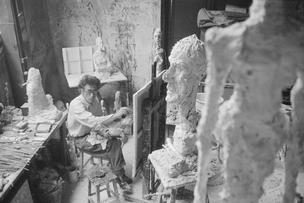
Swiss by birth, Giacometti settled in Paris during the glory days of the 1920s, and in some ways he was the ultimate bohemian-artist. Apparently indifferent to the acquisition of real estate, he labored in the same dwarfish, dust-filled studio for decades. He insisted on working from live models, often spending weeks and even months in front of the same subject while invariably declaring his efforts inadequate. He bemoaned his failures with dramatic flair. “The more one works on a picture, the more impossible it becomes to finish it,” he once said, with typical exasperation.
His curmudgeonly charm was captured recently in the film, “Final Portrait,” in which Geoffrey Rush plays the artist. It shows him overcome by unshakable self-doubt as he tries to complete a portrait of James Lord, his biographer. Giacometti reminds us, among other things, that a capacity for self-criticism is necessary for artistic greatness, and any artist who loves what he or she does is probably doing something very wrong.

WNYC is funded by sponsors and member donations