REVIEW: "Pipeline" Looks at the Trials of a Black Boy
Young men who are African American have the deck stacked against them, no matter how wealthy or educated their parents are, and one wrong step can put them in the school-to-prison pipeline. That's the message behind playwright Dominique Morisseau's drama "Pipeline," now at Lincoln Center Theater.
This is an important topic, especially in our city. "Black students are suspended and expelled at a rate three times greater than white students," according to civil rights data collected by President Obama's Education Department.
In New York City, black students are 3.6 times more likely to be suspended than whites, and minority students are more likely to be arrested in school by the police officers who provide security. For many, that means that school becomes their first entrée into the criminal justice system.
But Morisseau's play doesn't tackle this subject head on; instead, it's more oblique and focuses on an African American mother's anxiety over the future of her son.
Omari (Namir Smallwood) has pushed one of his teachers at his upstate, elite (mostly white) prep school.
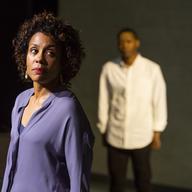
His mother Nya (Karen Pittman), a teacher herself, but in a city high school, immediately starts panicking. Will his school expel him? (It's his third strike, though the first two offenses are unspecified). Will the teacher press charges?
This should be riveting — those questions are great narrative drivers. But instead, the show meanders. Omari is a cypher: he tells us where his rage comes from, but he seems to be such a sweetheart that it's hard to believe he ever gets angry. We also never hear from the teacher he hurt or his school. The play is entirely focused on his mother's anxiety, and because she seems like an unreliable narrator — she's prone to panic attacks, she drinks, she has unreasonable expectations of her ex-husband — it's hard to take her seriously. It's easy to come away thinking: Omari is such a good guy, surely his mother's concerns are overblown?
Yet an audience who pays attention to the news knows they're not.
Morisseau and director Lileana Blain-Cruz try to keep our eyes on that fact through a device: during transitions between scenes, the back wall becomes a video screen that flashes clips of brown-skinned students in school hallways, sometimes laughing, sometimes fighting, sometimes being handcuffed by school security. Despite how hopeful Omari's situation seems, the clips seems to say that the system he's trapped in is working against him.
But that's a lot of weight for those videos to carry.
Morrisseau, the writer of the well-received "Skeleton Crew," is a strong voice on the African American experience. But not enough dots are connected here. Nya and her ex-husband seem blindsided by these latest developments — but why, if Omari already had two strikes against him at the school? Wouldn't some plan have been put into place? Omari's father seems like such a caring guy, why does the play portray him as an absent father when he keeps trying to step in to help? Would an elite prep school really want the publicity of filing charges against one of their students?
By the end, it feels like a play that could use more development time to better zero in on character motivations and plot points. It ends feeling almost hopeful, yet everything that has come before has tried to drill into us the idea that when it comes to black boys facing an often-racist system, they are not going to win.
By Dominique Morisseau, directed by Lileana Blain-Cruz.
At Lincoln Center's Newhouse Theater, through August 27.

WNYC is funded by sponsors and member donations