Robert Moses, The Power Broker, and The Secret Diary of Harold Ickes
When Robert Moses quit his post on the Board of Trustees at Hofstra University, it barely grazed a slow news day. He had left Hofstra in a huff, citing the dubious ethics of some so-and-so professor, unnamed in the recording above, who in the mind of Moses had committed a serious breach of ethics by using his lofty academic post for base political purposes. Whether this counts as news or not depends on your perspective. It might have been a hot item in Hempstead, but in The New York Times the controversy merited two brief columns on successive days on its double-digit back pages and then disappeared forever. Moses’ irascible nature was old news it seems, even at its freshest.
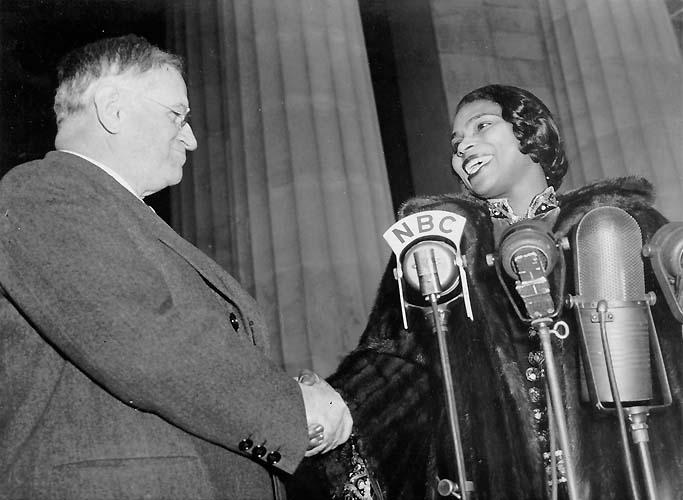
It helps to be specific when speaking about someone who has drawn the ire of Robert Moses - so many have felt the lash of his tongue, the sting of his pen, or worse, that it’s easy to get confused. The Hofstra professor brought to our attention by our emcee H. V. Kaltenborn, a future Radio-Hall-of-Famer borrowed for this broadcast from NBC, is either Dr. Charles E. Stonier, who earlier in the year had written a report on Moses’ beloved Jones Beach that had summoned the builder’s pique, or Hofstra President Dr. John Crawford Adams, who defended it. Maybe an amalgamation of both.
At this point though, who cares? History, perhaps rightly, offers a collective shrug at the Hofstra hubbub (though the relationship between Moses and his mouthpiece in the incident, Nassau County boss J. Russel Sprague, might be worth a closer look). Robert Moses did a lot of political posturing, pace Kaltenborn’s insistence in the audio above that Moses is “so far apart from politics that he can tell the truth as he sees it.” The truth is there was very little to stop Moses from speaking his mind. And the truth is he was deeply entrenched in politics, virtually immovable, despite his outward appearance as an untainted, above-reproach public servant. And true, Kaltenborn is kind of joking - the full recording, available in full below, is a from dinner hosted by the Long Island Daily Press, and carries a light tone, closer to a friendly roast than the undoubtedly more solemn ceremony that surrounded Moses' honorary degree from Hofstra, conferred in 1948, in more peaceful times. Kaltenborn is piling on two things at once in his playful introduction: Moses' combative nature, and his (deceptive) reputation as an upstanding public servant. But the addition of a single grain of sand to Moses’ vast beachheads of righteous rage and political maneuverings would seem to add little to the historical record that isn’t already there.
Kaltenborn is building here, using the day’s topical grist - Moses’ minor skirmish with a fill-in-the-blank professor - to offer a suggestion for posterity: a book about Moses that wasn’t "laudatory," one that was called “something like ‘The Ten Greatest Fights of Robert Moses.’” Dr. Hofstra U. wouldn’t make the cut, no. The best “summing up” of Moses’ contentious side, according to Kaltenborn, is The Secret Diary of Harold Ickes, and a political fight par excellence contained in its pages.
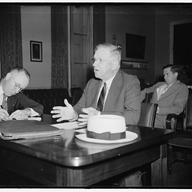
Ickes, though less well-known today, was the New Deal. He was Roosevelt’s Secretary of the Interior for his entire presidency, and in the early months of FDR's administration was put in charge of the new Public Works Administration, which became one of the struggling nation’s chief sources of public relief. It was also one of its cleanest, spending $4 billion graft-free dollars over Ickes' 6-year reign building bridges, highways, and housing throughout the United States. Famously curmudgeonly, and with a smart wit tart enough to match Moses', Ickes' grim demeanor belied a genuine concern for the poor and dispossessed. He was an early champion of racial equality: acting as FDR's main liaison with the African-American community, he was largely responsible for the formation of FDR's famous "Black Cabinet." Indeed, he was one of FDR’s trusted allies, a man FDR called to perform much of his political heavy lifting. For years he kept a diary, published posthumously in three volumes in the 1950s - a diary that Moses, Kaltenborn, and the evening's attendees are clearly all well familiar with, or at least familiar with one of the stories held its first volume: the time when, in 1934, Ickes found himself in the center of a flame war between Moses and the president.
Roosevelt had long carried a well-established but publicly-hidden hatred of Moses. Shortly after ascending to the presidency, Roosevelt tasked Ickes with informing Fiorello La Guardia that he wanted Moses out. As La Guardia stalled on acting on Roosevelt's wishes, Ickes prepared PWA Administrative Order Number 129, which would officially command that no New Deal funds would go to any authority that had a public official on its governing body - an order designed to effect exactly one man - Robert Moses. So long as Moses held public office, New York City wouldn't see a dime in federal funds. La Guardia had little choice, first wavering, then wilting under the pressure of the New Deal fiat, finally promising Ickes in January of 1935 that he would oust Moses from his seat of power, the Triborough Bridge and Tunnel Authority. However, before acquiescing to the order, La Guardia made the mistake of showing it to Moses, then considered New York's most capable and dedicated public servants, who leaked it to the press, cultivating a rabid public fervor at Ickes' perceived vendetta. Ultimately Ickes, La Guardia, and Roosevelt conceded defeat and hastily amended the order, grandfathering in City Housing Commissioner Langdon Post, and huh, look at that... I guess it applies to Moses too. (You can read more here or here.)
Kaltenborn gives a tendentious overview of the affair in the broadcast above, cherry picking the choicest cuts from Ickes’ Secret Diary, those highlighting Moses contentious nature and Ickes’ and the president’s eventual defeat. After reading a passage describing Moses as a “highly disagreeable and unpleasant person,” he jokes that this is “the kind of biography that Bob Moses likes.”
Perhaps. But "perhaps" in small doses. Small doses in light roasts. Small doses that end with Moses arms akimbo over a vanquished and humiliated foe, with recently raised superblock towers and anger-grey parkways to praise and frame his glower. Those small doses. But even then I have my doubts whether Moses, hidebound and thin-skinned as he was, would have truly taken to such a biography. Kaltenborn is today perhaps most famous for his “Dewey Defeats Truman” call during the 1948 presidential election. I’d argue history would prove him wrong on this account too, for when Robert Caro published The Power Broker, in September of 1974, 16 years after the recording above was laid to disc, Moses hated it.
Caro had built a beachhead of his own, one made of not tens, but hundreds of Moses’ fights, detailing not just the fair fights like the one traced above, but also Moses' many mismatched, bullying, red-baiting battles - fights that revealed the often seemingly invisible legacy of indifference to public need in the most powerful public servant in New York history. The Power Broker wasn’t a rival to the outclassed hagiography written by Moses minion Cleveland Rodgers - there’s a reason boxers are split into tranches, from heavyweight down to straw - The Power Broker was a rival to Moses himself, and it severely damaged his reputation, perhaps irreparably. True, by 1974 the man who had fought and defeated a president was feeling forty years of wear, and was already ousted from many of his seats of power, but Caro pulled his punches, cutting down a 3,000+ page manuscript to a "mere" 1344, with Ickes and Order 129 counting for 18 of them.
Kaltenborn's proposed book hasn't really been written - Caro's brilliant doorstop of a book skips over the battle over Moses' proposed Lower Manhattan Expressway (Lomex), one of Moses' first real defeats and, I'd argue, certainly one of Moses' "ten greatest fights." But if our archives have learned anything from the dozens of Moses' transcription discs we've reformatted in the last couple months, it's that there is more to Moses than 1344 pages can handle, even when adding the recent 256 page book that covers the Lomex fiasco.
I'm not even sure Kaltenborn's book is even the best book that could be written yet on Moses. Much of what's interesting lingers in his small to mid-sized fights - the Title 1 clearance of Columbus Circle, the removal of Tuscarora Nation for the Robert Moses Power Dam at Niagara Falls, maybe even the Hofstra University controversy, which could lend further light to history of Moses' early pet project, Jones Beach. The details matter because the people involved matter. Few New Yorkers have had such a massive, lasting effect on the lives of his fellow citizens than Robert Moses, and the stories of the men and women who found themselves forced by fate to try to face him down - Jane Jacobs and Shirley Hayes, Clarence Kaskel, Chief Clinton Rickard, Drs. Charles E. Stonier and John Crawford Adams, and, of course, Harold Ickes - deserve to be told too.
Audio courtesy of the NYC Municipal Archives WNYC Collection.
WNYC archives id: 150436
Municipal archives id: LT8045

WNYC is funded by sponsors and member donations