Trump's Rise Gives Gillibrand a Long-Awaited Opportunity
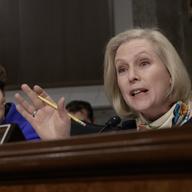
Donald Trump provided the opportunity, but New York Senator Kirsten Gillibrand has been working for years to become a national Democratic leader.
Once overshadowed by the woman she replaced, Hillary Clinton, and New York’s senior Senator, Chuck Schumer, Gillibrand has emerged as the vocal leader of the opposition to President Trump.
She’s rallied a following by seeking equality and justice for women, She's also built one of the Senate’s most potent fundraising operations and used the money raised to help elect allies in Congress.
It’s put Gillibrand on the presidential wish list of many Democrats waiting for 2020.
Like many New Yorkers , Gillibrand hadn’t planned on Donald Trump winning the presidency.
“I was shell-shocked,” she said, “I felt that I didn’t understand what had happened. And I was drained and just so sad.”
Gillibrand said she mourned for a few weeks after Election Day. But thinking about the border wall, immigration and the Iran nuclear deal, she asked herself a question.
“How can we fight back? How can we make sure the horrible things he ran on didn’t actually happen?” she said. “And how could we protect our country?
Gillibrand has voted against all but two of Trump’s cabinet appointments — more than any other Democrat. She was the only vote against confirming Defense Secretary James Mattis, arguing that hiring a recently retired general for the position undermined civilian authority over the military.
And she was a headliner at the Women’s March on Washington, held the day after Trump’s inauguration.
“This is the moment when women stood strong and stood firm and said ‘Never again!’" Gillibrand shouted from the stage at the event, which drew and estimated half-million people to D.C. “This is the moment that you are going to be heard!”
It’s a role — and a political brand — that Gillibrand has been building toward for eight years in the Senate and another two in the House.
Before the election, she was best known for taking on the military over sexual harassment in 2013. The year before, she started a political action committee called Off the Sidelines to help women run for office.
It’s an example of Gillibrand making use of a political power tool.
Off the Sidelines is what’s known as a leadership PAC — a separate account that allows members of Congress to raise more money from the same donors. Someone who gives the $10,000 maximum to a campaign account can give another $30,000 to a leadership PAC.
And many of Gillibrand’s top donors do, iincluding her former law firms, Goldman Sachs, Comcast and Corning.
Craig Holman, who lobbies on campaign finance, ethics and other issues for Public Citizen, said leadership PACs are one way the U.S. campaign finance system favors those already in office.
“It really is an abuse of the campaign finance system,” Holman said.
He said companies and political action committees donate for a reason.
“Those people almost always have business pending before the office holder," he said. "That’s why they’re making these contributions.”
Take Corning, for instance — a major manufacturer in upstate New York. GIllibrand has pushed for patent reform to protect companies like Corning from certain types of lawsuits. Corning also lobbied for a bill known as the 21st Century Cures Act, which fast-tracks approval of new drugs and medical devices — which Corning manufactures.
Gillibrand voted for the bill, and it became law in December.
Corning has also lobbied for causes that Gillibrand has opposed, like the Trans Pacific Partnership, President Obama’s Asian trade deal.
Corning and its employees have donated $155,000 to Gillibrand and Off the Sidelines since 2011, according to Center for Responsive Politics data. Gillibrand has raised more than $43 million since joining Congress.
A spokesman for Gillibrand said he didn’t know if Corning lobbied Gillibrand directly, but that she talks to as many New York businesses as possible.
A senior advisor, Glen Caplan, said: "Senator Gillibrand makes decisions based on what she thinks is best for New Yorkers....She is grateful for the support she has received across the state for speaking her mind and fighting hard for New York."
Corning did not respond to a request for comment.
So far, Gillibrand’s PAC has raised over a million dollars in similar contributions and another $4 million in smaller donations from a long list of individual supporters.
The PAC has raised more than $6 million in its lifetime — more money than the leadership PACs of Senate leaders Mitch McConnell and Chuck Schumer combined, over the same period.
“I think the work of Off the Sidelines, while relatively small ball, is still really important to me,” Gillibrand said. “And I think it’s important to all those communities those women stand up for.”
She’s donated $1.2 million to more than 100 candidates since the PAC was founded. Forty-five of them are in Congress now.
Former Vermont Governor Howard Dean, a longtime party activist, said Off the Sidelines will buy her a lot of friends in Congress and across the country.
“I think she is a strong Democrat. I think she is a mainstream progressive,” Dean said. “Anybody who gives money to other people running for office is clearly seeking a leadership role.”
But for every dollar that Off The Sidelines spends, just 30 cents goes to a woman running for office.
An equal amount was spent on salary for staffers, including people who have worked in Gillibrand’s Senate office and for Off the Sidelines.
The PAC has paid for travel, office space and campaign and communications advice.
And because it takes money to make money, about 17 cents of every dollar spent was on fundraising — holding events, building the PAC's online presence and sending out a steady stream of emails to spur donations to candidates and causes around the country.
Her latest cause is health care.
“The members of Congress who voted for this bill seem to lack any empathy,” Gillibrand said at a press conference last week, urging people to “push back hard” against members of Congress supporting the American Health Care Act, the bill to repeal and replace President Obama’s Affordable Care Act.
Democrats think the house shot itself in the foot by passing an unpopular bill that guts Obamacare.
It gives Gillibrand an opportunity to challenge vulnerable Republicans. She said she’ll support female candidates so that the demographics of Congress resemble the country’s.
“I’ve personally recruited candidates and helped them along the way, given them my best advice and guidance,” she said. “We have more women serving, which matters.”
It matters because bills like paid family leave or affordable day care would pass with more women in Congress, Gillibrand said, and would improve women’s lives. But she said that even with millions in the bank, she can’t do it alone.
“Nothing ever gets done in Washington unless regular people stand up and demand it,” Gillibrand said. “That is just true.”
It’s an important lesson she learned during her first major victory in the Senate, as a key engineer in getting the federal government to pay the health care bills of 9/11 first responders.
John Feal, a construction worker who helped clean up the aftermath at Ground Zero, met with hundreds of members of Congress during the 10-year push to pass the bill.
“She’s one of the five I can count on my hand that I truly, honestly like, trust and believe in,” Feal said
Gillibrand is a true believer in all the issues she chooses to take on, said Dina Refki, who studies women in government at SUNY-Albany. She said Gillibrand deftly wields her authority as a senator.
“She has been an effective messenger because she’s been consistent with it, with the message, and relentless with the message,” Refki said. “She tends to change the debate because of the stature she has.”
Howard Dean said he admires Gillibrand’s “guts.”
“I think the Democratic Party in particular is longing for somebody who’s not mealy-mouthed,” he said.
But Gillibrand has yet to win over colleagues on that bill changing how the military sexual harassment cases are handled, or those other issues like paid family leave.
And Refki said ‘women’s issues' are about more than gender, while Gillibrand often speaks of women as if they’re all the same. Refki said women experience inequity differently depending on their class, race and experiences.
Gillibrand said bills like paid leave disproportionately benefit low-income and minority women.
She also backed Donna Edwards, who is black, over Chris Van Hollen, who is white and was the establishment favorite, in Maryland’s Democratic Senate primary last year. Van Hollen is now Gillibrand’s Senate colleague, where they’re in the minority.
That’s why Gillibrand said she needs the public to back her up – and why she’s stepping up more into the spotlight.
“That’s the only way,” she said, “you’re going to hold this president accountable."

WNYC is funded by sponsors and member donations