Visual Art at the Bang on a Can Summer Music Festival
Visual Art at the Bang on a Can Summer Music Festival
By Sarah Lindmark
Every morning during Bang on a Can’s week-long Media Workshop, the four Media Fellows would walk to seminar together through MASS MoCA’s extensive network of galleries, hallways, staircases, and doors. Our usual path took us through Julianne Swartz’s Tonal Walkway, where ghostly disembodied voices followed us through a creaky covered bridge; Spencer Finch’s Cosmic Latte, where hundreds of exposed, hanging lights guided us through a recreation of our view of the Milky Way from planet Earth; Sarah Crowner’s sparkling, ocean-blue Wall (Hot Blue Terra Cotta); and James Turrell’s startlingly hypnotic yet revealing technicolor installation Into the Light.
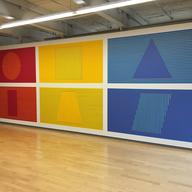
But it wasn’t just the festival’s writers who regularly passed through the museum’s galleries: performing music inside the gallery spaces was commonplace throughout the week. For example, a concert of Eve Beglarian’s music and a performance of seven of Philip Glass’s Etudes for Solo Piano took place in the Wardwell Gallery – a long, thin, hallway with a gigantic mural of pink, orange, and blue text surfacing through a background of thin silhouetted trees. Other favorite venues included the Finch gallery and various parts of the museum’s sprawling installation of Wall Art by the late Sol LeWitt. In fact, only a handful of evening concerts and the end-of-the-week marathon took place in MASS MoCA’s Hunter Center for the Performing Arts.
One unique aspect of the Lunchtime concerts is that they take place in multiple gallery spaces – the audience walks around the museum together in between each piece. Two of the four total works programmed on the Friday Lunchtime concert were performed in the LeWitt exhibit, and in both cases, the performers chose their preferred venue with the audience in mind.
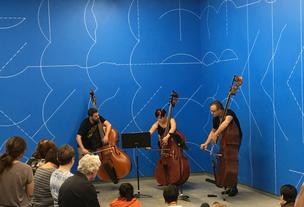
The first of the two was a piece written for solo bass, Four Moons by Miya Masaoka, but performed by a trio of basses by Performance Fellows Will Yager, Rebecca Lawrence, and Gregg August. The piece requires a scordatura, or an alternate tuning for their double basses, and consisted entirely of long, deep, dissonant drones. Yager, August, and Lawrence warned the audience before the piece began that it had the potential to cause a trance-like state. The LeWitt piece they chose as their backdrop was especially fitting for the work: an almost completely enclosed space that surrounded the viewer in a field of electric blue with thin, white, wavy lines, like being folded up into an unfinished blueprint. While Yager stated that he chose the gallery space because of its acoustics, it was easy to think that each different wavy line coincided with each slow, wavering note that grew out of the double bass trio.
At the same Friday afternoon concert, Performance Fellow Susan Summers performed a solo saxophone piece in front of another of LeWitt’s works. The piece, titled Deep Flowers and written by composer Evan Chambers, showcased Summers’s ability to play with an extreme pitch and dynamic range on the alto saxophone. Near-silent notes would slowly fade in and out of the space, in stark contrast to the smooth yet piercing pitches that would follow. The LeWitt work she performed in front of consisted of a series of bright orange wavy lines over a saturated green background that would run in and out of each other, swirling across the entire width of the gallery space. Both the LeWitt piece and Summers’s performance of the Chambers work seemed to envelop the audience in a series of hypnotic waves, suggesting a relationship between the two works.
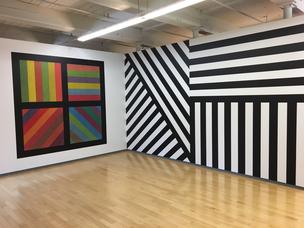
Contemporary music has maintained a long and loving relationship with contemporary art spaces. Minimalist composer Steve Reich played many of his early shows at art galleries around New York, and fostered a mutually beneficial relationship with Sol LeWitt. Reich even has a wall-drawing in his kitchen that was a gift from LeWitt himself. Similarly, the three Bang on a Can founders held many of their early shows in art galleries as well. For their inaugural 1987 marathon, they consulted a book of New York art galleries for the initial search for a space willing to put on a twelve-hour concert of contemporary music. “Our very first Marathon was in an art gallery,” Julia Wolfe told the four media fellows in a group interview last week. “A very cutting edge, controversial one called Exit Art.”
Around a decade later, Bang on a Can co-founder David Lang sat bored in one of the many rehearsals at the Williamstown Theater Festival for an upcoming concert. He decided to email Joseph Thompson, the man spearheading the MASS MoCA project in the nearby town of North Adams: “You don’t know me, but I’m from Bang on a Can.” He got a response from Thompson thirty minutes later, inviting him to the old factory site.
“I told him who we were, I said what we wanted to do, and we shook hands. That was it.” After a few years of fundraising and networking, their agreement paid off. MASS MoCA became a nationwide symbol for arts-based community development, and Bang on a Can had a cutting-edge space to start their Summer Festival and continue their Marathon tradition.
The Bang on a Can Marathon, held at the Hunter Center for the Performing Arts, was a six hour long extravaganza of contemporary music ranging from Steve Reich’s Runner to David Lang’s multimedia work how to pray. One of the works performed was by Pamela Z, Attention, a piece that includes video and a string quartet (cellist Ashley Bathgate, violist Molly Collier-O’Boyle, violinists Sofie Thorsbro Dan and Yi-Chun Lin). In Attention, a cell phone in the projection would ring, and one of the players would seemingly answer the call on her own phone during the performance, having short conversations with a disembodied voice echoing through the Hunter Center.
The lighting would change as the piece transitioned between moods – typically from dark to light, drawing the audience’s attention away from the screen and to the performers and vice-versa. Not unlike James Turrell’s Perfectly Clear, the visuals would blur in and out, enticing the audience into searching for the identity of the object coming in and out of focus on screen.
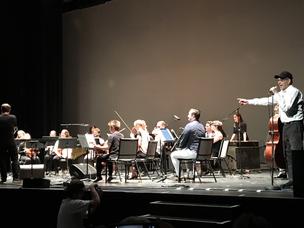
The six-hour show concluded with Reich’s Runner. Chock full of the composer’s characteristic overlapping rhythms and tightly woven, repeated melodies, Runner was both engaging and hypnotic. Conducted by Brad Lubman, the chamber orchestra flowed effortlessly through each rhythmic modulation, with the piano grounding the ensemble with a series of constantly churning repeated chords as the violins, violas, percussion, and winds added color to the work’s texture. The friendship between Steve Reich and Sol LeWitt came into focus during Runner – although the LeWitt gallery was on the other side of MASS MoCA, the artist’s bright colors, thin lines, geometric shapes, and repeated patterns seemed audible in Reich’s work. This week, visual art and music became so deeply intertwined that they no longer needed separate performance and exhibition spaces. Contemporary art was no longer either audible or visual; it was simply art
Sarah Lindmark is currently working on a Master's Degree in Musicology at the University of California, Irvine.

WNYC is funded by sponsors and member donations