Weekly Music Roundup: David Walters & Friends, José González, The Hold Steady
Week of Feb. 22: This week, Afrocentric music by David Walters featuring Ballaké Sissoko and Vincent Ségal , a Spanish-language debut for José González, and more questionable behavior from The Hold Steady.
PREMIERE: An Afro-Franco-Caribbean Treat From David Walters And Friends
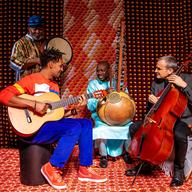
Singer and guitarist David Walters was born in France, but his family roots are in the Caribbean islands of Martinique and Saint Kitts, and while you’ll hear him singing a little in English and French, much of his new album, Nocturne, is sung in Martinican Creole. The music is also a hybrid – Walters is a DJ and producer, but here he restricts himself to acoustic guitar and vocals, and his band includes Ballaké Sissoko and Vincent Ségal, who have made two magical albums together of West African-tinged chamber music for kora, the 21-string harp of the region (played by Sissoko), and cello (played by Ségal). Rounding out this elegant quartet is the Guadeloupean percussionist Roger Raspail, whose playing is just as tasty and restrained as the string players around him. Today we premiere the video for the song “Baby Go,” which Walters describes as a “search for peace in the face of a relationship doomed to failure… the goal is to leave each other gently. Baby, go slow…” The song – and the album as a whole – has a sunny, lilting quality that will make it a perfect accompaniment to summer cookouts. You know, when we can do that again…
Open Door Policy: An Invitation from The Hold Steady
Brooklyn rockers The Hold Steady have just released their new album, Open Door Policy, with their usual pairing of Craig Finn’s spoken-sung stories of life on the margins and the sextet’s buoyant brand of indie-heartland-rock. As with the band’s best albums, like Separation Sunday and Stay Positive, these songs all seem to relate to each other: here are tales of people trying to deal with limited options, the lure of low-level crime and substance abuse, an over-medicated society, and finding love in all the wrong places. But there is also a recurring thread about the power of music to overcome all of that. It's implied in the band’s stubbornly uplifting sound, and sometimes explicitly woven into the lyrics. Stamped hands, lanyards, backstage passes – all the badges of the devoted concertgoer – appear throughout; sometimes the narrator seems to be in the audience, and at others on the stage, surveying the crowd. (The album was finished just before the pandemic.) “Spices” is a good example – a song that builds to a big, brassy conclusion as the narrator, in the woods facing a difficult decision, states “and if the band ever plays ‘The Resurrection,’ it’s at the end of the show.” (Finn’s lyrics are full of allusions and are sometimes self-referential – the band’s Separation Sunday album ends with the song “How A Resurrection Really Feels.”)
The Hold Steady also announced two live streaming shows from Brooklyn Bowl on March 5 and 6.
Adrian Younge Pulls No Punches In The American Negro
The revolution may not be televised, as the late Gil Scott Heron famously said, but it may well be broadcast – possibly by Adrian Younge. The multi-instrumentalist, composer, conductor and arranger is about to release The American Negro, a searing look at racism through words – both spoken and sung – and music. The album is just part of a larger project that includes Younge’s four-part podcast series Invisible Blackness and his short film called T.A.N. “Revolutionize” is the new single from the record, and its spoken text – “you are tuned in to the Black consciousness” and soulful chorus make this a relatively easy entry point to what is an unflinching, provocative album. Younge plays most of the instruments, and arranges and conducts the orchestra in a track that may nod to Blaxploitation film scores, classic soul, and Younge’s own work with artists like Jay Z and Wu-Tang Clan.
The American Negro comes out on Friday, February 26.
Jose Gonzalez Releases First New Music In Five Years, And First Ever In Spanish
So much about Jose Gonzalez’s career has been a surprise: the fact that, despite his name, he is Swedish; the unexpected success of his quiet, voice-and-Spanish guitar versions of The Knife’s “Heartbeats” (used in a memorable TV ad for Sony Bravia televisions) and “Teardrop” by Massive Attack; his work with Ben Stiller on the soundtrack to The Secret Life Of Walter Mitty; and now, the fact that Jose Gonzalez, the son of Argentine immigrants to Sweden, is about to release his first-ever song in Spanish. The song is “El Invento,” a charming, melodic song that asks some pretty basic questions about who we are and why we’re here. “Historically,” Gonzalez writes, “most traditions have invented answers to these questions.” That invention usually involves recasting those essential questions into some form of prayer, and this song, written after the birth of Gonzalez’s daughter, is ultimately a prayer for, if not answers, at least a calm place to think.
Afro-jazzy New Single From Pino Palladino And Blake Mills
Bass player Pino Palladino has played with everyone from The Who to D’Angelo; guitarist and producer Blake Mills has worked with Fiona Apple, Alabama Shakes, and many others. So when they got together to make a collaborative album, called Notes With Attachments, they were able to call on a lot of talented friends to join them. The album doesn’t come out until March 12, but they’ve just released this track called “Ekuté,” which looks like an alternate, perhaps creole spelling of the French “ecouté,” or “listen.” In other words, it looks like something from the David Walters album, above; and it sounds like a more amplified, harder-edged version of Walters’ Afrocentric music. Here Palladino and Mills are joined by the drummer and bandleader Chris Dave, the terrific sax player Marcus Strickland, and near the end, the violinist (and singer/songwriter/whistler) Andrew Bird. The song is a simmering instrumental that combines West African funk (and briefly, near the end, the West African ngoni, a type of lute) with a jazzy interplay of horns. The rhythm provides real momentum; and with most of the musicians playing several instruments over the course of the track, it has another layer of motion as well.
Ex:Re Combines Rock Singer, Classical Composer, and String Ensemble
Elena Tonra is best known as the singer/songwriter in the very excellent British band Daughter. But she has also done a solo album under the name Ex:Re (pronounced like x-ray). Now, she’s remade that album in collaboration with the French-British composer and arranger Josephine Stephenson, who was, conveniently, the pianist on those Ex:Re songs, and the fine London-based string band called 12 Ensemble. “Where The Time Went” is the opening track on both versions of the album, and this new edition is accompanied by a video of an eerily deserted London. The songs were originally about the end of a relationship, but the feelings of loneliness and melancholy that Tonra touches on in her lyrics feel less specific and more broadly felt now. The lush, ever-growing arrangement for the 12 Ensemble heightens the emotional impact.