Why Northeast Priorities Take a Backseat in Congress
New York City Police Commissioner William Bratton and more than a dozen officers traveled to the halls of the U.S. Senate recently to speak up for a program that is universally supported at home.
Most of the officers worked at Ground Zero or at the Staten Island landfill where the toxic debris was brought. But Congress was refusing to renew a bill covering health care costs for police, fire and other workers who responded to the terrorist attack — also known as the James Zadroga 9/11 Health and Compensation Act.
“Twenty-three New York City police officers perished on that day," Bratton said. "Since that time we have lost another one hundred fifteen.
“The clock is ticking.”
Despite broad support in the House and Senate, the money was in limbo as Congress wrapped up their work this year. A deal to include the money in a transportation bill fell through. Then the Zadroga act became part of budget negotiations.
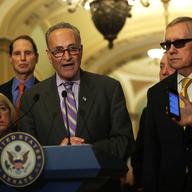
“I was so disappointed," said New York Democratic Senator Chuck Schumer, "to hear some of my colleagues use Zadroga as a trading piece, like some bargaining chip.”
Schumer was able to get the funding in the spending bill at the 11th hour, but he said the health care money should never have been part of those negotiations.
The 9/11 money isn’t the only local priority that’s struggled to make it through Congress. What's important in the Northeast can often take a backseat in Congress.
Earlier this month Congress passed a five-year bill funding transportation — but tri-state lawmakers in both parties had to fight off cuts to bus, train and other transit.
And then there’s gun control, which has frustrated Connecticut Senator Chris Murphy.
“How cold-hearted is this place?” he asked at a recent event marking the third anniversary of the Sandy Hook Elementary School shooting.
Three years ago after the Newtown shooting and again this month after San Bernadino, Democrats couldn’t push any gun laws through Congress.
Democrats couldn’t even convince Republicans to support a ban on gun sales to people on federal terror watch lists.
“You have failed to keep us safe," said Po Murray, a Newtown resident who helped found a group seeking more restrictive gun laws. "We are sick and tired of your inaction.”
And Republicans are refusing to consider any gun control legislation now.
It's not just that the largely Democratic tri-state delegation is the minority party.
“In the past, Chuck Schumer would be an incredibly powerful guy," said Bruce Haynes, a founder of Purple Strategies, a Virginia-based firm which advises both Democrats and Republicans. Schumer is a prodigious fund raiser, and once ran the Senate political committee trying to oust incumbent Republicans.
So the growing influence of huge amounts of money in campaigns has made him enemy number one.
“If you were a Republican Senator who saw millions of dollars…coming down to try to defeat you," Haynes said. "That doesn’t necessarily endear you to support initiatives that he’s favoring.”
Schumer often gets his way — like boosting a tax break for transit in the budget package passed last week. But Haynes said if Schumer wants something, it becomes a target.
Or sometimes it’s just a matter of different priorities.
Even Conservative Republican Scott Garrett of New Jersey supported more mass transit funding. But House Republicans wanted to cut money for local buses and trains.
Garrett says that’s because the economy in most places in the U.S. doesn’t depend on mass transit.
“Transit is always a difficult issue politically because much of the country is not invested in it as we are,” he said.
Garrett supports paying for transit. But he doesn’t like the way Congress is doing it now: loading bills down and cramming them through Congress at the last minute.
He wants bills to work their way through committees and then both chambers of Congress with votes at every step.
Garrett has joined other House Republicans voting against those bills on principle — even the transportation bill because it doesn’t say how to pay for all the road and bridge projects inside.
Those votes against local needs aren’t likely to hurt Garrett and other Republicans, said Bruce Haynes with Purple Strategies. Garrett’s been elected seven times to represent northern New Jersey in Congress.
When November rolls around, Haynes said voters will be focused on national issues like terrorism and the economy.
“These are the things that are front and center with voters," he said. "And the hometown issues? Well, we’ll get to them when we get to them.”
The nitty gritty details of how bridges get fixed, commuter trains get funded or how to care for those who sacrificed their health on 9/11 will be long forgotten.

WNYC is funded by sponsors and member donations