Why Should Women Be Educated? President Eisenhower 'Mansplains'
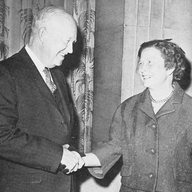
Why should women be educated? What sounds like an odd question today was very seriously considered by Dwight D. Eisenhower and other speakers at a luncheon fundraiser for Barnard College, held at the Waldorf-Astoria on October 19th, 1961. Eisenhower, who was the President of Columbia University for the brief interim between his career as a General and his tenure as POTUS, speaks about his belief in the need for an educated populace to solve the major problems of the time (read: communism). With all of the deleterious effects of “the pressure groups of labor, of the agricultural community, of the people who hate this or like that” on public discourse, what role can women play in a sensible approach to self-government? Mostly, according to Eisenhower, as good mothers to the nation’s children.
Although Eisenhower is quick to say he doesn’t “want for a moment to decry the importance of the woman doctor, the lawyer, the social worker, the teacher” or even the woman scientist, he speaks mostly to the “inescapable duty of the mother” to prepare her children to be informed citizens. In this respect, he argues, “to make a distinction between men's and women's education is as silly as the value of it is obvious.” Furthermore, women have to be educated to be able to vote.
Eisenhower is introduced by then-President of Columbia Grayson Kirk and by Millicent Carey McIntosh, who was the chief administrator at Barnard from 1947-1962--first as Dean of the College and later as the President. McIntosh was known for her insistence that women could engage in both professional careers and family life and lived out this conviction as one of the first married heads of a Seven Sisters college. She also undertook massive fundraising campaigns during her tenure, resulting in the construction of two new buildings on campus (Lehman and Reid Hall) and the addition of the Minor Latham Playhouse to Milbank Hall. McIntosh was well-liked on Barnard’s campus (where she was referred to as “Mrs. Mac”) as well as across the street at Columbia. (Barnard is affiliated with Columbia University; the two institutions are financially and legally separate but share many resources and have cross-listed undergraduate courses.)

As an archivist at Barnard, I was excited to hear about this recording from WNYC Assistant Archivist Ana Marie, and I wanted to see what other materials we had at Barnard that might contextualize it. An article about the luncheon in the Barnard’s student newspaper, the Bulletin, glosses over Eisenhower’s remarks about child rearing and focuses more extensively on McIntosh’s speech. While the WNYC recording cuts off after Eisenhower’s speech, I was able to listen to the complete recording we have in our audio collections, including the introductory remarks of Vice Chairman of the Barnard Board of Trustees Francis T. P. Plimpton, as well the extended remarks of McIntosh after Eisenhower finished. McIntosh speaks about funding structures, citing the 1961 figure that only 1.3% of corporate donations given for higher education went to women’s colleges, even though the vast majority of private colleges at the time were single-sex. She also notes shortages in candidate pools--in both feminized professions like librarianship and nursing as well as fields such as electronics engineering. In McIntosh’s words, it is important to think of college education “not as something nice for the girls, but as something that is so basic to our culture and to our future that we will all rethink our patterns.”
Martha Tenney is the Digital Archivist at Barnard College. For more information on our collections, including the papers of Millicent C. McIntosh, see archives.barnard.edu.
Audio courtesy of the NYC Municipal Archives WNYC Collection.
WNYC archives id: 150267
Municipal archives id: LT9442

WNYC is funded by sponsors and member donations