The WNYC-WNYE Connection
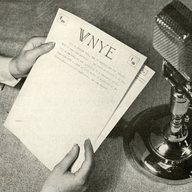
WNYC and WNYE were once very close. They exchanged equipment, time, talent, and programming in various ways. In early 1946 the following account of WNYE's history was written. Although not signed, I believe the document was authored by James F. Macandrew, then Radio Coordinator for the Board of Education.
The legal-sized, typed, and mimeographed history was discovered among the papers and recordings of former WNYC producer and host Albert Arkus, an alumnus of the WNYE All-City Radio Workshop. The work, which could have used some editing, does not appear to have been published anywhere prior to this posting. But it is a rare period rundown of the extent of WNYE's early dependence on WNYC. It is also an interesting account of the New York City high schoolers getting involved with radio long before Radio Rookies.
In a few instances, I have 'bolded' content related to WNYC. Photos and a few footnotes have also been added to clarify points.
A History of Station WNYE
"This is Station WNYE, Brooklyn, New York; the FM station for the schools. WNYE is owned and operated by the Board of Education of the City of New York..." That sentence (in the morning announcement which 'signs the station on the air') makes WNYE one of four such stations in the country. Only three other stations in America (at present writing, early in 1946) are owned and operated by school systems. To the members of the WNYE staff, it is a growing source of gratification that this distinction will soon pass, and that many more FM educational stations will be welcomed to the fold this year, if FCC applications and manufacturers' promises bear fruit.
But the morning announcer might also go on to say, with equal truth, "WNYE is the only school-operated station which conducted pre-professional training in broadcasting, with network cooperation, for high school students in the city; which offers students three courses in radio engineering, three in program production, and throws in the rudiments of television, acting and writing for good measure." If he were permitted to go on boasting, he might mention student engineers who take (and pass) as a final course exam the FCC license as a radio telephone operator, first-class; student writers who turn out three different series of weekly programs; student actors who take part in two dramas and two quiz program a week.
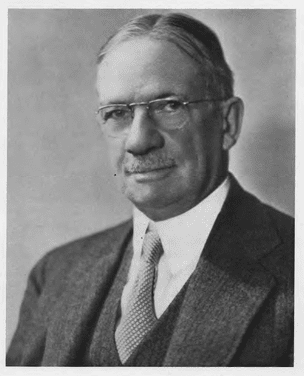
But behind this whirl of intense and purposeful activity of today lies a fifteen-year-old story of many doubtful yesterdays. It is a story that begins with Albert L. Colston, father of educational broadcasting in New York City, former principal of the Brooklyn Technical High School, and first Director of Station WNYE.
It was back in 1929 that Dr. Colston, then associated with the Mathematics and Mechanical Drafting Department of the Manual Training High School in Brooklyn, first dreamed of a technical high school which would offer intensive terminal courses in many machine-age subjects, as well as extraordinary preparation for engineering school, to the machine-and-math minded boys of the city. He topped his dream with a radio tower, envisioning a studio on the top floor which would serve the double purpose of training radio engineering and providing educational programs for the classrooms of the city.
As plans for the new building grew on the drafting boards, the radio elements were more than a dream. Originally it has been Dr. Colston's intention...in a day when the higher frequencies wavelength of 810 Kc, (then assigned to the municipal station, WNYC) on a time-sharing basis. This did not prove practicable, although WNYC has served the Board of Education nobly for more than seven years by simultaneously emitting on an AM band from ten to thirteen WNYE programs each week. Fortunately, by 1936 the ultra-high frequencies [1] were being considered for school service, and a memorable trip to Washington was undertaken in that year by Dr. Colston, William Pabst, the present Principal of Brooklyn Tech, and Herman Haverkamp, now Chief Engineer of WNYE.
It was at an FCC hearing, the primary purpose of that journey to Washington, that Dr. Colston made the historic request for consideration for the need of school broadcasting...not only for sound broadcasting in the ultra-high frequencies, but for space in the spectrum for educational television. The latter may seem of purely academic significance at the moment, but it is an indication of Dr. Colston's vision that he saw the need ten years ago...even though ten more are likely to elapse before anything can be done about it.
The request for a UHF wave-length received a warmer response, however, and the FCC encouraged New York City's radio pioneers to apply for a license.
In February of 1937, Mr. Haverkamp and Howard Shaw, an English teacher assigned by Dr. Colston to organize the radio programming, were hard at work. Pending the arrival of their UHF license, they concentrated on developing the new Board of Education studio atop the Brooklyn Tech Building, and the end of the year found their station equipped with all but a transmitter. Accordingly, early in 1938 they began broadcasting by piping their programs to the Municipal Broadcasting Station, for broadcast on a standard wavelength. They were joined now by James F. Macandrew, the present Radio Coordinator, who has charge of all Board of Education radio programs, and by Ricardo Muniz, another teacher of radio engineering.
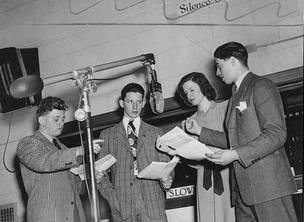
So WNYE went on the air, on 810 Kc., compensating for the lack of its eagerly-awaited transmitter by piping its programs to WNYC which broadcast them on a standard wave length. A wide variety of programs was attempted, for elementary, junior high, and senior high school classes. Participants were picked from students and teachers, as well as men and women prominent in the life of the city. Subject areas investigated then and subsequently have included high school English, speech, history, economics, French, German, Spanish, Hebrew, Latin, consumer education, art, music, mathematics, and guidance. The vocational high schools have sponsored a special series dealing with opportunities in vocational education. The elementary schools have heard broadcasts in history, civics, literature, and nature study. In addition to sharing many of the high school programs, the junior high schools have had their own programs in current affairs and safety education. As might be expected, English, speech, languages, and the social studies have most effectively integrated radio broadcasts with their classroom work. In the physical sciences, the radio programs as the supplementary aid seem to work out the best as a home listening assignment except in the enrichment of the science curriculum through the inspiration of biographies of great scientists, presented in dramatic form.[2]
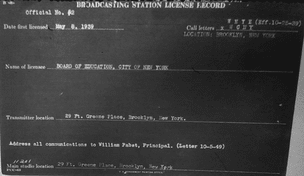
But we're getting far ahead of our stories. We were back in 1938, in the fall of which the long-awaited FCC license for a UHF transmitter on 41.1 megacycles came through, and work was begun on the construction of the transmitter. Construction was completed in Spring 1939, and WNYE proudly took to the air waves, not only through WNYC but on a wave length of its own, continuing, however, to broadcast simultaneously on both frequencies.
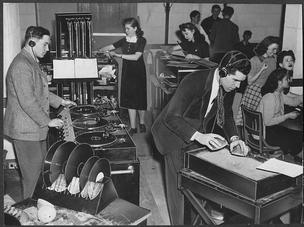
Then in June, Howard Shaw left the station, and Mr. Macandrew took over as Radio Coordinator, acquiring as his assistant Van Rensselaer Brokhahne, now Production Manager of the station. Another engineer Edward Kratt...was added to the staff, since all the technical instructors then had the double responsibility of training student operators, as well as operating and maintaining the station themselves. But 1940 was the end of one period and the beginning of another, for by 1940 the decision was reached to switch over from ultra-high frequency transmission to Frequency Modulation.[3] 1940 was also the year in which the All-City Radio Workshop was organized, a group of the best student talent in the high schools of the city. With the growth of more ambitious programming, it has become evident that the boys of Brooklyn Tech could not meet the demands of casting dramas, and so auditions were held and the successful applicants of both sexes were made available for casting calls as the exigencies of the term's programming developed. From this humble beginning, a group of youngsters serving on an extracurricular basis from time to time, and reporting when only called upon, came the present Workshop...a series of regular classes carrying school credit, following a course of study developed with the cooperation of NBC, broadcasting regularly each week on WNYE and (through the courtesy of CBS) dipping into television once a month.
It is this group which has drawn such comments as those from the judges of the Annual Exhibit of Educational Recordings held by the Institute for Education by Radio at Columbus, Ohio:
It is incredible that high school students can turn such professional performances. (Johnny Quinn, USN)[4]
The production was excellent and the script was well written. The high school radio workshop group gives this program a production which ranks with a professional cast. The girl who served as narrator did a professional job of reading lines. (And There Were Shepherds)
Returning to 1940, the decision to convert to FM meant going off the air while the new transmitter was installed, and so WNYE was not heard from during the academic year 1941-42, [until] the new transmitter was ready and WNYE took to the air on its new wavelength of 42.1. The following year found the All-City Workshop reaching new heights of technical and emotional perfection, for the war years brought, among other programs, "Plays for Americans" by Arch Obler. This series was so successful that "Johnny Quinn, USN" was sent to Columbus on transcription to compete in the Exhibit of Educational Recordings at the eighth annual Institute for Education by Radio, and to be judged the best high school broadcast of 1943, after competing with other schools, local organizations, and professional broadcasting stations.
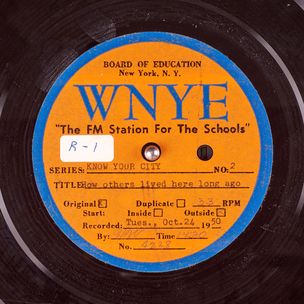
To jump two years, another WNYE program took another national award two years later. "Know Your City" a quiz program on local New York geography and history was cited by the 1945 Schools Broadcast Conference for outstanding excellence of classroom use of our broadcasts completed our gratification. WNYE had now been recognized for well-nigh professional producing, and for superior educational application.
The Columbus award actually arrived in the spring of 1944, of course, and by genuine coincidence, something equally gratifying came that spring. It was the suggestion, made by the National Broadcasting Company to the Board of Education, that the New York City schools set up at WNYE training courses in broadcasting for high school students. Of these, three were to be technical: Radio Theory, Broadcast Station Operation, and Sound Recording, largely limited to boys attending Brooklyn Tech. Three were to be on the other side of the control room glass and were to be open to students from the city's 54 academic and 26 vocational high schools. These courses were: Radio Scriptwriting, Radio Acting, and Radio Production. Their syllabi were submitted to NBC for advice; periodically, engineers, script department executives, and producers come down from Radio City to observe WNYE operations and to advise the teachers who conduct them.
For WNYE is still run by New York City teachers, although the number has been raised from four to seven to cover the increased teaching load, as well as expanding operations. To say it is supervised by teachers would be more accurate, for actually it is run by the students: students who write half the scripts, who operate not only the controls but (once they earn their licenses) the transmitter as well, under teacher supervision; who play the parts, select the music, provide, build and operate the sound effects, announce the shows, transcribe the broadcasts, keep the logs, and generally keep the station on the air.
Some seventy-five of them a term pass through our hands, and some of them have already been heard from professionally. Who? Andree Wallace, the "Jane Thompson" of Ethel Barrymore's "Miss Hattie" series, currently of "Our Gal Sunday" and other daytime serials. Mario Siletti of WOR's Sound Effects Department; Ed Pollock of station WKNY; George Fisher, Michael Dreyfuss, and half a dozen others. No, we don't encourage all of them to try the hard road to kilocycle fame [5]...only the top layer of the heavy cream floating on the rich milk we skim from our "feeder" schools each term. Our technicians, of course, have been in great demand throughout the war, a demand that has not yet slacked off, but which we realize inevitably must...unless television begins to absorb our technically trained graduates.
____________________________________
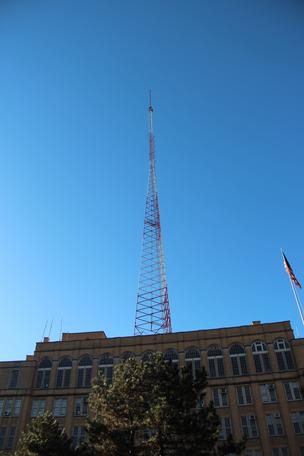
Outside of program sharing and exchanges, Brooklyn Tech also housed WNYC's emergency AM transmitter. On many occasions, it was used to send out all of WNYC's programs from the WNYE 420-foot tower atop the school making its peak 597 feet above DeKalb Avenue.[6] It is the tallest structure in Brooklyn.
Years later WNYE began leasing time to a significant number of community and ethnic programmer broadcasting shows in 13 different languages including French, Haitian, Creole, Polish, Russian, Ukrainian, Greek, Chinese, and Korean. Because of the outspoken reaction by these broadcasters and their listeners to an effort to sell the station in 1992, the Board of Education backed off on the initiative. In November 2000 Board of Education Chancellor Harold Levy proposed leasing WNYE to WNYC.[7] WNYC CEO Laura Walker pushed for the deal and argued in a letter to The New York Times,
WNYE-FM would be used throughout the city's school system in support of the music curriculum, featuring world music, ethnic music, jazz, American standards and classical music. A single ninth-grade initiative under discussion would reach 100,000 students -- thousands more people than currently listen to WNYE.
Walker also maintained that WNYC was committed to helping the Board of Education find ways for ethnic programmers to continue to reach their audiences.[8]
Less than two weeks after Walker's letter to the Times, the tragic events of September 11th unexpectedly brought the two stations together. The attack on the World Trade Center destroyed our FM transmitter located in the center's North Tower and WNYE generously loaned us their FM frequency to broadcast our signal, preempting their programming until we restored our FM signal over the following weekend. Ultimately, however, the proposed leasing of WNYE to WNYC was not fulfilled as the arguments of the ethnic programmers and their supporters prevailed.
Some of the past series airing on both WNYE and WNYC included:
Bill Scott, Forest Ranger - This series was syndicated and sent to stations across the country by the Cooperative Forest Fire Prevention (CFFP) Campaign, a collaboration between the United States Department of Agriculture, the Advertising Council, and the state forestry service. Originally broadcast in the fall of 1946, the series has been used by 147 schools and colleges and aired by some 200 commercial stations. The full series can be found at the link above. Additionally, Martin Grams has prepared a smart piece about the series.
"Know Your City is a weekly quiz program on New York City dedicated to telling New Yorkers, the thrilling story of their city's progress from a wilderness to the capital of the world. The program is designed to make New Yorkers appreciate and understand the dynamic of life that is enacted each day in our wonder city and to show our citizens their part in making and keeping our town the greatest city in the world." (Description from the 1949 Know Your City school broadcast manual) This series was presented by The City History Club of New York in cooperation with WNYE, The Division of Curriculum Development of The Board of Education, and WNYC-AM. It has received recognition several times from the Ohio State Institute for Education by Radio.
This broadcast of Know Your City from February 9, 1954, is about Fordham Village and Fordham University in the Bronx. The quizmaster is "Aunt Edith" and the children's accents are priceless. Quite a few of these programs have recently been digitized and we hope to make them available on the web soon.
Tales From the Four Winds was a radio series from the 1940s and 50s dramatizing the folk tales and legends of different lands. It was the brainchild of Fan Kissen, a teacher, consultant, scriptwriter, and producer who launched the program over WNYE. The radio programs were quite popular with the school children of New York and neighboring cities and were broadcast directly into New York City school classrooms. The series was honored twice by Ohio State's Institute for Education by Radio and the School Broadcast Conference.
Teenage Book Talk was designed "to open doors to the world of books for junior and senior high school listeners. Each week the program features a lively informative discussion by a group of teenagers who talk about a current book, generally with the author as a guest on the program. The discussions are guided by Margaret C. Scroggin, Coordinator of Young Adult Services at the New York Public Library. The series is made available to WNYE by WNYC, which broadcasts the program originally on Saturday at 10:30 a.m." (Description from the WNYE 1963-64 Radio Manual). The program earned a Peabody Award in 1961 with the submission of this broadcast of New York City teens talking with Eleanor Roosevelt about her book, Your Teens and Mine.
Famous New Yorkers was a drama series planned and written "with the needs of the curriculum in mind'; the figures of New York City and State history were selected because of their important contributions 'to our way of life.' Of those profiled in the twenty-eight-part series are twenty-five men and three women. Included were: Alexander Hamilton, Alfred E. Smith, Lou Gehrig, Walt Whitman, Lillian Wald, and Susan B. Anthony.
__________________________________________
[1] "Ultra-high frequencies" refers to AM "Apex" frequencies in the 41.02 to 43.98 megahertz band. Applicant stations were given experimental licenses to broadcast in the new band using AM transmitters. WNYE was assigned the call letters WCNY licensed at 41.1 megacycles. Because of the call sign's similarity to WNYC, it was changed to WNYE on October 25, 1939.
[2] Carroll Atkinson wrote in Public School Broadcasting to the Classroom in 1942 (Meador Publishing Co., Boston, pg. 18): "With the rapid expansion of the radio service of radio programs to the classroom, it was soon discovered that the Board of Education broadcasts were consuming so much of the WNYC daily schedule that other branches of municipal government were being crowded out of their proper use of the city-owned broadcasting facilities. New York City thereupon was granted one of the short-wave [Apex] allocations set aside for educational purposes by the Federal Communications Commission."
[3] In May 1940, the FCC authorized the first FM broadcast band covering 40 frequencies between 42 to 50 megacycles. Apex stations were told to convert to FM or go off the air. WNYE had special permission to continue as an Apex AM station until June 29, 1941. In 1942 WNYE converted to FM and began broadcasting at 42.1 MHz and then 44.9 mHz. In 1945 the second FM band 88.1 to 106.9 was authorized by the FCC and WNYE moved there, initially at 91.7, before ending up at its current 91.5 in 1947.
[4] The judges of the Eighth Annual Exhibition of Recordings by the Institute for Education by Radio at Ohio State University awarded "Johnny Quinn USN" its 'First Award' for the 25-minute Arch Obler drama airing on May 28, 1943, on both WNYE and WNYC. James F. Macandrew was the director and producer.
[5] Another famous alum of WNYE's All-City Radio Workshop was Bruce Meyerowitz, a.k.a. 'Cousin Brucie Morrow' known primarily for his work at WABC and WCBS in New York.
[6] Board of Education of the City of New York, Specialized High Schools in New York City, 1946, pg. 77.
[7] Hinckley, David, "It Looks Like Bye-Bye, NYE," Daily News, November 30, 2000, pg. 284
[8] Walker, Laura, "Letters to the Editor," The New York Times, August 31, 2001, pg. 18.

WNYC is funded by sponsors and member donations