Camp For Young Refugees Teaches U.S. School Skills
Each summer, about 100 students from more than 25 countries learn how to sit at cafeteria tables, pose questions to each other and work in groups.
The students are children of refugees and asylum seekers whose families were brought to New York City by the International Rescue Committee. They take math and English classes for six weeks. But for them, preparing for school also means learning how to be an American student.
"The expectations of an American classroom are very different than what most of our students have experienced," said Sara Rowbottom, who manages education and learning for the I.R.C.'s Refugee Summer Youth Academy, which started in 1999.
She said many of these kids come from countries where schools rely on rote memorization. By contrast, American schools put more "focus on critical thinking, collaborative learning, being very independent" and letting students express themselves.
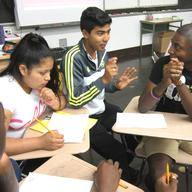
Sixteen year-old Bikash Shrestha, who moved to Woodside, Queens from Nepal this past spring, was getting a taste of that in a class for teenagers. About 20 students sat in clusters of desks in a classroom at Murry Bergtraum High School in Lower Manhattan, just as they would in high school.
"What is your favorite room like? Use three adjectives," asked a Tibetan student sitting in his cluster. The entire room was listening.
"Living room is my favorite room because I can play games like Xbox, PlayStation and I can relax anytime and watch TV," Shrestha replied, as the teacher and students snapped in approval.
The students were getting ready to write personal essays in English. They had spent the morning discussing their homes and favorite activities. Some were from West Africa and others from Asia and Latin America.
Shrestha left Nepal in the spring to join his father, an asylum seeker who moved to New York two years ago. He seemed excited about starting high school and he had an advantage because he'd studied English at his school in the small city of Banepa. But he wasn't used to the rhythm of an American class.
"I feel, like, nervous whenever a teacher talks to me," he said. "And when somebody points to me, I'm like, what to do now?"
He said classes back home consisted of a lot of reading but few conversations with students and teachers.
"In Nepal we’re used to continuously read," he explained. "Like reading, reading, reading all the time. But here we got time to talk and to, like, explain our opinion and having fun."
Classes at the IRC's academy run from Mondays to Thursdays, with field trips on Fridays. Teens are divided from younger children. The little ones learn how to sit on a classroom rug and participate in group activities, such as singing songs.
"It's not just how good is your English, it's how good is your school readiness," explained academy director Kira O'Brien. Staffers look out for students who are shy or withdrawn, mindful that many carry difficult memories from their home countries or refugee camps.

WNYC is funded by sponsors and member donations