This Week in Rut or Recovery
Two years after the financial collapse, some are in a recovery, others are stuck in a rut.
We asked It's a Free Country readers to share their stories about how the economic slump has changed their lives in ways both big and small. We asked a simple question: Are you seeing signs of a rut or a recovery? Are the signs in your community? In your home? In your workplace, if you're lucky enough to still have one? After a week that brought us gloomy new unemployment numbers and a second draft of the Bowles-Simpson deficit reduction plan, here's what people had to say.
Got a Rut or Recovery story of your own? Share it at It's a Free Country»»
Want to see what others are saying? Explore the map, slideshows, and story archive here»»

My cousins own a restaurant/bakery in Boerum Hill in Brooklyn. They have had a really rough year or two. They sell a lot of pies, etc, for Thanksgiving and she always makes beautifully decorated cookies that look like turkeys. Last year, she had to give them all away - people will buy a pie, but wouldn't waste money on something like a $4.50 cookie that is just an extra. This year, she sold more than half of the turkey cookies. I call it the Turkey Cookie Index. An economic indicator that people are more willing and able to buy a little something extra that they don't really need this year.
-- Jennifer
I graduated in June with a M.S. in Conflict Analysis and Resolution. After six months, I found a job as a Barista. I am sitting on almost $140,000 in debt and no one will take on an entry-level candidate. The only advice I keep hearing is, "Good luck. Hang in there."
-- Louis
I was laid-off from a good paying job in advertising in November 2007, just at the very beginning of the mortgage crisis. My wife and I had just bought an apartment (yeek!) and we were about to have a baby (double yeek!). I struggled to find another full-time job, taking any freelance work I could find. Regardless of money, navigating the health insurance wilderness was no easy task, though we were able to pay-out-of-pocket into a plan through Freelancer's Union. Many waves of layoffs were taking place all around me. After several months, I decided that if we were to live with this level of uncertainty, I might as well strike out on my own and form my own business. I invested in some video equipment, and I began my own web design and video production business. It seemed insane at the time, and fall 2008 was extremely difficult-- but three years later, I'm still working, and while my profits are small, my business has grown. We've made many changes-- we eat many more meals at home, I work from home, gift-giving is curtailed from multiple gifts to one or two, our vacations have been limited to visits to friends and family-- but slowly we seem to be stabilizing.
-- Matthew
I live off Steinway St. in Astoria, a street known for shopping, and mostly clothing stores. In the last couple of years, independent stores have been closing, leaving mostly chain stores and a lot of empty storefronts. In the last few months, I've noticed the storefronts are reopening--but the new shops are all food stores (bakeries, smoothie places, even an organic grocery), which is odd for Steinway. My guess is that people are still buying necessities like food but not spending on more discretionary items.
-- Sandra
I live off Steinway St. in Astoria, a street known for shopping, and mostly clothing stores. In the last couple of years, independent stores have been closing, leaving mostly chain stores and a lot of empty storefronts. In the last few months, I've noticed the storefronts are reopening--but the new shops are all food stores (bakeries, smoothie places, even an organic grocery), which is odd for Steinway. My guess is that people are still buying necessities like food but not spending on more discretionary items.
-- Sandra
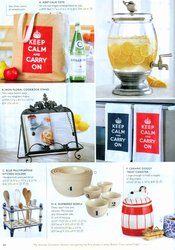
This story comes from my mother, who is a perennial recipient of mail-order catalogues. This holiday season she has noticed a proliferation of goods embossed with a version of the 1939 poster issued by the British Government as Hitler's Luftwaffe geared up for attacks on the U.K.. The slogan: "Keep Calm and Carry On" was designed to assuage the fears of an understandably nervous public. That it would re-appear today is not surprising given The Great Recession. But the message of uplift, to me anyway, is also pernicious because it asks us to part with our money (to purchase the totebag or handtowel - see .jpg) in spite of a real need for fiscal responsibility.
-- Amy
My extended family used to exchange presents, but last year we started a "not junk up the earth" game where everyone dumpster dives or thrift shops for one gift and a "rob your neighbor" game ensues. More fun, less spending.
-- Lisa
Working at a law firm that handles major corporate restructurings and chapter 11 bankruptcies, I've had a fairly secure position from which to witness this economic recovery. The stimulus stopped the bleeding, and the recovery is in full swing. The problem is that much of the country is not included in the recovery. We constructed an economy that excludes certain portions of the population. From decaying inner cities to never-developed portions of Appalachia, millions of Americans are literally unemployable. After the recession, millions more workers are now superfluous. This recession, triggered by Wall Street recklessness, has exposed the effects of decades of neglect. Entire industries have cratered. Our infrastructure is collapsing. Schools are not preparing students for a 21st century economy. College leaves millions saddled with debt. “Middle class,” which once meant a life of economic security, now means living in a constant state of anxiety. Don’t blame President Obama, or even George Bush (though he didn’t help). This crisis is 50 years in the making. But investors should be pleased; corporations are raking in record profits. The United States adopted corporate values as its own, and now the economy is doing just fine without many of us.
-- Jay
Until the Obama administration recognizes that the Fed has done all it can with monetary policy and that initiatives in fiscal policy are now required, we are in a rut. That doesn't mean we need to extend tax cuts for the rich or provide more additonal stimulus to for public works! It means we need to provide incentives for new business formation, research and development and retrain housing and construction workers in skills in other fields [the housing market will take a long time to recover]. The government needs to reduce military spending [see Cato Institute study], commit to energy independence at all costs and provide real tort reform to lower healthcare costs. Abandon the Federal pension program and move to 401k contributions, drop Congress’ health care and pension plans so they are on par with the rest of America. To help the consumer dig out of the hole, bring back tax deductions for credit card debt [along with a sunset clause] since financial firms won’t provide a break for their 29.9% rates though they are paying only 0.25% funding cost and give a tax break to those who cannot refinance their mortgages due to credit issues. We’ve bailed out Wall Street – but how about us consumers? Until we are healthy, this economy is going nowhere and we have been all but ignored!
-- Michael