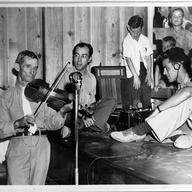
Intrepid City College Staffers Record Dust Bowl Refugees for WNYC Documentary
Robert Sonkin and Charles Todd were working at the City College Department of Public Speaking when they decided to spend their summer vacations in 1940 and '41 at the Farm Security Administration (FSA) camps of central California. With the help of Alan Lomax, their project was underwritten by the Archive of American Folk Song at the Library of Congress. Carrying a "portable" 50-pound Presto disc cutter, they recorded cowboy songs, traditional ballads, square dance calls, camp council meetings, storytelling sessions, and the personal experiences of the Dust Bowl refugees who lived in the camps. Drawing from more than 200 field recordings, the folklorists produced the above documentary for WNYC in 1942, one of three in a broadcast series called Songs of the Okies.
Sonkin and Todd described their folksong expedition for the New York Times Magazine in November 1940:
It is a somewhat bewildering experience to travel a few miles inland from the modern, cities of the California coast to the hot valley of the San Joaquin, where many of the Okies have made their homes in government camps, private camps or in roadside tents and shelters. Geographically, it is still California, but for the collector of songs, it is another and far more fascinating world. Strolling in the evenings through one of the big Farm Security Administration camps, past long rows of tents and metal 'units,' one hears fragments of tunes that a more prosperous America has forgotten in the process of growing up and getting rich. [1]
Todd told a documentary broadcast panel at the Institute for Education by Radio sponsored by Ohio State University in 1941 that making the recordings in migrant camps was much easier than they thought it would be.
Our best results often came when we found somebody who looked good, went into his metal shelter or his tent, simply sat down and gossiped for a while, until gradually he warmed to the idea of getting out a guitar and starting to sing.[2]
In addition to the ethnographic research Todd did with Sonkin in California, he also documented folk music in upstate New York and parts of New Jersey. In 1942, he returned to California and worked as associate manager of the Tulare Migrant Camp in Visalia. He was later drafted into the Army and went to work as a public relations officer. After the war, Todd continued to work in public relations and later headed up the Speech and Communications Department at his alma mater, Hamilton College.
Sonkin had degrees from both City College and Columbia University and founded the speech clinic at City College. In addition to the research he did with Todd in California, Sonkin also documented the African-American community of Gee's Bend, Alabama, where other FSA work was being carried out. After the Japanese attack at Pearl Harbor, he participated in an Archive of American Folk Song-sponsored project to document the man in the street's opinion of the war effort. Like Todd, Sonkin was drafted into the military during World War II, where he served in the Army Signal Corps.
At the end of the war, Sonkin became a speech professor at City College, where he retired in 1976. Todd and Sonkin remained in touch and undertook a collaborative project which resulted in a book on Alexander Bryan Johnson, an American philosopher, and banker, published in 1977. Robert Sonkin died in 1980 at the age of 69. Charles Todd lives in Vero Beach, Florida.
For more about Sonkin and Todd's recordings and work, go to the American Folklife Center, Library of Congress, Voices from the Dust Bowl.
[1] Todd, Charles and Robert Sonkin, writing in "Ballads of the Okies," The New York Times Magazine, November 17, 1940, pg. 117.
[2] Todd, Charles, Education on the Air: Twelfth Yearbook of the Institute for Education by Radio, Ohio State University, Columbus, 1941, pg. 239.
______________________________________________________________________________________

WNYC is funded by sponsors and member donations