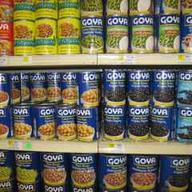
After 75 Years, Goya Knows Its Beans
The “Goya” label can regularly be found on the shelves in supermarkets and bodegas. With more than 2,000 different products — from beans and olive oil to canned sardines and tropical fruit nectars — the company has grown in size lockstep with the increase in the nation’s Latino population.
But Goya’s success has been in understanding that sometimes a bean is not just a bean.
“We have a saying here,” said Robert Unanue, president of Goya Foods. “We’re united by language, we’re separated by the bean. We all eat different beans in different countries.”
Goya knows that even if the language is the same for immigrants from countries like Cuba, Costa Rica and Colombia, what they eat is not. And that’s where Goya has succeeded — in creating products targeted to those specific palates: pinto beans in Puerto Rico are known as galanos and cooked with rice, but in Mexico, its pintos used to make refried beans.
Goya began 75 years ago in Lower Manhattan by Unanue’s grandfather, Prudencio Unanue, who emigrated from Spain. He sold Spanish-made food products to his fellow immigrants. In 1936, when the Spanish Civil War made importing from that country impossible, Prudencio sold sardines from Morocco with the name “Goya” on it. He liked the name and felt it had a tie to Spain, so he bought the brand for a dollar.
“He built the company on the immigrant community coming into the United States,” Unanue said.
After its start in New York City, Goya eventually moved its offices to Secaucus, New Jersey. It now has 16 facilities in the U.S., the Caribbean and Spain, with sales over a billion dollars. A new cannery in Texas, employing around 150 people will open in about a year and half. And, if a $82 million tax abatement is finalized in New Jersey, Goya plans to build a multi-million dollar headquarters and warehouse in nearby Jersey City. It’s also considering expanding operations in Mexico.
Even as the company grows, it keeps control over the production and distribution of its products. Unlike many competitors, Goya still delivers direct to stores and bodegas. Doing so allows the company’s sales reps to know what products sell in which neighborhoods.
“Every store can have a different assortment,” explained Burt Flickinger, managing director with Strategic Resource Group, who has studied the company. “So if it’s people from the Caribbean and you have Dominican consumers in one neighborhood and two blocks away Cuban consumers, Goya will have a slightly different assortment of preferences for consumers.”
This leads to faster turnover of products and higher profits for the company. Flickinger has estimated that Goya makes double the profits on each item it sells compared to its competitors.
Getting into larger stores, however, hasn’t always easy. Robert Unanue said it wasn’t until the 1960s that supermarkets began to accept Goya’s products because they didn’t want, as he put it, that “element.”
But as the company’s products became more popular with broader audiences, including non-Latino shoppers, all that changed. Goya products can regularly be found in large supermarket chains from Whole Foods to Wal-Mart.
Like any family-run business, Goya has had its share of internal strife. In the late 1960s, Robert’s uncle Charlie tried to take control of the company. That led to court battles and litigation, and his uncle eventually left the family business.
But now with a fourth-generation working at the company, it has survived and continues to grow and expand.
Flickinger said its very success could be a temptation for the family to consider selling the company.
“There’s always tension when there’s a lot of money to be made,” he said. “A financial firm or a strategic acquirer — Kraft or ConAgra — could come in and say ‘We’ll give you billions because this is a faster growing business with Goya than anything we could self developed on our own.’”
Flickinger said that doesn’t appear likely to happen any time soon.
So, in the meantime, without the pressure of meeting investor expectations on Wall Street, the bean counting that will matter most to Goya will be that by done its consumers.

WNYC is funded by sponsors and member donations