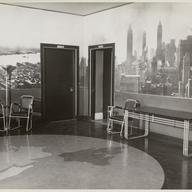
A 1939 Snapshot of WNYC
Two years after WNYC's new WPA-built studios came online, the author Mary Field Parton (1878-1969) wrote a 232-page guide to New York called, Metropolis: A Study of New York. Published by Longmans Green and Company, she described the work as being concerned "primarily with the study of bigness: big industries, enormous processes, complex problems that the governing of a population of over seven million persons presents." In it, she devoted a slender chapter to the municipal radio station, WNYC.
HIGH ABOVE THE CITY, UP TWENTY-FIVE FLOORS IN THE Municipal Building, is the city-owned broadcasting station, WNYC. You are cordially invited to visit the station and attend a broadcast. You will rejoice that you live in a democracy that allows freedom of speech on the air; freedom, too, to its minorities.
The circular reception room has a ceiling-high magnificent panorama of the city taken from the air. Every tower, every roof, and chimney is in its correct position. The six studios and audience room demonstrate the modern trend in decoration: soft, subdued colors, straight lines, nothing superfluous, monel metal. The science of physics is master here. The transmission of sound is the paramount problem.
Glass windows of the audience room separate the visitor from the broadcaster: two half-inch-thick plates of glass set at an angle from one another to break any sound originating in the audience room. The walls are soundproof. They look like huge porous plasters. The floating floors absorb reverberations. The laminated doors are soundproof. The acoustical treatment of the studios is constructed to accent or diminish sound by seemingly magical controls.
You will see machines that produce the various sound effects; three records can be played at a time, thus, for instance giving a baby's cry, the howling of the wind, the crash of an automobile. You will see a control room, all-important, not understandable except to the man who twists the knobs and watches the swing of indicators. You will be shown the drama studio. Here, behind a beautiful monel metal screen, is a hollow space planned originally for an organ but, because of acoustic conditions, suited only for the spectral voice of "Death" in dramas requiring his presence.
In the musical library, a treasure trove, are the records of the world's masterpieces. Day in and day out New Yorkers enjoy a feast of the noblest in music.
The chief municipally-owned broadcasting station, non-commercial in character, is New York City's WNYC. Your guide will tell you how the station serves the police and harbor departments, the schools, the fire department, in fact all of the citizens of the city.
Mary Field Parton was born in 1878 in Covington, Kentucky, and grew up in Detroit. Rebelling against a strict religious upbringing, she attended the University of Michigan and then taught briefly. After hearing an influential lecture by socialist leader Eugene V. Debs, she moved to Chicago and began work at one of social reformer Jane Addams' settlement houses.
Soon after, she became a labor reporter and met the famous attorney Clarence Darrow. The two had a brief affair and remained life-long friends, according to her daughter, Margaret Parton. Darrow wrote the introduction to The Autobiography of Mother Jones, edited by Parton and published in 1925. Letters between Parton and Darrow can be found in Chicago's Newberry Library. Mary Field Parton reported many labor cases for progressive magazines and counted among her friends the writers Lincoln Steffans, Theodore Dreiser, and Sinclair Lewis. Through the 1940s, she wrote fiction, non-fiction, and many magazine articles. Mary Field Parton died in 1969.
For more views of WNYC from the period see A WNYC Scene Sampler Circa 1939 by Laszlo Matulay.
The above excerpt from Parton's work, according to The Hathi Trust, is in the public domain.

WNYC is funded by sponsors and member donations