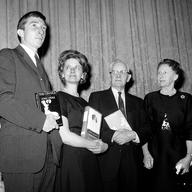
1964 National Book Awards Ceremony
The 1964 National Book Awards ceremony, hosted by former quiz show personality (now Rutgers University president) Mason Gross, kicks off with the prize for Poetry being awarded to John Crowe Ransom. Ransom, grumbling about the five hundred word limit imposed on recipients, delivers a rather ornate and florid defense of lyric poetry, seeing it as "a homage to external nature, despite the griefs it causes us, and to human nature, despite its hateful and treacherous tendencies…" Valery and Bergson are then cited in an argument for the poet's seeming immorality. The Devil, after all, must exist, or the job of temptation would fall to God. As if reveling in this excuse to behave badly, Ransom notes he has exceeded his five hundred word limit.
The prize for History goes to William H. McNeil, for The Rise of the West, still a much-respected work in the field. The winner for Science, Philosophy, and Religion goes to Christopher Tunnard and Boris Pushkarev for Man-Made America: Chaos or Control? which warns of creeping urban blight and suburban sameness. The Art and Letters award goes to Aileen Ward for John Keats: The Making of a Poet. In her acceptance speech, she graciously recommends a rival biography of Keats published in the same year, Walter Jackson Bate's magisterial John Keats.
The Prize for Fiction goes to John Updike for The Centaur. Updike, just days short of his 32'nd birthday, sounds strikingly young and endearingly nervous, a far cry from the self-assured media smoothie of later years. He makes a plea for "accuracy or lifelikeness" in fiction, which he admits sounds strange coming from the author of a book about Greek gods and goddesses appearing in rural Pennsylvania. But this, he insists, was reality for him. "…each of us who claims to be writers should strive, I think, to discover or invent the verbal texture that most closely duplicates the tone of life as it arrives on his nerves." He goes on to describe the current writer's condition as being one of isolation, both from other writers and from those of the past. "The writer now makes his marks on paper blanker than it has ever been."
The second part of the ceremony is reserved for a paper delivered by the distinguished physicist and Nobel laureate I. I. Rabi. Entitled Science and the Other Culture, it makes the by a now familiar plea for a cessation of hostilities, both real and imagined, between science and the humanities. Rabi doesn't do his cause much good by first reading a nasty description of scientists in academia by former University of Chicago president Robert Hutchins and then responding in kind. He goes on to envision a future shaped by what he sees as the three most important scientific achievements of the age: weapons of mass destruction, the great advances in communication, and the challenges posed by automation. Poets, scholars, and other representatives of the humanities "missed the bus" in the 18'th century when the Industrial Revolution was changing the face of the earth. Rather than sneer at and retreat from scientific advances they should have plunged in and tried to integrate the new earning with the old. He makes a plea that in this upcoming revolution, which he predicts will be just as earth-shaking as the last, such notables as the members of this group do not make a similar mistake. One senses a great deal of sincerity in this request. Rabi was a man of striking moral and ethical principles. He refused to work on the Manhattan Project and never patented any of his discoveries. One also senses a fair degree of exasperation.
The official part of the ceremony concludes with the reading of a telegram from President Johnson.
John Crowe Ransom (1888-1974) is best remembered now as a founding member of the literary group known as the Fugitives (later called the Southern Agrarians) and for his championing of the New Criticism. Both in his poetry and later critical writings, he extols virtues associated with a long ago and perhaps non-existent past. As Richard Gray observes on the Poetry Foundation website:
…the thesis that nearly all of Ransom's writing sets out to prove, in one way or another, is that only in a traditional and rural society—the kind of society that is epitomized for Ransom by the antebellum South—can the human being achieve the completeness that comes from exercising the sensibility and the reason with equal ease."
John Updike (1932-2009) was a prodigious talent, writing short stories, novels, poetry, casual humor pieces, and, in its quiet, unassuming way, probably the most far-ranging and penetrating critical oeuvre in American 20'th century literature. Updike's closing plea in this speech, that the writer make something "useful and beautiful and, in a word, good," dovetails neatly with the assessment handed down by the magazine he was forever associated with. In its obituary notice of Updike, Adam Gopnik of The New Yorker writes:
Updike’s great subject was the American attempt to fill the gap left by faith with the materials produced by mass culture. He documented how the death of a credible religious belief has been offset by sex and adultery and movies and sports and Toyotas and family love and family obligation. For Updike, this effort was blessed, and very nearly successful.
Isidor Isaac Rabi (1998-1988) was a brilliant physicist but also, as his contribution to these proceedings shows, deeply committed to the advancement of a cohesive, morally aware culture. A government insider, he was a strong voice for arms reduction and international control of atomic energy. Regarded by many as the conscience of the scientific community, he seemed utterly uninterested in personal gain. In his New York Times obituary he is quoted as recalling:
In the late 1930's, I and my friends sat around and talked about what we'd do if we had a million dollars. I thought and thought and finally I said, 'I think I'd buy a new hat.'
Audio courtesy of the NYC Municipal Archives WNYC Collection.
WNYC archives id: 150015
Municipal archives id: T53 and T54

WNYC is funded by sponsors and member donations