1968: Fifty Years Later
Assassinations. The fight for civil rights. Protests against the Vietnam War. Labor strikes. 1968 was undoubtedly a momentous year in a dramatic era.
Like the rest of the nation, the New York City region was deeply affected by the events that took place 50 years ago, sometimes in ways we are still working to understand. The WNYC newsroom is revisiting the watershed moments of a watershed year to see what we can learn from them now. Throughout 2018, WNYC's All Things Considered host Jami Floyd is speaking with historians, journalists, authors, student protesters, and others who participated in those events, or have examined their significance. We also have dug into the station's rich collection of historical audio, with the help of its archivist Andy Lanset.
Our series begins on April 4, 1968, the night the Rev. Dr. Martin Luther King Jr. was assassinated. Keep checking the top of the page as we add segments throughout the year.
The Year In Review
The events of 1968 changed the country and the people who lived through them. Political upheaval and culture wars became constant, as did the younger generation's coping methods of music, social activism, and bucking the status quo.
"It was really the explosion of the faith in the conventional wisdom, which began in earnest as the Vietnam War fell apart," said Charles Kaiser, author of 1968 in America: Music, Politics, Chaos, Counterculture, and the Shaping of a Generation. "It proved that whatever the establishment had told you about anything was not necessarily to be believed."
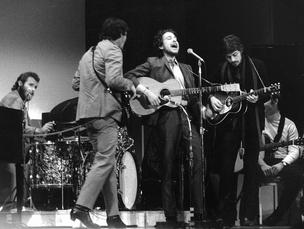
As the establishment's foundation was shaken and political violence escalated, music became a unifying force for young people, said Kaiser, who turned 18 years old in 1968. Great musicians, including Aretha Franklin, Bob Dylan, Janis Joplin, and The Beatles, helped create community and a moral clarity.
"What kept me and everyone my age alive through all of [the chaos] was what we could hear on the radio," Kaiser said.
December 11 | Co-op City Opens
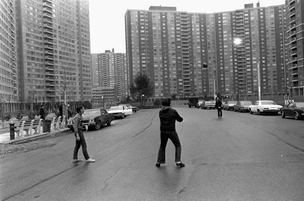
On December 11, 1968, New York City became home to the largest co-operative housing complex in the world, Co-op City.
The idea was to build affordable housing, under New York’s Mitchell Lama Program, to lure middle-income New Yorkers to the city’s outskirts. And it worked. When it opened 50 years ago, almost all of its more than 15,000 units were sold out.
Architecture critics assailed its sterile design at the time, but many residents say it has offered them affordable housing and a tight sense of community.
“In my 47 years of living in my one apartment, I have come to know my fellow cooperators,” said resident Sonja Clark. “My children went to school here. I went back to school here because they have a college for seniors. There is so much to do and be in Co-op City.”
Though Co-op City lacks easy mass transit connections to Manhattan — it takes more than an hour to get to Grand Central Terminal and normally requires taking both the bus and subway — Clark said the commute is worth it.
“We have so much room. We have closet space,” she said. "The rooms are large. They're airy. We have central air."
In the early days, residents organized to fight increases in their maintenance charges and to get construction problems fixed. That resulted in a 13-month rent strike, the longest and largest in United States history, before a compromise was reached.
“We had to get involved to get the elected officials to support us. And we organized 50 bus loads to go to Albany to give us some relief,” said longtime resident Bernie Cylich, who also served as president of the Co-op board of directors.
About 43,000 people live in Co-op City, according to the 2010 Census. But the project may have never existed if the business there before it had been successful. Before Co-op City, an amusement park called Freedomland operated on the same location for four years. It was only because the park went out of business that the state and local authorities, along with the Amalgamated Clothing Workers of America, were able to develop the land as housing.
November 14 | Yale Goes Co-ed
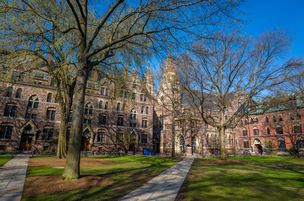
In November 1968, Yale University President Kingman Brewster stunned students and alums of the prestigious New Haven institution when he announced the school was going co-ed.
The announcement came shortly after Princeton released a report that recommended that Ivy League school go co-ed. In his haste not be left behind, Brewster followed suit, but made the decision with little planning. It did not go over well. Most alumni (who were, of course, all men at that point) resented the idea of women at their beloved university. And students (also all men) had a similar reaction, but for a different reason. When Brewster led a meeting at Trumbull College — the dormitory that was to be used to house the incoming women, audience members hissed and jeered because they didn't want to have to move out. (Yale revised that plan and instead devoted certain entryways in each of the dormitories — called "residential colleges" — to accommodate the new women students.)
Ultimately, 576 female undergraduates enrolled the following fall. They were far outnumbered by 4,000 male students on campus.
One member of that first class of women, Alice Young, said it was clear that male students weren’t exactly ready to have female peers.
“The men were used to having women only on the weekends,” she said. “So to see us around the campus during the week was a little different for them and for some a little intimidating.”
Hostile faculty members further complicated matters. Nancy Malkiel, an emeritus professor of history at Princeton University and the author of "Keep the Damned Women Out": The Struggle for Coeducation, said that some instructors were welcoming, and others not so much.
“A new woman student went to the chair of the history department and asked whether the chair of the history department would consider giving a course in women's history,” Malkiel said. "And he looked at her and he said that would be like teaching the history of dogs.”
Young, who was also one of the few Asian-Americans at Yale, said her experience prepared her to be a pioneer on campus and during her subsequent career as a distinguished lawyer.
But it was clear that while Yale and its female students had made history, changing the university’s male dominated culture would take much longer — as suggested when a fellow Yale student, Deborah Ramirez, alleged that Supreme Court Justice Brett Kavanaugh had sexually harassed her when they were both there in the 1980s.
November 6 | Nixon Wins; the Modern Political State Is Born
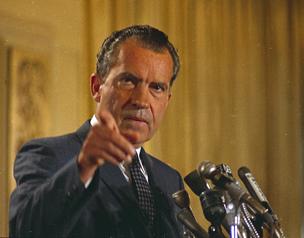
The 1968 election was so close, it wasn't decided until the wee hours of the following day. When Richard Nixon finally did claim victory — at the Waldorf-Astoria Hotel in Midtown Manhattan — he suggested he wanted to heal a fractured country.
"We want to bridge the generation gap," he said. "We want to bridge the gap between the races. We want to bring America together."
But those words would puzzle, if not anger, anyone who had been following the divisive and negative campaign he had been leading for the previous several months. In fact, author Rick Perlstein argues Nixon's 1968 campaign became a blueprint for the anything-goes, fear-based politics so familiar to us today.
“Richard Nixon’s commercials are unlike anything we had seen to that point,” said Perlstein, author of the 2009 book Nixonland: The Rise of a President and the Fracturing of America. “They are incredibly jarring, garish, very, very negative, show absolutely horrifying images of Americans at each other's throats.”
Perlstein says the Nixon campaign played directly into the anxieties of Americans rocked by riots and protests that had taken place in the years leading up to the 1968 race. One particularly searing ad showed a white naked female mannequin lying on the street in the aftermath of a riot.
“What we call that sort of image now is a dog whistle,” he said. “The message really is: The violation of white womanhood by all these dusky hoards who are overwhelming polite America.”
Perlstein see a direct parallel between that campaign and the political messaging of our current president; Trump’s 2016 campaign used slogans — including “the silent majority” — from Nixon’s 1968 campaign. And, the writer says, the two Republicans sounded the same overall theme.
“The idea is that, 'America is falling apart. It was liberal’s fault. It was Civil Rights activists fault, and if we just go back to this kind of white-picket-fence-America and stop all this ridiculous — what we now call political correctness — everything will be OK,'” Perlstein said. “And of course, [Nixon] won and, of course, that became the template for Republican electioneering ever since.”
October 12-27 | When Black Athletes Took a Stand
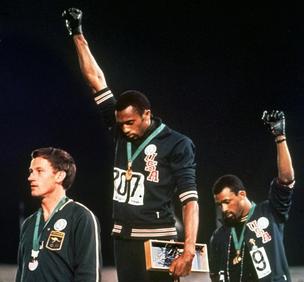
The iconic moment from the 1968 Olympic Games in Mexico City, in which U.S. sprinters John Carlos and Tommie Smith hung their heads and raised their gloved fists after receiving their medals, wasn’t meant to be that way.
The idea that morphed into that image started almost a year earlier, shortly after a young, black sociologist named Harry Edwards arrived at San Jose State University as a visiting professor. Profoundly disturbed by the backlash against the civil rights movement, he co-founded an initiative, the Olympic Project for Human Rights, to leverage the high profile that African-Americans gained when they excelled at sports.
In November 1967, Edwards discussed the project at a Black Students Conference in Los Angeles and proposed that black athletes boycott the Mexico City Olympics that were to take place the following year. The Rev. Martin Luther King Jr. even made an appearance to show his support.
“Our churches were being bombed,” Edwards remembered in a recent interview with WNYC. “Our leaders were being shot down in broad open daylight. Black people were being beaten, driven down the street like basketballs with fire hoses that were so powerful they would take the bark off of trees.
He continued, “We thought that this went beyond trying to get a court judgement to halt this kind of behavior. We thought that it was necessary to bring this to the attention of the world.”
One of the stand-out speakers at that meeting was Lew Alcindor, a 7-foot-2-inch center at UCLA who had taken the college basketball world by storm. He would, by the time he graduated, lead the Bruins to three consecutive national titles and an 88-2 record.
Alcindor — we know him today as Kareem Abdul-Jabbar — had a keen social conscience. He hailed from upper Manhattan and witnessed the riots that broke out in 1964 after police shot and killed a black teenager, and was also profoundly affected by the murder of Emmett Till in Mississippi nine years earlier.
At the November 1967 meeting, Alcindor spoke about those incidents to about 200 fellow athletes and received a standing ovation. Edwards, the sociology professor, knew from that moment that he had at least recruited one person who would follow through on the boycott. In fact, Alcindor didn’t even attend the Olympic tryouts, though his UCLA coach pressured him to do so.
In the end, however, Alcindor was the only black athlete to intentionally sit out the games in protest. Edwards now says a universal boycott would have been impossible, that too many people had too many opinions. Ultimately, the Olympic Movement for Human Rights let athletes decide how to protest, and whether to attend the Olympics.
Alcindor spent the summer in Harlem, leading basketball clinics for Operation Sports Rescue, which taught kids the importance of education. Many of his fellow African-American athletes made the U.S. Olympic Team, and headed off to the Mexico City Games, which were held in October, rather than the summer, because of the heat.
On Oct. 16, the fourth day of the games, sprinter Tommie Smith ran the 200-meter dash in 19.83 seconds, breaking the Olympic, and world, record. His American teammate, Harlem-born John Carlos, came in third. Then together, the two runners took off their shoes and carried them, in their socks, as they mounted the victory podium to protest poverty back in the United States. Smith wore beads to denounce lynching; Carlos wore a black scarf around his neck to show support for black pride. And while the Star-Spangled Banner played over the loudspeaker, they bowed their heads and each held a fist up in the air, covered with a black glove as a sign of black power.
As American black athletes continued to win medals, similar signs of protest appeared. When the U.S. won gold in the 4 x 400-meter relay, three members of the team — Lee Evans, Larry James and Ron Freeman — wore black berets to their medal ceremony and also thrust their fists in the air. When Queens native Bob Beamon cleared an astonishing 29 feet, 2½ inches, shattering the Olympic and world long jump record, he walked to the podium wearing black socks over his sweat pants.
The tradition of black athletes and other celebrities leveraging their fame into political statements goes back to actor and singer Paul Robeson, who also played football in college the NFL; it continued with baseball Hall of Famer Jackie Robinson and boxer Muhammad Ali. But with the 1968 Olympics, as all the world was watching, this tradition reached a new pitch.
“The black athlete is the most influential, most important, most visible black employee this country’s ever produced,” said ESPN commentator Howard Bryant, the author of The Heritage: Black Athletes, a Divided America, and the Politics of Patriotism. “When you start thinking about integration and change in this country, where did it come from? It didn't come from the sciences and the humanities. It really did come from these black athletes.”
The response to the protests in Mexico City were severe. Smith and Carlos were suspended by the U.S. Olympic Committee and expelled from the Olympics. When they returned home, they were treated like traitors. Their athletic careers unraveled. For years they received death threats. They couldn't find good jobs. Their marriages failed, their families suffered. Carlos blamed the suicide of his first wife on the post-Olympic pressures they faced.
Even though his form of protest was less visible, Alcindor received what he would call “a firestorm of criticism, racial epithets and death threats.” In one interview on the "Today Show," NBC sportscaster Joe Garagiola, Sr., suggested Alcindor leave the country if he did not want to put his talents to work for it.
He went back to UCLA, however, and then onto an astonishing career in the NBA, winning six MVPs and becoming the all-time leader in points scored and career wins—a record that stands to this day. Meanwhile, he began his conversion to Islam, and, in 1971, began publicly using the name Kareem Abdul-Jabbar.
Abdul-Jabbar continued to take stands on civil rights issues and, in 2016, emerged as a prominent defender of San Francisco 49er quarterback Colin Kaepernick shortly after he “took the knee” during the national anthem—the latest example of “The Heritage” of social protest by black athletes.
Fall | The Year TV Started Thinking Outside the Box
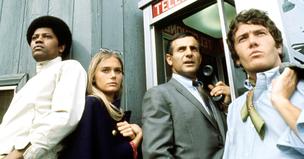
“The Lawrence Welk Show,” “Gilligan’s Island,” “The Andy Griffith Show” — television in its early years was primarily escapist — and white. But in the late 1960s, as racial conflict became inescapable on the streets of American cities, TV producers and writers took notice.
What followed was a series of shows, or story lines of existing shows, that brought more people of color to the small screen, though generally in harmonious relationships with Caucasian characters. The results, especially when seen 50 years later, can be quaint and even amusing — if also, well, dated.
Here are a few notable highlights from 1968:
THE MOD SQUAD: Executive Producer Aaron Spelling gave the crime drama an interracial and youthful slant with this entry about three undercover detectives. Each character sported counter-cultural traits (Clarence Williams III had an afro, Michael grew his hair long, and Peggy Lipton wore bell bottoms) and had been on probation for minor crimes when Capt. Adam Greer (Tige Williams) convinced them to join "the fuzz." The obvious attempt to appeal to a young audience was summed up in the tag line: “One black, one white and one blonde.”
“What strikes me about ‘The Mod Squad’ is that it takes these three people who in regular life would have been hated,” NPR TV Critic Eric Deggans said. “The Black Panthers and the student-led movements that were going on at the time were incredibly paranoid about undercover operatives from the police or the feds encouraging them to get in trouble so they could get arrested. So in the real world these kinds of people were pariahs, but on television, they were heroes.”
HAWAII FIVE-O: Another cop show, this one is probably better remembered for its soaring theme music and alpha-male protagonist (“Book ‘em, Danno”) than any plot lines. Still, the setting of this long-running police procedural (1968-1980) prompted CBS to employ numerous Asians and Pacific Islanders — though as subordinate characters.
“Unquestionably, the white guys are in charge,” Deggans said. “And interestingly, when CBS revived the show in 2010, it was the same formula. There were these two white guys running this unit in Hawaii and all the Asian actors were supporting actors.”
STAR TREK: This science fiction classic also featured a multi-racial cast, and but went further by introducing humanoids from other planets, some of whom (like Dr. Spock, a Vulcan-human hybrid) work alongside earthlings. Though the series debuted in 1966, a 1968 episode featured one of television’s first interracial kisses between a white man (Captian Kirk) and a black woman (Chief Communications Officer Nyota Uhura).
“People paid attention to it,” Deggans said of the episode, “and it’s one of the things that has distinguished ‘Star Trek’ over the years.”
September 24| Studio Museum in Harlem Opens
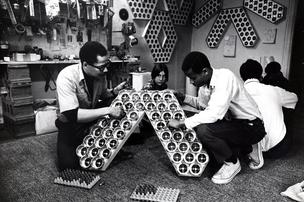
On a September evening 50 years ago, the political went artistic.
Artists, curators, and cultural cognoscenti – black and white -- gathered in a second-floor loft space above a storefront on Fifth Avenue in Harlem on a Tuesday evening 50 years ago top mark the opening of the Studio Museum in Harlem, an art museum to be dedicated to African-American art. On the walls was a series of sculptures in geometric shapes, adorned with light bulbs, the work of Tom Lloyd, one of the few artists at the time who was experimenting in using electronic technology.
“What everybody said is that this was indeed a happening,” said Thelma Golden the current director and chief curator of the Studio Museum in Harlem, who wasn't there that night, but has heard stories about it. “That is, it felt like something different and new.”
The idea for the museum grew out of long-simmering indignation by black artists that mainstream museums were ignoring their work. After Dr. King was assassinated in April 1968, New York’s Museum of Modern Art planned a memorial exhibition, but failed to include a single African-American artist, until just days before the opening. That inspired black artists, activists and philanthropists to organize and open their own space.
From the beginning, the Studio Museum was popular, attracting over 15,000 visitors during its first three exhibitions, including nearly 300 school groups. Later, as the museum prospered, it took over a former bank on 125th Street and turned it into an exhibition space. Three years ago, it announced it would replace that building with one custom-designed as a museum by architect David Adjaye, with Cooper Robertson as executive architects. The new building opens in the year 2021 on West 125th in Harlem.
September 9 | Ugly Teachers Strike Begins
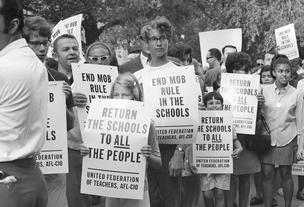
The 1968 New York City teachers strike was one of the ugliest incidents in the city’s history, pitting social reform against racial stereotypes, union solidarity against community activism, and doing very little to improve the equity and quality of the education public school children received.
The story begins about four years earlier, when 460,000 students stayed home in a boycott to protest second-class treatment they received: crowded classrooms, broken-down facilities, insufficient textbooks. When neither the boycott, nor other measures made an impression on the city’s school board, civil rights leaders took another approach: community control.
“Every time we brought in a teaspoon of integration, the Board of Ed threw it out by the shovelful,” said the Rev. Malcolm Galamison, a school integration activist. “And then the black community got to the point where we thought that we ought to have community control of schools.”
In 1967, the city Board of Education agreed to test the idea in a few parts of the city, including Ocean Hill-Brownsville, a largely African-American section of Brooklyn. A local school board of community leaders hired Rhody McCoy, a black educator, as their head administrator, who would have relative autonomy to run the schools in those neighborhoods as he saw fit.
The following April, after the assassination of the Rev. Dr. Martin Luther King Jr., violence erupted at one of the schools, Junior High School 271. The school closed for two weeks, and some of the white teachers said they felt unfairly demonized.
“We said, ‘Before we can go back into that school, you have to tell the children we are not the enemy,’” UFT chapter chairman Fred Nauman told WNYC for a 2000 documentary.
McCoy, exercising his autonomy, fired 13 teachers, arguing they were trying to sabotage the community control experiment.
Every time we brought in a teaspoon of integration, the Board of Ed threw it out by the shovelful.
Nauman and several of the other teachers turned to their union for help. When McCoy told them they should go to the school district’s central office on Livingston Street to be reassigned, they objected, and insisted on getting their old jobs back. The following fall, with no resolution in sight, UFT President Albert Shanker rallied 50,000 union members to go on strike as the school year began.
The strike was resolved, then started again; resolved, then started again, with the city’s central school board ordering the Ocean Hill-Brownsville district to take the teachers back. But McCoy wouldn’t. Meanwhile, the black-versus-Jewish aspect of the conflict became more pronounced, with the Black Panthers and the Jewish Defense League taking sides.
Finally, in November, the union and the city reached a final agreement. The local school board was disbanded, and the teachers went back to work at their old district.
But the wounds did not heal. A poem, written by a former JHS 271 student, which called Shanker “Jew boy” and seemed to threaten the union president’s life, surfaced and appeared in the New York Post. Then, the UFT found an anti-Semitic flyer its officials said was distributed in the Ocean Hill-Brownsville district and made tens of thousands of copies of it to give to each and every public school teacher in the city.
In the end, teachers were on strike for 36 days.
September 7| Miss America Under Attack
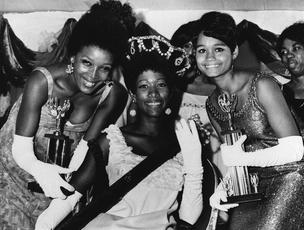
On September 7, 1968, the Atlantic City boardwalk was buzzing, partly because the Miss America Pageant was taking place that night but also due to a group of women protestors stationed outside Convention Hall.
The protest was organized by a feminist group called New York Radical Women, and their argument was that the pageant was overtly sexist. They changed, sang, and threw their bras into a trash bin on the boardwalk, all while mostly unsympathetic onlookers walked past.
Of course, those involved in the competition saw it differently. Pageant Director Albert Marks, also known as "Mister Miss America," noted the pageant was entirely volunteer-run (he oversaw it for 25 years without pay) and provided academic scholarships to women. That’s not to say that Marks himself was a champion of women's liberation.
"Being a male 100 percent," he told NPR reporter Eleanor Fischer, "I wonder how many of these females, out on the boardwalk, if they had a man, would have the time to do what it is they’re doing. Maybe there’s an omission here that leads to frustration."
That night, few blocks away, another form of protest was taking place.
In a different Atlantic City hotel, the nation's first Miss Black America Pageant was underway. Nineteen-year-old Saundra Williams took the title. She said the black pageant sends a much-needed message: "Black beauty is equal to the beauty of the white woman, and it can be represented, and we as a race should be proud."
The Miss Black America pageant continues today. You probably know a very famous contestant: Oprah Winfrey competed as Miss Black Tennessee when she was 17.
The 1968 boardwalk protest against the Miss America pageant made a lasting impression. It gained national attention, and was largely seen as the arrival of the women's liberation movement in the national consciousness.
Black beauty is equal to the beauty of the white woman, and it can be represented, and we as a race should be proud.
That was fifty years ago, and the pageant continues today along with controversy around it. Last fall, the Miss America Organization all but collapsted after emails between the organizers were made public, including emails from then-CEO Sam Haskell, including sexist and vulgar terms to describe the contestants. Haskell was ousted; Regina Hopper has taken his place, and former Fox News host Gretchen Carlson has been brought on as chair of the board.
Carlson says, this year’s event signals a turning point. They’re no longer calling it a pageant; now, it’s a competition. And they’re putting an end to the swimsuit portion of the competition.
“We’re adding in this new caveat that we’re not going to judge you on your outward appearance because we’re interested in what makes you you,” Carlson said on Good Morning America in June of 2018. “Tell us about your goals and your achievements in life."
A new Miss America will be crowned on Sunday, September 9th.
July 17| When Humor and Horror Had Social Bite
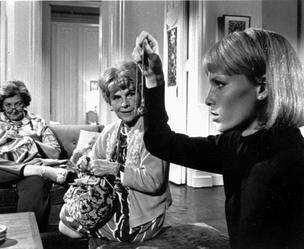
From "The Odd Couple" to "Rosemary's Baby," New York City played a big part in the films released in 1968. Vox's movie critic Alissa Wilkinson lays out some of the year's biggest blockbusters, and why many of them still resonate today:
The Odd Couple: A comedy that begins with a suicide attempt, Neil Simon's play-turned-flick gets lighter as it progresses and pokes fun at gender norms. "A lot of the humor comes from the fact that these men can't imagine themselves without the women they used to live with," Wilkinson says. "Yet the joke of the film is that the women of the film — whom we never see — have everything together and [the men] are hopeless without them."
The Producers: Just more than two decades after the end of World War II, making jokes about Hitler was still taboo. "The question is, when is it too soon to laugh at something? When you watch the 'Springtime for Hitler' musical, it is funny, but it's because they tried so hard to make something bad that they made something good," Wilkinson says. "It connects to the comedy of today by making political figures feel smaller."
Funny Girl: "People think of it as something light or trivial," Wilkinson says. "However, 'Funny Girl' is a story about a young women making her own way in the world and much of it is about Jewish identity in New York. It's actually a dark story once you get to the end of it and it tapped into questions of feminism and relationships."
Rosemary's Baby: "The most interesting thing is that it captures well the feeling of living in a society where you, as a young woman, are being told what to feel by different people and not really having agency over your own body," Wilkinson says. "It's about a woman's autonomy over her own body. It's placed in a horror film because it's as visceral a feeling you can possibly have as a woman." Horror has never been considered a highbrow genre, yet "Rosemary's Baby" influenced one of the most ingenious works of social commentary in recent years: Jordan Peele's 2017 indy hit "Get Out."
June 8 | Saying Goodbye to 'Bobby'
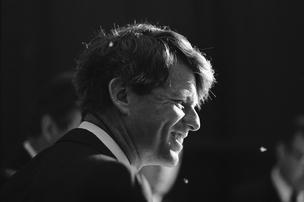
On June 8th, 1968, thousands of mourners filled St. Patrick's Cathedral in Manhattan to honor the life of Robert F. Kennedy. The senator from New York, a champion of progressive ideals, had been shot in Los Angeles three days earlier after winning the Democratic primary in California.
"My brother need not be idealized, or enlarged in death beyond what he was in life," his younger brother Teddy said in the eulogy. "He should simply be remembered as a good and decent man who saw wrong and tried to right it; who saw suffering and tried to heal it; who saw war and tried to stop it."
It was precisely what Bobby Kennedy sought to achieve in his life that made his death so tragic to Americans across the country. A politician who was converted to the fight for civil rights late in his career, Kennedy spent his time as New York's senator touring the country to bring awareness to poverty and inequality, particularly in communities of color.
"My grandmother has a picture of the Kennedy brothers on her wall," said filmmaker Dawn Porter, director of the Netflix documentary series Bobby Kennedy For President. "I always grew up understanding that the Kennedy's were very, very, important to black people."
In New York, Kennedy brought his fight for racial and economic equality to the Brooklyn, where he picked Franklin A. Thomas to run the Bedford-Stuyvesant Restoration Corporation.
"In my dealings with him, he was straight up, straight at you and clear," Thomas says in the documentary. "He was tough as nails."
Pushed by progressives to run for president against incumbent Lyndon B. Johnson, Kennedy's campaign was picking up speed when he won the Democratic primary in California. Hours after the victory, the 42-year-old was shot and wounded in the kitchen of the Ambassador Hotel in Los Angeles. He died the next day, on June 6th, 1968.
He should simply be remembered as a good and decent man who saw wrong and tried to right it; who saw suffering and tried to heal it; who saw war and tried to stop it.
Just five years after the assassination of his brother, President John F. Kennedy, Bobby's death shook the nation. Kennedy's casket traveled across the country by train, bringing scores of Americans to the railroad tracks to pay their respects as the deceased senator passed. During the public viewing at St. Patrick's Cathedral, The New York Times described the collective grief as "deep... and often overwhelming. [The viewers'] faces were drawn, their eyes were wet and the sobbing was often uncontrollable."
Though his influence as a crusader for peace and equality reached across the country and around the world, RFK left a unique legacy in New York.
"We typically think of the Kennedy's as a Massachusetts's family, but Kennedy was the senator from New York and he never forgot that," said Porter.
June 3 | Courting Fame and Vulnerability: The Shooting of Andy Warhol
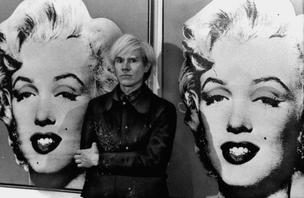
Widely considered the leader of the pop art movement throughout the 1960s, Andy Warhol was an artist who constantly sought the spotlight. He made eye-catching art out of everyday objects like soup cans and portraits of stars like Marilyn Monroe. When he was not making art, he was intentionally cultivating his social network.
"He collapsed the boundary between high art and popular culture, and he also returned realism to art after the reign of abstract expressionism and abstract painting," said WNYC's Art Critic Deborah Solomon.
Warhol, born in Pittsburgh in 1928, worked in his Manhattan studio known as The Factory, where the cutting-edge artists of the day flocked. He gravitated toward fame and association with glamorous celebrities throughout his career, all the while maintaining his shy and soft-spoken persona.
"His job was to be Andy Warhol," said WNYC's Sara Fishko, who has previously reported on Warhol. "He put on whatever he put on, his outfit and makeup, or wig, glasses, and went through his day as that person."
But Warhol's lifestyle and the free-spirited tenor of The Factory also made him exposed and vulnerable in a tumultuous era. On June 3, 1968, Warhol was shot in his studio by 30-year-old actor Valerie Solanas, who had had one of her scripts reportedly rejected by Warhol. In her bitterness and rage, Solanas attempted to kill him.
I can't think of too many in that category, who were so present in the minds and views of people on the streets of New York, and who believed that nothing would happen to them.
"In some way, he had let Valerie into his life, and by being Andy Warhol, he'd created a disappointment she could not live with," said author Stephen Koch said in "Andy Warhol: A Documentary Film."
Solanas plead guilty to assault and was sentenced to three years in prison. She was later diagnosed with schizophrenia.
Warhol survived the shooting after extensive surgery, but carried the scars on his torso with him for the rest of his life. He died after complications from a gallbladder infection in 1987, in part because he had refused to return to the hospital for treatment in the preceding months.
To some, it was miraculous that Warhol insisted on leading such an accessible life, despite his widespread fame -- especially in the late 1960s, at a time of escalating civil unrest and assassinations of famous figures.
"I can't think of too many in that category, who were so present in the minds and views of people on the streets of New York, and who believed that nothing would happen to them," said Fishko. "Everything changed. I think this was a period of tremendous change for art, for the city, for the culture, for politics. For everything."
April 27 | Coretta Scott King Speaks
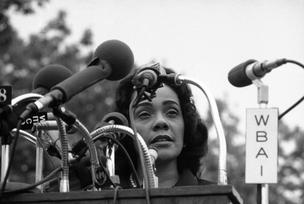
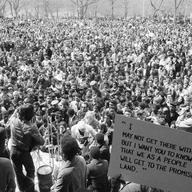
Just three weeks after the assassination of the Rev. Dr. Martin Luther King Jr., Coretta Scott King traveled to New York City to deliver an anti-war speech to thousands of people gathered in Central Park. She stood on the stage where he husband had been scheduled to stand, giving a speech based on notes found in his jacket pocket after he died.
"I simply read them to you as he recorded them,” Scott King solemnly told the crowd. “And I quote: Ten Commandments on Vietnam.”
King’s commandments condemned the U.S. government’s narrative and framing of the war, rejecting the notion of America as a liberating force for the Vietnamese people. Later in the speech, Scott King, who had long opposed the Vietnam War and convinced her husband to come out publicly against it, went on to expand on his Ten Commandments. A passionate advocate for the poor, Scott King explained how America’s investment in the war and its disregard for poor people were intimately intertwined.
“[There is a] kind of seamlessness with which she's moving back and forth between [what is] wrong with what the United States is doing in Vietnam with what is wrong with how the United States treats its citizens at home,” said Jeanne Theoharis, political science professor at Brooklyn College who has written extensively about Scott King’s influence on the civil rights movement.
She gave me her address, I wrote her a thank you note, a handwritten one. She wrote me back personally.
Theoharis says history misremembers Coretta Scott King as a bystander to the tumultuous era of the 1950s and 1960s. To truly understand the political evolution of Dr. King, and how the civil rights movement progressed after his death, Theoharis suggests taking a closer look at Coretta Scott King.
"I think sometimes the way we mark the assassination of Dr. King is this long ago horrible tragedy that kind of ends the movement. And I think when we center Coretta Scott King, we see that the movement continues," said Theoharis. "We see that the ideas that animated Dr. King's life carry on in people like Coretta Scott King, and get expanded with the work that she does for the next 40 years."
Those who knew Scott King personally remember her as a warm and gracious woman. Suzan Johnson Cook, a reverend and former ambassador-at-large for religious freedom under President Barack Obama, first met Scott King at an event in New York City when Johnson Cook was a young girl.
"She gave me her address, I wrote her a thank you note, a handwritten one. She wrote me back personally, and that was the beginning of our relationship," Johnson Cook said. "For a ten year old girl to receive a note from Mrs. Coretta Scott King in those days was such a marvelous move."
Given Scott King's devotion to civil rights, Johnson Cook said her legacy as a leader of the movement should be widely recognized.
"I knew her when she was great and alive, but I'm glad the rest of the world is coming to know who Coretta Scott King was," said Johnson Cook. "Not just meek and by the side, but in the front."
April 23 | The Columbia Sit-In
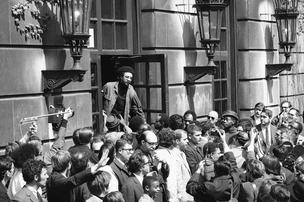
In late April 1968, student protesters threw Columbia University into turmoil. Hundreds of students took over several campus buildings in protest of the university's proposed construction of a gymnasium in a public park and its links to the Vietnam War. The students refused to leave until the university agreed to their demands.
By the time the protests came to a close, more than 700 students had been arrested.
"We were a generation of people who watched on TV the napalming, the aerial chemical bombardment of civilians," said Nancy Biberman, who took part in the protests as a member of Students for a Democratic Society. "[It] was grotesque, it was outrageous, and it enraged young idealistic students who thought that our government shouldn't be behaving in this way."
We're contemplating possibilities now that we wouldn't have thought about generations ago. On the other hand, the struggles continue.
The protests were organized by the SDS and the Students' Afro-American Society, which was strongly opposed to the proposed gymnasium in Morningside Park in Harlem.
"Black students were occupying Hamilton Hall, adjacent to Harlem, which had just exploded in response a few weeks earlier to Dr. King's slaying," said Raymond Brown, a prominent student organizer with the SAS at Columbia University.
Because of the proximity to Dr. Martin Luther King's death, Brown said, city and university officials were cautious about how to deal with the protesters.
"So it lasted longer than most comparable demonstrations," Brown told WNYC's Jami Floyd.
Despite their unifying passions, Brown said there were large rifts between African-American students and white students when it came to their demonstration strategy. According to Biberman, women were also sidelined in the decision making process and excluded from leadership positions among the organizers.
Half a century later, Brown said he sees their action as one chapter in an ongoing lineage of political resistance.
"We're contemplating possibilities now that we wouldn't have thought about generations ago," Brown said. "On the other hand, the struggles continue."
The accounts of Brown, Biberman and other students can be found in the book A Time to Stir, Columbia '68.
April 11 | The Struggle for Equal Housing
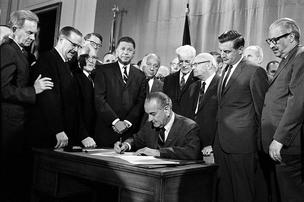
On April 11, 1968, the Fair Housing Act was signed into law by President Lyndon Johnson. Passed in the same month King was shot and killed in Memphis, Tennessee, the bill was a groundbreaking moment for the Civil Rights Movement, prohibiting discrimination on the basis of race, color, sex, religion, or national origin.
But half a decade later, housing discrimination remains a pervasive issues, said Fred Freiburg, the executive director of the Fair Housing Justice Center.
"When we talk about all of the modern day inequalities that exist in our society, you really can point to housing and where you live as being fundamental in that cycle," Freiburg told WNYC's Jami Floyd.
The organization takes an aggressive approach to investigating and rooting out housing discrimination in the New York City region. Among other tactics, such as filing lawsuits on behalf of claimants, the housing center hires actors to meet with landlords and collect information to see whether or not they are being illegally discriminated against.
Some of the actors, known as "testers," who have faced discrimination say the experience is deeply upsetting.
"What I take away from it is how devastating it is when you find out that you've been discriminated against," said Justin, who declined to use his last name. "Even though I'm an actor, even though I'm portraying a role."
"The impact that it has on you emotionally, it just cannot be overstated. It's just a really sick feeling in the pit of your stomach," he said.
According to Freiburg, housing discrimination is one of the building blocks of maintaining segregated neighborhoods.
A recent report authored by New York City Council Member Brad Lander found that New York City remains more segregated between black and white residents compared to other U.S. cities. More than 80 percent of New Yorkers who are white or black, according to the report, "would have to move to a different neighborhood" for black and white residents to be equally represented across the five boroughs.
April 4 | When King Was Killed
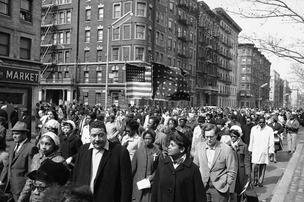
As news spread of Martin Luther King Jr.'s assassination in Memphis, Tenn., hundreds of thousands of people took to the streets across the country in grief and anger. Newark, Baltimore, Chicago and Washington D.C. saw full-blown riots that were met with a heavy police and military presence and resulted in more than 40 deaths.
Although there were reports in New York City of fires and property damage, the nation's largest metropolis remained relatively calm on the evening of April 4, and again the following day. Mayor John Lindsay himself walked through Harlem soon after he heard the news, and his presence and demeanor are often credited for the absence of violence and chaos.
"It became clear that there were people out in the streets in Harlem that night, and that's where he needed to be," said Clay Risen, author of A Nation on Fire: America in the Wake of the King Assassination.
The following day, Lindsay spoke about what he had witnessed in the streets of Harlem.
"I most certainly found the mood in New York City during my tours last night to be one of great grief, emotion, very deep emotion, with people weeping, and frustrated and lonely," he said. "And terribly lost and let down."
I most certainly found the mood in New York City during my tours last night to be one of great grief, emotion, very deep emotion, with people weeping, and frustrated and lonely. And terribly lost and let down.
Lindsay was a progressive Republican in an era fraught with racial tension and class division. Long before the moment he stepped out into Harlem that night, he had shown himself to be an advocate for civil rights, according to Errol Louis, a NY1 news anchor and former director of urban reporting at CUNY's Graduate School of Journalism.
Footage courtesy of the NYC Municipal Archives with assistance from the Museum of the City of New York.
"All of his career leading up to that he was taking some very unpopular political stands that would be unthinkable for a Republican in the current generation," Louis told WNYC's Jami Floyd.
In other words, it wasn't just the mayor's actions on that night that could explain the lack of an uprising in New York City.
Fifty years after the assassination of Martin Luther King Jr., Louis said New York City could use more political leaders who insist on solving the issues the civil rights leader passionately pursued.
1968: 50 Years Later is written by Jami Floyd, with production help from Mara Silvers, Katherine Fung, Malik Badjie and Rachel Smith. Matthew Schuerman is the editor. Darnell Jefferson contributed reporting to the Co-op city segment. Special thanks to WNYC Archivist Andy Lanset and the NYC Municpal Archives for permission to use archival audio throughout this series. Background music comes from the Free Music Archive. Brooklyn Deep contributed audio from its upcoming podcast "School Colors" for the segment on the teachers strike. The audio in the Yale segment is from the Manuscripts and Archives of Yale University Library (Kingman Brewster, Jr., president of Yale University, records [RU 11]).