Check Ahead: 'Dinner With Lenny, The Last Long Interview With Leonard Bernstein'
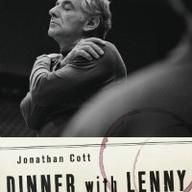
In November of 1989, one year before his death at age 72, the celebrated composer, conductor and educator Leonard Bernstein held what would be his last major interview -- with Rolling Stone editor Jonathan Cott. The twelve-hour visit at Bernstein's country home in Connecticut was fueled by vodka and asparagus hors d'oeuvres, and yielded a frank, passionate, and at times salty conversation on topics ranging from Stravinsky to Oliver Sacks; The Kabbalah to the Kinks. A portion of the interview appeared in the pages of Rolling Stone in 1990. Now, the edited conversation is available in its entirety in the book Dinner With Lenny: The Last Long Interview With Leonard Bernstein.
The work is hardly a straightforward question and answer session. Cott begins by setting the scene -- just before dinner time, with a tour through the cozy 1750s farmhouse that Bernstein called home. Read on for an excerpt from the book, out now from Oxford University Press.

Advisory: This excerpt contains language that some readers may find offensive.
-----
Leonard Bernstein was not one for celebrity interviews. “I don’t have favorite orchestras, favorite composers, favorite symphonies, favorite kinds of food, favorite forms of sex,” he warned me with a smile when I arrived at his New England country home in Fairfield, Connecticut, on the windy Monday afternoon of November 20, 1989. “So don’t ask me those ‘favorite’ journalist questions.”
“I won’t, I won’t,” I promised.
The then seventy-one-year-old white-haired but boyishly ebullient maestro, wearing a sweater and linen slacks, beamed, and led me into the cozy, white-clapboard, ten-room 1750s farmhouse, filled with early American furniture and antiques and bookshelves overflowing with volumes on, as he told me, “every subject under the sun.”
(I decided not to ask him to name his favorite book.)
“Dinner won’t be ready for a couple of hours,” Bernstein informed me, “so would you mind if we went over to my music studio and listened to a recording I made about twenty years ago of the Sibelius First Symphony? I’m supposed to perform the work in a few months with the Vienna Philharmonic and I haven’t listened to this old performance for years.”
So we made our way across the grounds of gingko, mulberry, Japanese maple, and half-weeping cherry trees to the nearby barn-red music studio (formerly a spacious groom’s quarters), on whose walls hung scores of drawings, paintings, and photographs, many of them signed. Seeing me eyeing them, Bernstein acted as my docent and gave me a short tour around the studio, and he provided me with a running commentary about those whom he referred to as his “heroes,” among them Abraham Lincoln (“That’s the famous Mathew Brady portrait of him without a beard”); John and Bobby Kennedy (a portrait taken by Richard Avedon); the legendary French music teacher Nadia Boulanger (pinning the ribbon of officier of the Légion d’Honneur on Bernstein’s lapel); and the writer Boris Pasternak (greeting the conductor in his dressing room after a 1959 concert in Moscow where, according to Bernstein’s biographer Humphrey Burton, he told the conductor: “You have taken us up to heaven, now we must return to earth. I’ve never felt so close to the aesthetic truth. When I hear you I know why you were born”).
Then Bernstein pointed out to me photos of the film director Luchino Visconti (who directed the acclaimed 1966 Vienna State Opera production of Verdi’s Falstaff conducted by Bernstein); the baritone Dietrich Fischer-Dieskau (who sang on Bernstein’s ravishing recording of Mahler’s Das Lied von der Erde with the Vienna Philharmonic); the playwright Adolph Green (who cowrote the lyrics for Bernstein’s musicals On the Town and Wonderful Town); the pianist Glenn Gould, for whom he harbored a special respect and affection (“There he is, my man, my baby!”); and a painting by an unknown artist of the actress Greta Garbo holding a Tarot Card depicting “The Lovers.” (In 1945, the producer Hal Wallis of Paramount Pictures seriously discussed the idea of making a “biopic” in which Bernstein would have played Tchaikovsky and Greta Garbo would have played Baroness von Meck, the composer’s patroness.)
He next showed me striking drawings of Beethoven and Mendelssohn; a self-portrait of Arnold Schönberg; and photographs of other twentieth-century composers such as Jean Sibelius, Aaron Copland, Marc Blitzstein, Lukas Foss, and one of Igor Stravinsky’s grave at the San Michele Cemetery in Venice. (When I brought up the name of Stravinsky’s collaborator, Robert Craft, Bernstein exclaimed: “Robert Craft—I could kill him—I mean, he spoiled such a lovely relationship between Stravinsky and myself.”) There were also photographs of some of his most admired conductors: Serge Koussevitzky (“My great Koussie!”), Bruno Walter, Pierre Monteux, Fritz Reiner (“My great master!”), Arturo Toscanini (“I have lots of Toscanini, he gave me many autographed pictures”), Carlos Kleiber (“What a genius, he’s a magician!”), and a blazing-eyed Dmitri Mitropoulos—his predecessor as music director of the New York Philharmonic (“It never occurred to me to be a conductor until Mitropoulos one day said to me, ‘You must be a conductor!'”).
Finally, Bernstein concluded the tour by leading me to his most cherished photograph, one that pictured him and his late wife (the Chilean-American actress Felicia Montealegre who died in 1978) seated together at a piano. Then he gently pushed me into a chair next to a table on which lay some Egyptian camel bells that Bernstein now picked up and shook, as if to signal the imminence of our listening-session, and proffered me a glass of vodka, particularly appropriate for the wintery Finnish music to come.
Dragging, amid fits of coughing, on a cigarette dangling from his lips, Bernstein rummaged through a collection of ancient LPs, dug out a still-pristine copy of the Columbia Records album of the Sibelius First Symphony featuring the New York Philharmonic (“a much-underrated orchestra,” the maestro commented), and placed it on a turntable. Softly, a solitary clarinetist began to unwind a seemingly endless sinuous and forlorn melodic line, over which Bernstein, in a tone of mock-grandiloquence, announced: “And did you know that the president of Finland anointed me Commander of the Order of the Lion in 1965?”
Passing his own vodka glass from one hand to the other, Bernstein then started to sing—humming, crooning, moaning, shouting-out gospel-style—as he conducted and danced along to the four movements of the symphony (written in 1898 when the composer was thirty-three). All the while he added recitative-like interpolations, explanations, words of approval and disapproval, and assorted comments for my benefit about this impassioned, mercurial, wildly inventive work.
“Listen, child!” the maestro announced to me. “Here’s the Jewish rabbi theme . . . There’s Beethoven . . . There’sTchaikovsky—it’s Swan Lake —and just wait for some Borodin and Mussorgsky later on . . . Some Grieg (but better than Grieg) . . . And now comes Sibelius—just listen, that’s unmistakably Sibelius. [L.B. sang and quickly wrote out for me on an old envelope the distinctively Sibelian rhythmic cell we’d just heard: Dah-dedum-dum.] Now, a wind . . . sighing . . . And now a pop song [singing] ‘What-did-we-do-till-we-loved?’ . . . Yeah, that’s completely Carousel . . . And now a breeze comes along.” Then, as the gorgeous Andante movement came to a close, the now-motionless maestro, glass upraised, bent his head and closed his eyes.
“There sure are a lot of borrowings in there,” I said, breaking the spell.
“But it’s so marvelous how all music is tied up together!” Bernstein replied enthusiastically, as he went over to the turntable to turn over the record. “I mean, I could go through Stravinsky’s Rite of Spring with you and point out what comes from Mussorgsky and Ravel—note-for-note passages from Ravel—outright, out-fucking-rageous steals! I could go through Beethoven at his most revolutionary, bar by bar, and show you the derivations from Handel and Haydn and Mozart.”
“What about Carl Orff?” I asked. “If you took Stravinsky’s Les Noces out of Carmina Burana, you wouldn’t have much left, would you?”
“Orff took nine-tenths of the style from Stravinsky’s Les Noces and the other tenth from Israeli horas. [L.B.was now off and away singing and dancing a hora, pounding the table as he went along.] And Orff was such a Nazi. Of course, the Israelis stole from the Romanians. So? It’s Stravinsky plus Jewish horas from Romania.
Because a composer is the sum total of his listening experience . . . plus the voice and jism that belong specifically to him: ‘I am Wolfgang Amadeus!’ ‘I am Ludwig!’ ‘I am Igor Fedorovich!’ ‘Me, me, Sibelius!’ And that makes them instantly identifiable to listeners with sensitive ears. And it’s in that sense that I can prove to you in my Talmudic way that Stravinsky’s Le Sacre is not a revolutionary piece and that it is a revolutionary piece because there’s never been anything like it, before or since.”
“Picasso,” I said, “once remarked that ‘good artists copy and great ones steal.’ ”
“Right. And part of the artifice of art is knowing how to steal classy .”
“But what if it’s unconscious?” I asked.
“Of course. It’s all unconscious.”
“There’s such a thing as a classy unconscious steal?”
“If you’re a good composer,” he replied, “you steal good steals.”
Bernstein now walked over to the turntable and started to play the symphony’s Scherzo and Finale movements. After a few minutes, a particularly passionate string passage (“Jerome Kern would be very proud of this melody”) forced from him a sweeping upward right armed movement and the instruction (to invisible violins):
“Now sing it on . . . stand up and sing!” Then, a moment later (to me): “Did you catch Jimmy Chambers on horn and Harold Gomberg on oboe? What great guys! They don’t make them like that anymore.” At that moment, there was a sudden pause in the score. “I have no idea what’s coming,” Bernstein said, his arms frozen in midair. And then, slowly, as the Finale began gradually to rise to its blazing climax, the symphony all at once stopped dead in its tracks. Lights out.
“What happened to the record?” I asked.
“That’s the ending,” Bernstein said to me as he lifted the tone arm. “Dum . . . Dum. Two chords. That’s it. No diminuendo, no ritard, no nothing . . . as if to say: ‘Fuck you, if you don’t like it, go home!’ And that’s very twentieth century.”
“In what way?” I asked, as Bernstein walked over to the couch next to mine and sat down.
“I went to see a Broadway revival of The Threepenny Opera the other night,” he told me. “A completely misconceived production . . . but just experiencing that score again, and that Bertolt Brecht libretto, which I’ve loved all my life!”
“Did you ever conduct it?” I asked.
“I did the world premiere of the Marc Blitzstein version at Brandeis University in 1952—he did the major translation of all time but nobody uses it anymore—with a nine-piece band including a banjo and piano, and with Lotte Lenya playing Jenny. But in this new production—and this is just apropos of Fuck-you endings—John Dexter [the late English theater and opera director] really screwed up because he didn’t have a conception.”
“Isn’t the English rock musician Sting playing the role of Macheath?” I asked.
“Sting is great . . . or could have been great,” Bernstein replied. “That isn’t the problem. Frank Rich [the then chief drama critic for the New York Times] reviewed it and got it all wrong—he hated it but for the wrong reasons.What do they know, critics!”
Leonard Bernstein’s assistant had earlier prepared and brought down to the music studio a tray of vegetable hors d’oeuvres. And now Bernstein leaned over and passed me a plate.
“Ummm,” he said, “what good asparagus, Jonathan, dip it in the hummus. And since dinner isn’t ready yet, let me pour you another glass of vodka. You’re allowed.”
Well, when in Finland, I thought, do as the Finns do—especially when your host is a Finnish Commander of the Order of the Lion. So I let the Commander replenish my glass.
“And now let’s press the Rewind Button,” Bernstein said.
“The Rewind Button on my tape recorder?”
“No, I mean the Rewind Button in your head . I want to do a fast rewind.”
“Do you have an Erase Button in your head, too?” I asked him. “That would be extremely useful.”
“No, you can try, but it will all come out in your dreams anyway. . . . But anyway, the point of my talking about The Threepenny Opera is that so many of those numbers are informed by what Brecht called the Verfremdungseffekt—the alienation effect. It’s just like the ending of Peachum’s song Das Lied von der Unzulänglichkeit [“The Song of Insufficiency”]—duhde-duh dum-dum. Done. You don’t try to enlist the audience’s sympathy, you don’t go for a hand, you just do your thing straight out. You say: This is the play, we’re actors, this is what we have to say—you pay to watch it, O.K., and if you don’t like it, go home. Like the last two chords of Sibelius’s First Symphony—there’s no ending, no goodnight.
“And in this production John Dexter always tried to go for a hand—the entire production was geared to make the audience like them. They ended every song with a strike-a-pose and lights-go-up and now-let’s-hear-the applause. But this goes against the grain of Brecht’s and Weill’s intent. And then there was poor Sting, who was born to sing the role of Macheath, but not surrounded by marvelous opera singers who made him sound like an asshole. In “Cannon Song,” Macheath trades lines with Tiger Brown about their days in the army and “Beefsteak Tartare” and all those incredible lyrics [sings: Sol-datenwohnen/Auf den ka-no-nen/Von Cap bis Cooch-Behar (“Soldiers live/On their cannons/From the Cape to Cooch Behar”)].
“Now, all the actors were body-miked, and Tiger Brown was played by Larry Marshall, who’s a terrific baritone, so his voice came out Rrrrrr and, by comparison, Sting’s voice was nothing —even with a mike. I mean, he’s got this rock voice, what are you going to do? He’s great, but you don’t show him up by surrounding him with all those marvelous singers with their great trained voices.”
“So you’d have to choose either one type of singer or the other,” I remarked.
“Actually,” he replied, “ The Threepenny Opera should be done by sort of amateurs, like Lotte Lenya, who was the original Polly Peachum and who sang those songs in a semi-professional manner, with no vibrato, and in a Berlin-1920s rough kind of way. It should be done with all the voices like that, or if you want great singing, do it with life-size puppets and a great pre-recorded sound track.”
“So how did you go about casting West Side Story?” I asked.
“Casting that show was a very tough problem because the actors had to be able to sing and dance and be taken for teenagers. Hah! Impossible! Everybody said we were crazy and to just forget it. Columbia Records didn’t want to invest in it or record it, so Steve Sondheim [who wrote the lyrics] and I auditioned it like crazy, playing the piano four-hands and screaming it out, trying to convey a quintet or all the contrapuntal things, those crazy fugues like the twelve-tone “Cool” fugue. No one, we were told, was going to be able to sing augmented fourths—Ma-reee- aaaah—C to F#. Impossible! Also, they said, it was too rangy for pop music—Tonight,Tonight. . . it just went all over the place. Besides, who wanted to see a show where the first-act curtain comes down on two dead bodies lying on the stage? That’s Not A Broadway Musical Comedy.
“So we were very much discouraged. And casting it was the ultimate problem: trying to find teenagers or people who looked like teenagers or who, with the aid of a hair piece and some good makeup, could pass for teenagers. So we settled on a mixture—some were actual teenagers, some were twenty-one years old, some were thirty but looked sixteen. Some of them were wonderful singers but couldn’t dance very well. Or there were great dancers who couldn’t sing very well . . . and if they could do both, they couldn’t act. We went through hell.
“And I’ll tell you one thing: it saved Columbia Records’ ass. Because finally they did record it, reluctantly, under protest—and it kept them from going bankrupt. They had just recorded my Candide, which was a flop on Broadway—it ran some two hundred performances and died—though that record eventually became a cult album. But 1957, when West Side Story opened, was a very tough year for record companies, which had always depended on their pop sales for solvency. You can’t make money releasing the complete recordings of Stravinsky conducted by Stravinsky. So Goddard Lieberson, who was the president of Columbia Records and who was interested in classical music, would balance his losses on classical music with their pop sales in order to do a little Copland or a little Stravinsky. But in 1957 their pop music albums weren’t selling. Bebop’s appeal was limited and was practically over.”
“But Columbia Records had Johnny Mathis,” I mentioned.
“Right, that’s the thing they could sell. Smarmy pop music.”
“Also, Columbia Records didn’t get into rock ’n’ roll in the late fifties, even though the birth of rock ’n’ roll was several years old by then,” I mentioned.
“Honey child, there was rock ’n’ roll in the late 1930s—before you were born—so don’t tell me that!” Bernstein exclaimed. “I first heard the phrase rock ’n’ roll in a song that Ella Fitzgerald recorded with the jazz drummer Chick Webb and His Orchestra for Decca in 1937—it was called ‘Rock It for Me.’ It says, opera’s out, rock ’n’ roll’s in. You don’t know it? Do you want to hear some of it?”
“You remember it after half a century?” I said disbelievingly.
Undaunted, Bernstein now began to sing, snapping his fingers, growling the horn riffs, and banging on the table in a memorable performance: “So be-heat it out in a mi-hi-nor key/Oooh! Rock it [baf!] Rock it [baf!]/Oh, won’t you ro-hock it for me (WAH!).”
“Wow!” I said. “That’s really like an early version of Chuck Berry’s ‘Roll Over Beethoven.’”
“That was the first time I heard about satisfyin’ my soul with rock ’n’ roll,” Bernstein told me, “and I used to go wild when I heard Ella (my angel!) sing that song. . . . So, here am I giving you an education. You can always learn something! [Looking at his watch] But we’ve been talking for more than two hours, Jonathan, and dinner is probably waiting for us. So let’s continue the conversation over our meal.”
[L.B. and I make our way back to the main house and sit down at the dining room table. As L.B. pours each of us a glass of red wine, his assistant, who has prepared dinner for us, comes in to greet us with two plates of radicchio salad.]
It’s so nice of you to have invited me for dinner.
--
Reprinted from Dinner with Lenny: The Last Long Interview with Leonard Bernstein by Jonathan Cott with permission from Oxford University Press USA Copyright © 2013 by Jonathan Cott.

WNYC is funded by sponsors and member donations