Musica Sacra
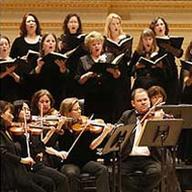
Musica Sacra, in the expert hands of their exciting new director, Kent Tritle, continue to show that they can sing anything from medieval to modern. Harnessing the distinctive cathedral-like properties of the Winter Garden, they perform two masterworks of 20th century choral music: Morton Feldman’s Rothko Chapel and Arvo Pärt’s Stabat Mater. Both works straddle the border between the secular and the spiritual, the vocal and the instrumental. And both have an ethereal sound that fill the Winter Garden with its glow.
Arvo Pärt’s meditative Stabat Mater (1985) is scored for a trio of singers: soprano, alto, and tenor; and a trio of string instruments: violin, viola, and violoncello. It’s another of his self-described “tintinnabuli” works, reminiscent of bells ringing and influenced by early music. His tintinnabular formula suggests that one plus one equals one, not two (i.e., the melody and the accompaniment are one), and this slow, meditative piece remains one of Pärt’s signature works.
Morton Feldman’s emotionally vast “Rothko Chapel” (1971) was written for Rothko’s array of paintings in Houston and scored for viola, solo soprano, chorus, percussion, and celesta. Yet while there are voices, there are no words. Rothko had committed suicide in 1970, and Feldman, who had become his close friend, responded with this personal and affecting choral masterwork. Although Feldman did not conceive of art as a medium for sending messages, writer Alex Ross posits that “Rothko Chapel,” is perhaps something of a Holocaust memorial, and more than a tribute to a single individual.

Musica Sacra is the longest continuously performing professional chorus in New York City, and stands alone in its ability to change one’s perception of choral singing forever. The group’s efforts are neither sectarian nor religious; rather, Musica Sacra is deeply committed to an artistic medium, which seeks communication through the most profound human experience. Musica Sacra has performed in all styles, from the chant of Hildegard to commissioned works and first performances of leading contemporary composers, such as Diamond, Britten, Khatchaturian, Convery and Rorem. They have recorded on RCA, BMG and Deutsche Grammophon music ranging from Handel (the first complete all-digital Messiah, in 1981, and still available), to Schoenberg, Bruckner and Meredith Monk.

Kent Tritle is one of America’s leading choral conductors and organists. He is also founder and music director of Sacred Music in a Sacred Space, the acclaimed concert series now entering its nineteenth season at the Church of St. Ignatius Loyola in New York City. In addition, Mr. Tritle is Music Director of the Oratorio Society of New York, New York City’s second oldest cultural institution. Kent Tritle is Organist of the New York Philharmonic. Mr. Tritle was named Associate Conductor of Musica Sacra of New York, Inc. and elected to their Board of Directors in 2006. In January of 2008 he became the Co-Music Director of Musica Sacra, and immediately after the untimely death of Richard Westenburg on February 20, 2008 he was named by the Board to the position of Music Director.

Feldman was a pioneer in aleatoric (“chance”) music and in music requiring improvisation. Also, he remains notorious for his extremely long, indeterminate works. Feldman surrounded himself with creative people, like composers Earle Brown and Christian Wolff; painters Mark Rothko, Jackson Pollock and Robert Rauschenberg; and pianist David Tudor. The painters in particular influenced Feldman to search for his own sound world. Feldman composed Rothko Chapel in 1971 as a tribute to his friend, the American abstract expressionist painter, Mark Rothko (1903 -1970), and for the building Houston, Texas, of the same name which houses fourteen black but color hued paintings by the artist.

Pärt is Estonia’s most renowned composer, who left his country in the during the Soviet era and now lives in Berlin. Working in a minimalist style influenced by the intellectual counterpoint elements of European jazz, he composed his Stabat Mater in 1985 as a commission from the Alban Berg Institute to commemorate Berg‘s 100th birthday.
Additional Resources:
Musica Sacra’s website
Alex Ross’s Morton Feldman essay “American Sublime”
New Sounds Live 2008-2009 Concert Season
World Financial Center